Stuck with bulky, inefficient traditional outdoor lights that limit your design and inflate energy bills? Old fixtures often mean high maintenance, poor light quality, and outdated aesthetics. It’s time for an upgrade.
Outdoor LED strip lights are replacing traditional fixtures due to their superior design flexibility, energy efficiency, longer lifespan, lower maintenance, advanced controllability, and ability to create seamless, modern lighting effects that older technologies simply cannot match.
The way we light our outdoor spaces is changing fast. For years, traditional fixtures like bulky spotlights, wall lanterns, and bollards were the go-to. But now, as a factory owner at Rhlite specializing in LED strip solutions, I see a clear shift. More and more, lighting designers, architects, and contractors are choosing outdoor LED strip lights. They offer a whole new world of possibilities that traditional fixtures just can’t keep up with. Let’s explore why this revolution is happening.
How Does Design Flexibility Give LED Strips an Edge?
Are you frustrated by the limitations of traditional outdoor fixtures that dictate your design rather than adapt to it? Bulky lights often create hotspots, interrupt clean lines, and can’t fit into tight or curved spaces, compromising your creative vision.
Outdoor LED strip lights offer unparalleled design flexibility. Their slim, pliable form allows for continuous lines of light, installation in tight coves, under railings, along pathways, and around complex architectural features where traditional fixtures cannot go.
One of the biggest reasons clients like Tom, who work on diverse lighting and architecture projects, are moving towards LED strips is their incredible versatility. Traditional fixtures are often standalone units. You place a spotlight here, a wall pack there. They are objects in the design. LED strip lights, however, can become part of the design, almost invisibly integrated. At Rhlite, we provide strips that can be cut to precise lengths, allowing for a truly custom fit. This opens up a whole new playground for lighting designers and architects.
Integrating Light Seamlessly:
Traditional fixtures often have a very defined and sometimes harsh light distribution. LED strips, especially when paired with diffusers or mounted in channels, can provide:
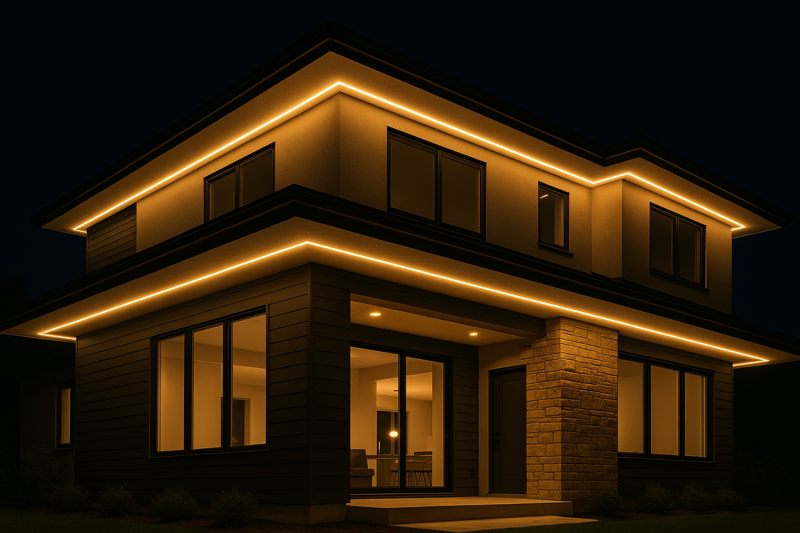
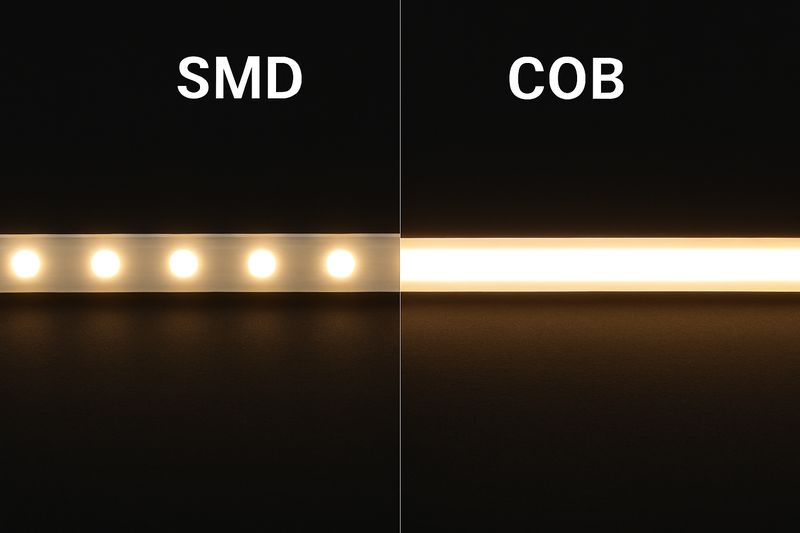
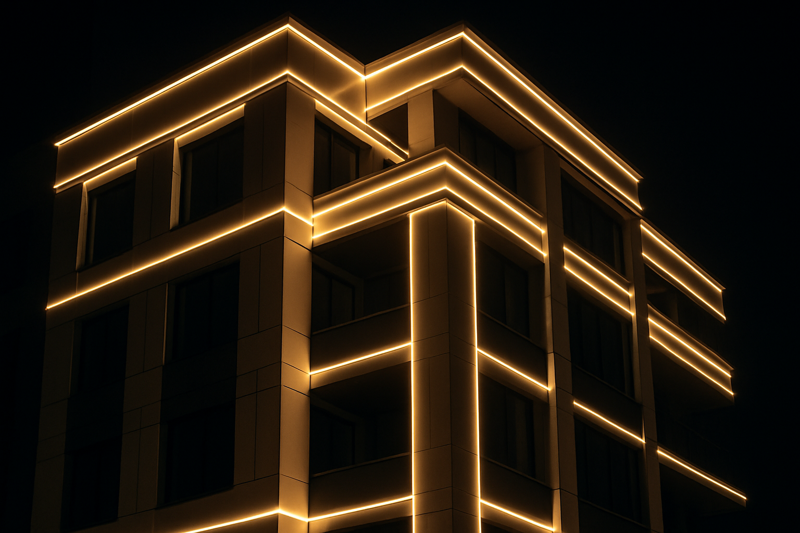
- Continuous, Uniform Lines of Light1: Imagine a perfectly even glow along the entire edge of a building facade, a long garden wall, or under a floating staircase. This is very difficult and expensive to achieve with individual traditional fixtures.
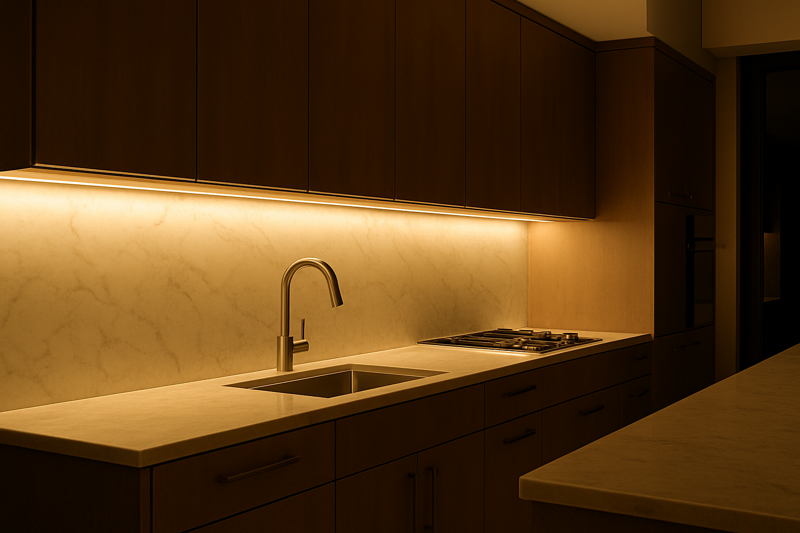
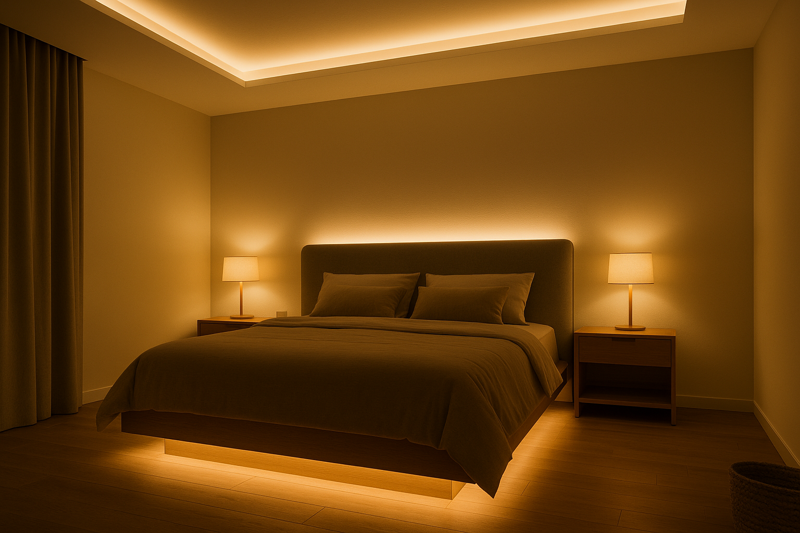
- Cove Lighting & Indirect Illumination2: LED strips are perfect for tucking into architectural coves, under ledges, or behind structures to create soft, indirect ambient light. This washes walls and ceilings with light without visible hot spots from bulbs.
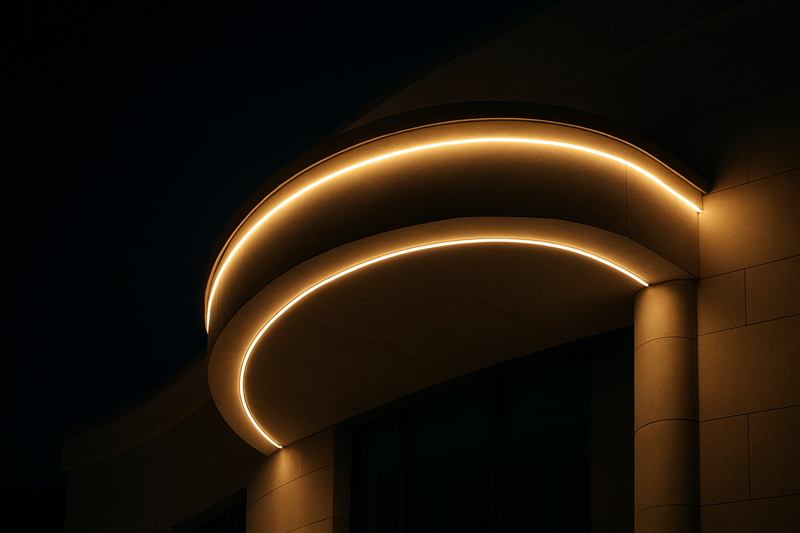
- Highlighting Curves & Complex Shapes3: Try wrapping a traditional bulb around a curved column or along an undulating pathway – it’s practically impossible. Flexible LED strips, however, can follow almost any contour, accentuating unique architectural details beautifully.
- Miniaturization & Concealment: Their slim profile means they can be hidden in very small spaces, like under cabinet lips in an outdoor kitchen, within handrail profiles, or embedded into decking.
I remember working with a lighting designer for a high-end resort in Japan. They wanted to illuminate winding garden paths and the undersides of floating cabana roofs. Traditional path lights would have been visually intrusive and spotlights couldn’t provide the continuous, gentle uplighting they desired. Our IP67 outdoor LED strips were the perfect solution, providing the exact effect with minimal visual hardware.
| Feature of LED Strips | Design Advantage Over Traditional Fixtures | Common Rhlite Application Example | Benefit for Designers/Architects |
|---|---|---|---|
| Slim, Flexible Form | Fits in tight spaces, follows curves, can be concealed | Cove lighting, under-railing, pathway edging | Unobtrusive, integrates with architecture |
| Continuous Light Output | Creates seamless lines of light, avoids spotting/scalloping | Facade lighting, long wall washes | Modern, clean aesthetic |
| Cut-to-Length | Precisely fits specific dimensions, minimizes waste | Custom lengths for bespoke furniture or features | Tailored solutions, perfect fit |
| Low Profile | Can be surface-mounted or recessed with minimal visual impact | Stair nosing, deck perimeter lighting | Enhanced safety with subtle integration |
| Wide Range of CCT/Color | Matches any design aesthetic or creates dynamic effects (RGB) | Warm white for ambiance, RGB for feature highlighting | Mood creation, branding opportunities |
This level of design freedom is a game-changer, allowing for more creative, integrated, and aesthetically pleasing outdoor lighting solutions than ever before.
Are LED Strips Significantly More Energy Efficient and Cost-Effective?
Are rising energy costs and the environmental impact of traditional outdoor lighting a concern for your projects? Old technologies like incandescent, halogen, or even older HID lamps consume vast amounts of power and have short lifespans, leading to high operational expenses.
Yes, outdoor LED strip lights are vastly more energy-efficient, consuming up to 80% less energy than traditional incandescent sources. This translates to significant long-term cost savings on electricity bills and a reduced carbon footprint.
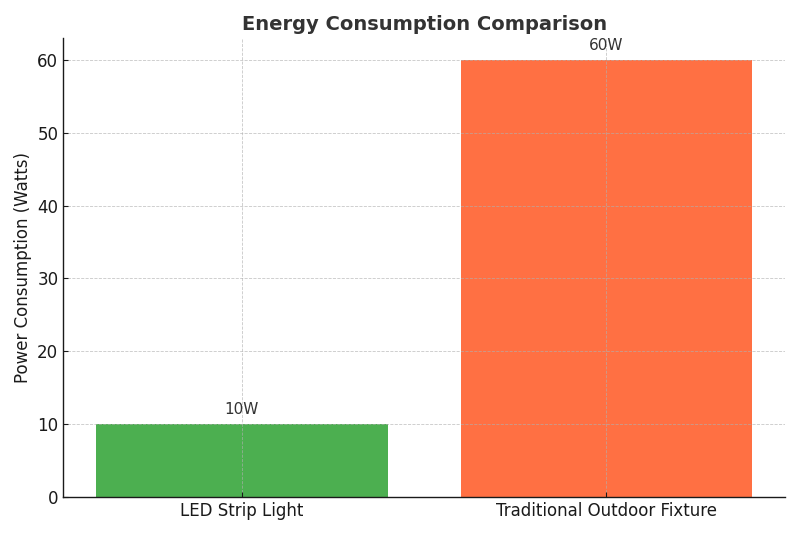
Energy efficiency is a massive driver in the adoption of LED technology, and outdoor LED strips are no exception. For clients like Tom, who manage budgets for large projects or source products for distribution where operational cost is a selling point, this is a key benefit. Traditional outdoor lighting, especially older types like incandescent or halogen floodlights, are notoriously power-hungry. Much of the energy they consume is wasted as heat, not light. At Rhlite, we focus on sourcing efficient LED chips for our strips, ensuring our clients get maximum lumens per watt.
Breaking Down the Savings:
The efficiency of a light source is measured in lumens per watt (lm/W)4. Higher numbers mean more light output for less energy consumed.
- Incandescent Bulbs: Typically offer around 10-17 lm/W.
- Halogen Lamps: Slightly better at 15-25 lm/W.
- Fluorescent Tubes (CFLs): Range from 50-100 lm/W, but have environmental concerns (mercury) and are not as adaptable as strips.
- LED Strip Lights5: Modern LED strips can easily achieve 80-150+ lm/W, depending on the specific LED chip and strip design. High-efficiency strips are constantly pushing this boundary.
Consider a typical outdoor application: lighting a 50-meter perimeter.
- Using traditional 60W incandescent bulbs every 2 meters would require 25 bulbs, totaling 1500W.
- An LED strip providing similar or better illumination might consume only 10W per meter, totaling 500W – a 66% reduction. For lower light level requirements, the savings are even more dramatic.
This isn’t just about lower electricity bills. Reduced energy consumption also means:
- Lower Carbon Footprint6: A more environmentally responsible lighting choice.
- Reduced Load on Electrical Systems: Potentially allowing for more lights on an existing circuit or smaller gauge wiring in new installations (always consult an electrician).
- Less Heat Output: While all lights produce some heat, LEDs produce significantly less. This is beneficial for nearby plants and reduces heat buildup in enclosed spaces.
This isn’t just about lower electricity bills. Reduced energy consumption also means:
- Lower Carbon Footprint: A more environmentally responsible lighting choice.
- Reduced Load on Electrical Systems: Potentially allowing for more lights on an existing circuit or smaller gauge wiring in new installations (always consult an electrician).
- Less Heat Output: While all lights produce some heat, LEDs produce significantly less. This is beneficial for nearby plants and reduces heat buildup in enclosed spaces.
When I discuss solutions with wholesalers from North America, the "Energy Star" equivalent performance and the potential for utility rebates in some areas are strong selling points that LED strips can often meet. The long-term operational savings far outweigh any initial cost difference, especially when you factor in reduced maintenance, which we’ll cover next.
| Lighting Technology | Typical Efficacy (lm/W) | Lifespan (Hours) | Energy Savings (vs. Incandescent) | Heat Output | Rhlite Focus |
|---|---|---|---|---|---|
| Incandescent | 10-17 | ~1,000 | Baseline | Very High | N/A (Obsolete for efficient lighting) |
| Halogen | 15-25 | ~2,000 | ~25-30% | High | N/A (Being phased out) |
| CFL (Outdoor Rated) | 50-100 | ~8,000-15,000 | ~75% | Moderate | N/A (Strips offer more flexibility) |
| LED Strip Lights | 80-150+ | 25,000-50,000+ | ~80-90% | Low | Sourcing high-efficacy LEDs, good thermal design |
The sheer energy efficiency and resultant cost savings make outdoor LED strip lights an economically sound and environmentally conscious choice over traditional alternatives.
Do Outdoor LED Strips Offer Better Durability and Lower Maintenance?
Tired of frequently replacing bulbs, cleaning corroded fixtures, or dealing with lights failing in harsh weather? Traditional outdoor lighting often requires constant upkeep, leading to ongoing labor costs and inconvenient downtime, a major pain point for property managers and end-users.
Yes, high-quality outdoor LED strip lights are significantly more durable and require far less maintenance. Their solid-state construction, robust weatherproofing (IP65+), and long lifespans (often 25,000-50,000+ hours) mean fewer replacements and less hassle.
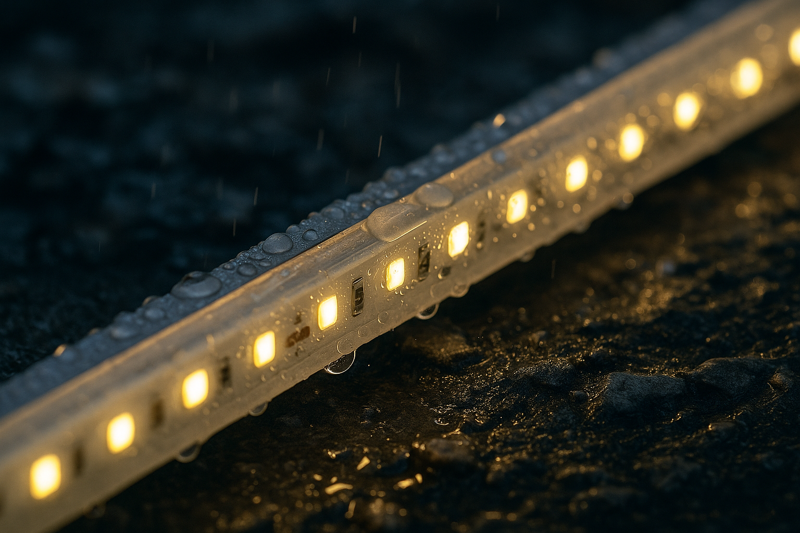
Durability and low maintenance are huge advantages, especially for outdoor installations that can be difficult or costly to access. For my clients, particularly contractors and installers like Tom, the "fit and forget" nature of good quality LED strips is a major selling proposition. Traditional fixtures, with their glass bulbs, filaments, and often less robust housings, are more susceptible to damage from impacts, vibration, and extreme weather. At Rhlite, we focus on manufacturing outdoor LED strips with high IP ratings (like IP67 or IP68) and using UV-resistant materials to ensure they withstand the elements for years.
Built to Last Outdoors:
- Solid-State Technology: LEDs are semiconductor devices, not fragile filaments or glass tubes like incandescent, halogen, or fluorescent bulbs. This makes them inherently more resistant to shock and vibration.
- Long Lifespan: LED chips are rated for tens of thousands of hours of operation. A typical LED strip might last 30,000 to 50,000 hours or more, compared to 1,000 hours for an incandescent bulb or 8,000-15,000 for a CFL. This means if a light is on for 8 hours a day, an LED strip could last over 10-17 years before needing replacement, dramatically reducing re-lamping labor.
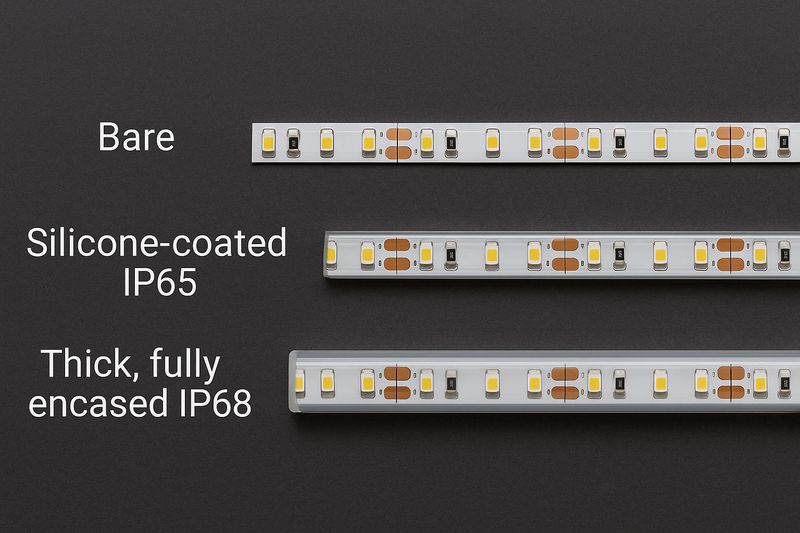
- Superior Weatherproofing: Quality outdoor LED strips come with high Ingress Protection (IP) ratings (e.g., IP65, IP67, IP68). This means they are sealed against dust and moisture.
- IP65: Protected against water jets – good for general outdoor use where not submerged.
- IP67: Protected against temporary immersion – excellent for most exposed outdoor applications.
- IP68: Protected against continuous immersion – for underwater or very wet locations.
This protection is achieved using materials like silicone or polyurethane (PU) that fully encapsulate the LEDs and circuitry.
- UV-Resistant Materials: The outer casing of quality outdoor LED strips is made from materials that resist degradation from sunlight, preventing yellowing, cracking, and brittleness over time.
The reduction in maintenance isn’t just about saving money on replacement bulbs. It’s also about:
- Reduced Labor Costs: Less time spent by maintenance staff on ladders or accessing hard-to-reach fixtures.
- Increased Safety: Fewer instances of electrical work in potentially wet outdoor conditions.
- Consistent Performance: No more dealing with sections of lighting being out due to burned-out bulbs.
A distributor client in Singapore once told me that the reduced maintenance calls for their LED strip installations in coastal properties (prone to salt spray and humidity) was a key reason their customers preferred them over traditional fixtures that corroded and failed quickly.
| Durability Factor | Traditional Fixtures (Typical) | Outdoor LED Strip Lights (Quality, e.g., Rhlite IP67) | Maintenance Implication |
|---|---|---|---|
| Light Source | Fragile glass bulb/filament | Solid-state LED chips | LED strips far more resistant to impact/vibration |
| Lifespan | 1,000-15,000 hours | 25,000-50,000+ hours | Far fewer replacements needed with LEDs |
| Weather Resistance | Varies, often lower IP ratings, prone to corrosion | High IP ratings (IP65-IP68), sealed construction | LEDs much better protected from elements |
| Material Degradation | Metal can rust, plastic can become brittle | UV-stabilized silicone/PU resists degradation | LED strips maintain integrity longer |
| Overall Maintenance | Frequent bulb changes, cleaning, repairs | Minimal; occasional cleaning | Significant reduction in labor and cost |
The combination of robust construction and extended lifespan makes high-quality outdoor LED strip lights a much more durable and lower-maintenance solution compared to their traditional counterparts.
What Advanced Control and Smart Features Do LED Strips Bring Outdoors?
Are you limited by the basic on/off functionality of most traditional outdoor lighting? In an increasingly connected world, users expect more sophisticated control, dynamic effects, and integration with smart home or building management systems, which old fixtures often cannot provide.
Outdoor LED strip lights readily integrate with advanced control systems, enabling dimming, color changing (RGB/RGBW), scheduling, remote operation via apps, and synchronization with music or other smart devices, offering a dynamic and interactive lighting experience.
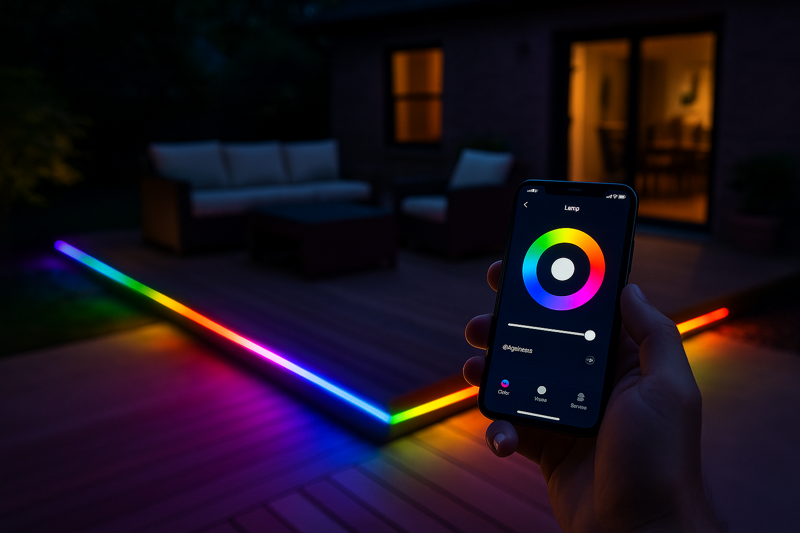
Beyond just providing light, modern outdoor LED strips offer a level of control and interactivity that was previously unimaginable with most traditional fixtures. This is particularly appealing to tech-savvy users and commercial clients who want to create unique ambiances or automated lighting scenes. For OEM clients like Tom, offering products with smart control capabilities can be a significant market differentiator. At Rhlite, we provide LED strip controllers and power supplies that support a wide range of control protocols.
Expanding Lighting Capabilities:
- Dimming7: Most LED strips are easily dimmable with the correct controller, allowing users to adjust brightness levels to suit the mood or activity – from bright functional light to a soft ambient glow. Many traditional fixtures are either non-dimmable or require specific, often bulky, dimmers.
- Color Changing (RGB/RGBW)8:
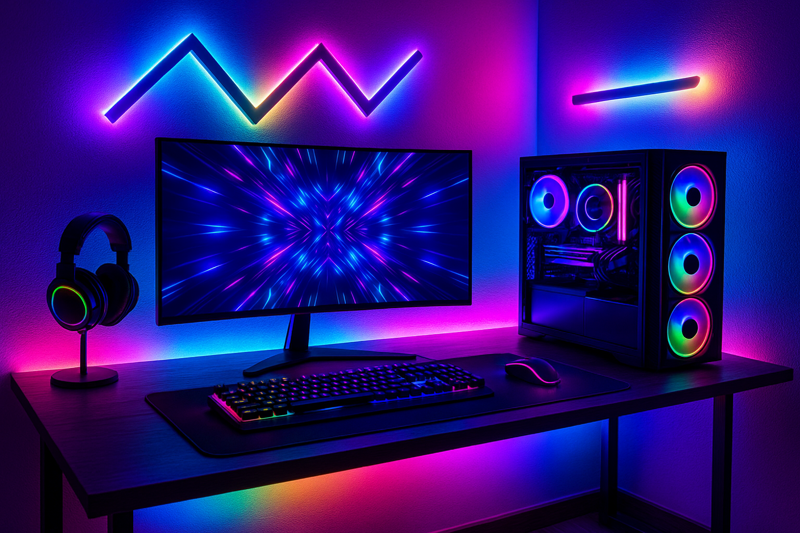
- RGB strips can produce millions of colors, perfect for themed events, holiday lighting, or creating dynamic architectural highlights.
- RGBW strips add a dedicated white LED chip, providing both vibrant colors and high-quality white light, offering the best of both worlds.
- Tunable White9: Some LED strips allow adjustment of the white color temperature (CCT) from warm to cool white, enabling users to change the ambiance throughout the day or for different occasions.
- Scheduling & Automation: Smart controllers allow users to set schedules for lights to turn on/off or change scenes automatically at specific times or based on triggers like sunset/sunrise.
- Remote Control: Many systems can be controlled via smartphone apps, dedicated remote controls, or voice assistants (like Alexa or Google Assistant), offering convenience and flexibility.
- Zoning & Scene Creation: Sophisticated controllers allow different zones of outdoor lighting to be controlled independently or grouped into pre-set scenes (e.g., "Party Mode," "Relax Mode," "Security Mode").
- Integration with Smart Systems: LED strip controllers can often be integrated with broader smart home automation systems (e.g., Control4, Crestron, Zigbee, Z-Wave) or Building Management Systems (BMS) for centralized control.
I’ve worked with contractors installing lighting for outdoor entertainment venues in North America. They increasingly demand RGBW LED strips with DMX controllers to create dazzling, synchronized light shows that simply aren’t possible with static traditional lights. This adds immense value and "wow" factor to their projects.
| Control Feature | Traditional Fixtures (Typical) | Outdoor LED Strip Lights | Advantage of LED Strips | Rhlite Solution Component |
|---|---|---|---|---|
| Dimming | Limited, often requires special dimmers | Widely available, smooth dimming | Precise brightness control, energy saving | Dimmable LED Drivers, Controllers |
| Color Changing | Fixed color, or requires filters | RGB/RGBW options for millions of colors | Dynamic ambiance, branding, festive lighting | RGB/RGBW LED Strips & Controllers |
| Tunable White | Not commonly available | Available for CCT adjustment | Adaptable white light for different moods/times | Tunable White LED Strips & Controllers |
| Scheduling/Automation | Requires external timers | Integrated with smart controllers | Convenience, energy saving, security enhancement | Smart LED Controllers |
| Remote/App Control | Rare, or via basic remotes | Wi-Fi, Bluetooth, RF app/voice control | Ultimate convenience, control from anywhere | Wi-Fi/Bluetooth Controllers |
| System Integration | Very limited | DMX, Zigbee, Z-Wave, API for BMS/Smart Home | Centralized control, advanced automation possibilities | DMX Decoders, Compatible Controllers |
The advanced control capabilities of outdoor LED strip lights transform them from simple illuminators into dynamic tools for shaping atmosphere, enhancing security, and improving user experience.
Conclusion
Outdoor LED strip lights clearly outperform traditional fixtures in flexibility, efficiency, durability, and control. Their adoption signifies a smart, modern approach to illuminating outdoor spaces effectively and beautifully for years to come.
-
Explore how continuous lighting can enhance architectural aesthetics and functionality, creating a seamless glow in various settings. ↩
-
Discover the advantages of cove lighting for creating soft, ambient spaces without harsh shadows, perfect for modern interiors. ↩
-
Learn about innovative lighting techniques that accentuate architectural features, enhancing the beauty of unique designs. ↩
-
Understanding lumens per watt is crucial for making informed lighting choices that save energy and reduce costs. ↩
-
LED strip lights offer significant energy savings and versatility, making them a smart choice for modern lighting solutions. ↩
-
Exploring the connection between energy use and carbon emissions can inspire more sustainable living practices. ↩
-
Explore how dimmable LED strips can enhance your lighting experience by adjusting brightness for different moods and activities. ↩
-
Learn about the technology behind RGB and RGBW LED strips and how they can transform your space with vibrant colors. ↩
-
Discover the advantages of tunable white LED lighting and how it can create the perfect ambiance for any occasion. ↩