Planning an outdoor LED strip light project but unsure which IP rating will survive the weather? Choosing incorrectly can lead to frustrating failures, wasted money, and even safety hazards. It’s a common concern.
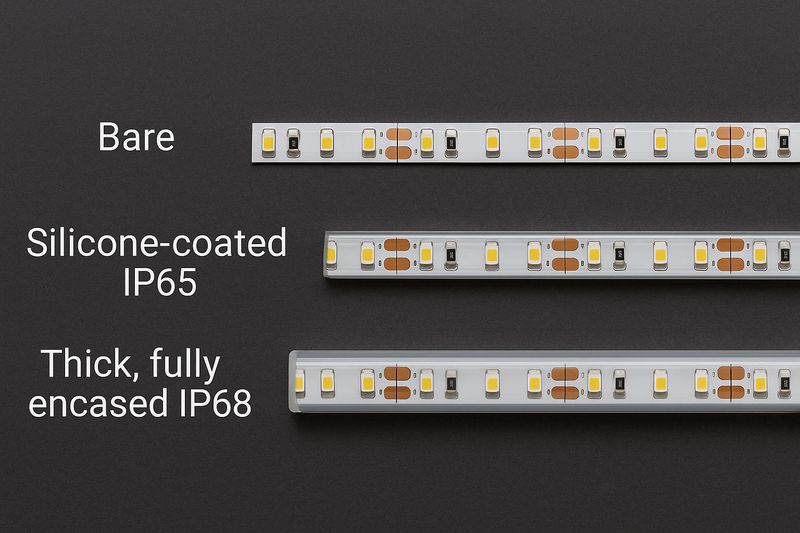
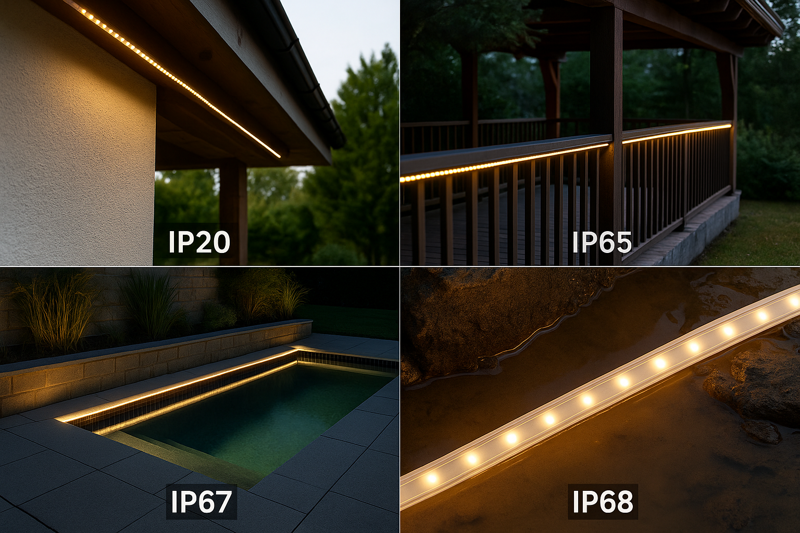
The IP rating you need for outdoor LED strips depends on the specific exposure to dust and moisture. Generally, IP65 is suitable for sheltered areas, IP67 for most exposed outdoor locations, and IP68 for underwater or very wet conditions.
As a factory owner at Rhlite, specializing in LED strip solutions, I frequently discuss IP ratings with my clients. Whether it’s lighting designers like Tom planning a stunning facade in North America, contractors installing landscape lighting in Japan, or distributors stocking products for varied climates, selecting the correct Ingress Protection (IP) rating is crucial for the longevity and safety of any outdoor LED strip light installation. It’s not a one-size-fits-all answer, so let’s break down what these ratings mean and how to choose the right one for your needs.
What Exactly Do IP Ratings Mean for Lighting?
Confused by the numbers like "IP65" or "IP67" on product specifications? These codes seem technical, but they provide vital information about how well a light fixture is protected against common outdoor hazards.
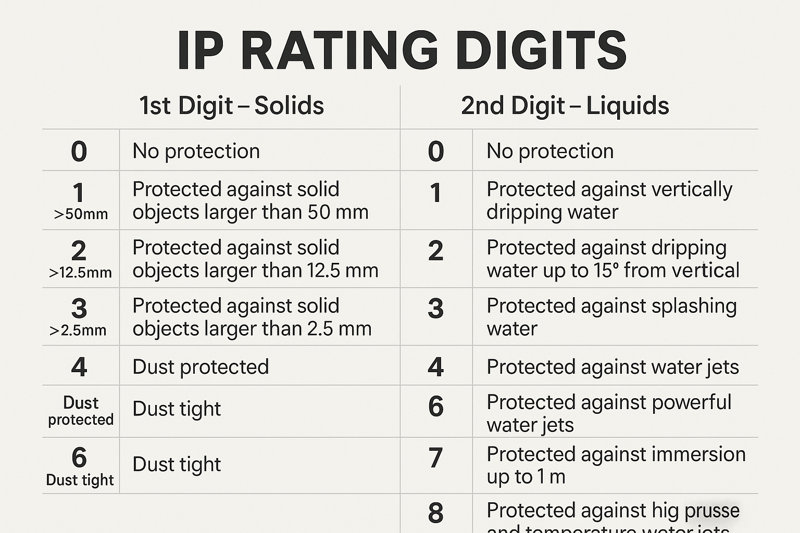
IP ratings define the level of sealing effectiveness of electrical enclosures against intrusion from foreign bodies (like dust and tools) and moisture. The first digit indicates solid particle protection, and the second indicates liquid ingress protection.
Before we dive into specific recommendations, it’s essential to understand what "IP" stands for and how the numbers work. IP stands for "Ingress Protection" or sometimes "International Protection" Marking. It’s a standard defined by the International Electrotechnical Commission (IEC) to classify the degree of protection provided by enclosures of electrical equipment. For my B2B clients, like Tom, who are sourcing products, understanding this standard is key to verifying if a product truly meets the demands of an outdoor environment and avoids issues like suppliers falsifying certificates.
Breaking Down the Digits:
Each IP rating has two numbers:
First Digit – Protection Against Solids (Dust, Debris, Accidental Contact):
This digit ranges from 0 (no protection) to 6 (completely dust-tight).
- 0: No protection against contact and ingress of objects.
- 1: Protection against solid objects greater than 50mm (e.g., accidental touch by hands).
- 2: Protection against solid objects greater than 12.5mm (e.g., fingers).
- 3: Protection against solid objects greater than 2.5mm (e.g., tools, thick wires).
- 4: Protection against solid objects greater than 1mm (e.g., most wires, screws).
- 5: Dust Protected. Ingress of dust is not entirely prevented, but it must not enter in sufficient quantity to interfere with the satisfactory operation of the equipment.
- 6: Dust Tight. No ingress of dust; complete protection against contact. For almost all outdoor LED strip applications, you’ll want the first digit to be a ‘6’.
Second Digit – Protection Against Liquids (Water, Moisture):
This digit ranges from 0 (no protection) to 9 (protection against high-pressure, high-temperature water jets). The most relevant for outdoor LED strips are:
- 0: No protection.
- 1: Protection against dripping water (vertically falling drops).
- 2: Protection against dripping water when tilted up to 15°.
- 3: Protection against spraying water (water falling as a spray at any angle up to 60° from the vertical).
- 4: Protection against splashing water (water splashing against the enclosure from any direction).
- 5: Protection against water jets (water projected by a nozzle (6.3mm) against enclosure from any direction). This is often considered "weatherproof."
- 6: Protection against powerful water jets (water projected in powerful jets (12.5mm nozzle) against the enclosure from any direction).
- 7: Protection against the effects of temporary immersion in water (ingress of water in harmful quantity shall not be possible when the enclosure is immersed in water under defined conditions of pressure and time – up to 1 meter of submersion for 30 minutes).
- 8: Protection against the effects of continuous immersion in water (under conditions which shall be agreed between manufacturer and user but which are more severe than for numeral 7). The equipment is suitable for continuous submersion in water.
At Rhlite, when we state an outdoor LED strip is, for example, IP67, it means it’s completely dust-tight (6) and can withstand temporary immersion in water (7). This detailed understanding helps ensure the product meets the rigorous demands of outdoor environments.
| IP Digit | Meaning for Solids (1st Digit) | Meaning for Liquids (2nd Digit) | Relevance to Outdoor LED Strips |
|---|---|---|---|
| 0-4 | Not generally sufficient for outdoor use | Not generally sufficient for outdoor use | Avoid for exposed outdoor applications |
| 5 | Dust Protected | Water Jets (e.g., from a hose) | IPX5 is a minimum for some sheltered outdoor uses |
| 6 | Dust Tight | Powerful Water Jets | IP6X is standard for solid protection |
| 7 | N/A (First digit is solids) | Temporary Immersion (up to 1m for 30 mins) | IPX7 is excellent for most outdoor use |
| 8 | N/A (First digit is solids) | Continuous Immersion (conditions specified by mfr.) | IPX8 is for underwater/very wet locations |
Knowing these definitions is the first step to choosing the right protection level.
Which IP Rating is Best for General Outdoor Exposed Locations?
Planning to install LED strips on building exteriors, in gardens, or along pathways where they will be exposed to rain, sprinklers, and dust? You need a rating that can handle these common outdoor challenges reliably.
For most general outdoor exposed locations, an IP67 rating is highly recommended. It offers complete dust protection and can withstand temporary immersion, making it robust enough for rain, sprinklers, and even accidental brief submersion.
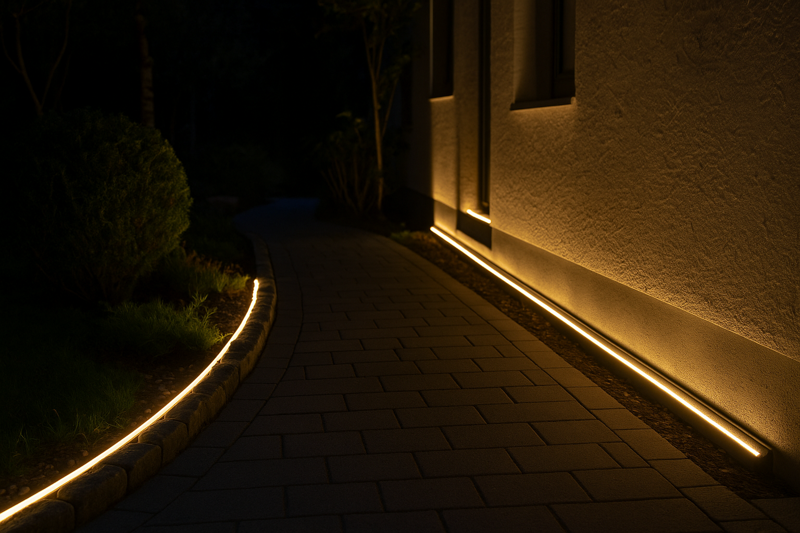
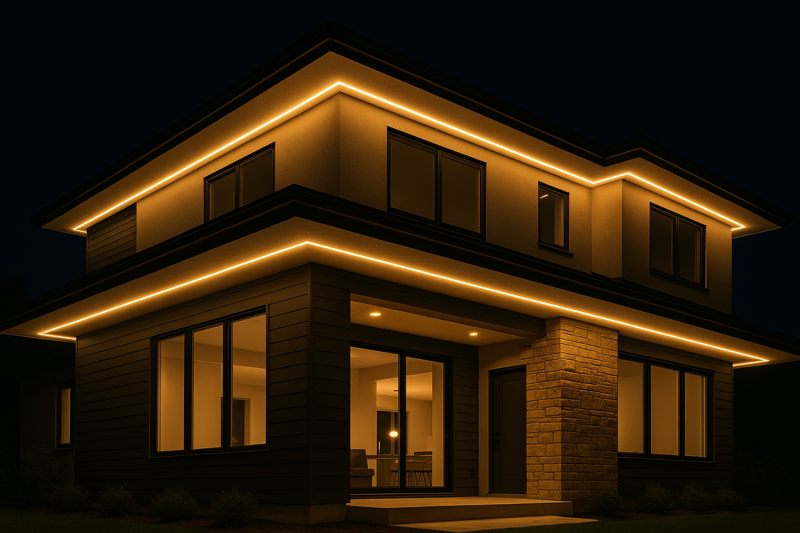
This is a very common question I get from clients like Tom, who are sourcing for a variety of projects. When LED strips are installed on building facades, in landscape features, along railings, or embedded in decks, they are directly exposed to the elements. While IP65 can handle water jets (like rain or a hose), IP67 provides an extra level of security, particularly against standing water or heavy downpours that might lead to temporary pooling. At Rhlite, our IP67 outdoor LED strips are among our most popular for this reason.
Why IP67 is Often the Sweet Spot:
- Dust Tight1 (6): The ‘6’ ensures that no dust or dirt particles can penetrate the strip’s enclosure. This is crucial because dust can accumulate, absorb moisture, and potentially cause short circuits or block light output over time.
- Temporary Immersion Protection2 (7): The ‘7’ means the strip can be submerged in water up to 1 meter deep for 30 minutes without harmful ingress. While you might not plan to submerge your lights, this rating provides a significant buffer against:
- Heavy rainstorms and puddles forming around the installation.
- Accidental flooding in garden beds or low-lying areas.
- Being hit directly by lawn sprinklers.
- Snowmelt accumulating around the fixtures.
When IP65 Might Be Considered (with caution):
An IP65-rated strip (dust tight and protected against water jets) can sometimes be sufficient for outdoor use if the location is somewhat sheltered. For example:
- Under wide eaves or soffits where direct, heavy rain is less likely.
- On covered patios or verandas.
- Vertical wall installations where water will run off quickly.
However, for truly exposed horizontal installations, or where peace of mind is paramount, stepping up to IP67 is a wise investment. I’ve seen instances where a client opted for IP65 in a garden bed installation to save a little on initial cost, only to face issues after a particularly wet season. The cost of replacement and re-installation often outweighs the initial savings. For distributors in regions like North America or Japan with diverse weather, recommending IP67 as a standard for most exposed applications minimizes potential customer complaints.
Consider a scenario where a landscape architect is designing lighting for a public park. The LED strips might be installed along pathways near sprinklers and in areas prone to collecting rainwater after a storm. Here, IP67 is essential for ensuring the lighting system remains operational and safe for years, minimizing maintenance calls for the park authorities.
| Feature Comparison | IP65 Rated Strip | IP67 Rated Strip | Recommendation for Exposed Outdoor Use |
|---|---|---|---|
| Dust Protection | Dust Tight (6) | Dust Tight (6) | Both are equal here (excellent) |
| Water Protection | Protected against water jets (e.g., rain, hose) | Protected against temporary immersion (up to 1m) | IP67 offers superior water protection |
| Common Uses | Sheltered outdoor areas, soffits, covered patios | Facades, pathways, gardens, decks, general outdoor | IP67 is generally safer/more robust |
| Rhlite Focus | Good for specific, less demanding applications | Preferred for most standard outdoor installations | Prioritize IP67 for reliability |
For most outdoor installations that aren’t fully submerged, IP67 strikes the best balance between robust protection and cost-effectiveness.
When Do I Absolutely Need an IP68 Rating for LED Strips?
Are you planning to install LED strip lights directly in water, such as in swimming pools, ponds, or fountains? Or perhaps in areas that are constantly wet or prone to long-term submersion? In these demanding situations, even IP67 might not be enough.
An IP68 rating is necessary when LED strip lights will be continuously submerged in water or installed in environments with constant, deep water exposure. The manufacturer will specify the depth and duration for which the IP68 rating is valid.
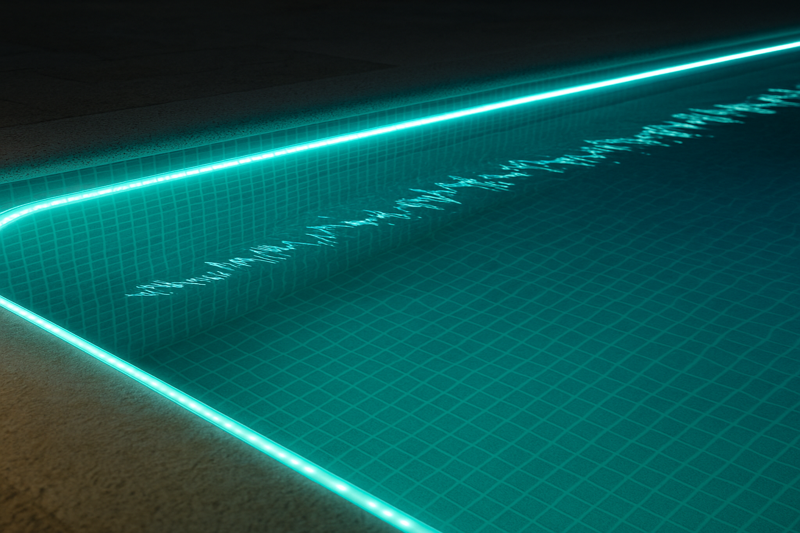
For certain specialized applications, the protection offered by IP65 or IP67 isn’t sufficient. This is where IP68 comes in. When clients like Tom are sourcing for projects involving water features, high-end pool lighting, or marine applications, specifying IP68 is non-negotiable. It’s important to note that IP68 is a more demanding standard, and the "conditions" for submersion (depth and time) are usually agreed upon between the manufacturer and user, or clearly stated by the manufacturer. At Rhlite, our IP68 LED strips undergo rigorous testing to ensure they meet these submersion criteria.
Key Applications Requiring IP68:
- Swimming Pools and Spas: For underwater lighting effects.
- Fountains and Water Features: To illuminate water jets or the basin.
- Ponds and Aquariums: Though for aquariums, specialized aquarium-safe lighting is often preferred.
- Boat and Marine Applications: For deck lighting or accents that may be submerged or constantly exposed to water.
- Areas with Poor Drainage: Locations where water is likely to pool and remain for extended periods.
- Certain Industrial Wash-Down Areas: Where equipment is subjected to intense and prolonged cleaning with water.
What Makes IP68 Different?
The primary difference between IP67 and IP68 is the duration and depth of water immersion the product can withstand.
- IP67: Protection against temporary immersion (typically up to 1 meter for 30 minutes).
- IP68: Protection against continuous immersion under conditions specified by the manufacturer (e.g., up to 3 meters indefinitely, or other specific parameters).
This means the manufacturing process for IP68 strips is often more robust, potentially involving thicker or more specialized encapsulation materials (like high-grade PU or silicone) and more stringent sealing techniques for connectors and end caps.
One of my clients, a contractor specializing in luxury pool installations in North America, exclusively uses our IP68 LED strips. They learned the hard way that trying to use lower-rated strips in such an environment leads to rapid failure and unhappy customers. The slightly higher cost of true IP68 products is negligible compared to the expense and reputational damage of a failed underwater lighting system. It’s crucial to verify that an IP68 claim is backed by proper testing and specifications from the supplier.
| Feature | IP67 Rating | IP68 Rating | When to Choose IP68 |
|---|---|---|---|
| Primary Water Protection | Temporary Immersion (e.g., 1m for 30 mins) | Continuous Immersion (depth/duration specified by manufacturer) | Underwater, prolonged submersion, very wet areas |
| Suitable Applications | Most exposed outdoor areas, rain, sprinklers | Pools, fountains, ponds, marine, areas with constant water | Direct, long-term contact with water is expected |
| Construction/Sealing | Robust, e.g., silicone extrusion, PU potting | Often more specialized/thicker encapsulation, very secure sealing | Highest level of water ingress protection needed |
| Cost Implication | Generally more expensive than IP65 | Typically the most expensive outdoor IP rating due to higher mfg demands | When lower ratings will definitively fail |
| Rhlite Product Example | IP67 Outdoor LED Strip (Silicone Extrusion/PU) | IP68 Submersible LED Strip (Specialized PU Potting) | Pools, water features, demanding wet environments |
If there’s any doubt and the application involves prolonged or deep water contact, always err on the side of IP68 and confirm the manufacturer’s submersion specifications.
Can I Use Indoor LED Strips Outdoors if They Are in a Channel or Covered?
Tempted to use cheaper indoor LED strips (e.g., IP20 or IP33) outdoors if you place them inside an aluminum channel with a diffuser or under a solid covering? This is a common question, often driven by a desire to save costs, but it’s generally a risky approach.
No, it is not recommended to use indoor LED strips (IP20/IP33) outdoors, even if placed in a channel or under a cover, unless that channel system itself provides a complete and certified IP rating for the entire assembly suitable for outdoor conditions.
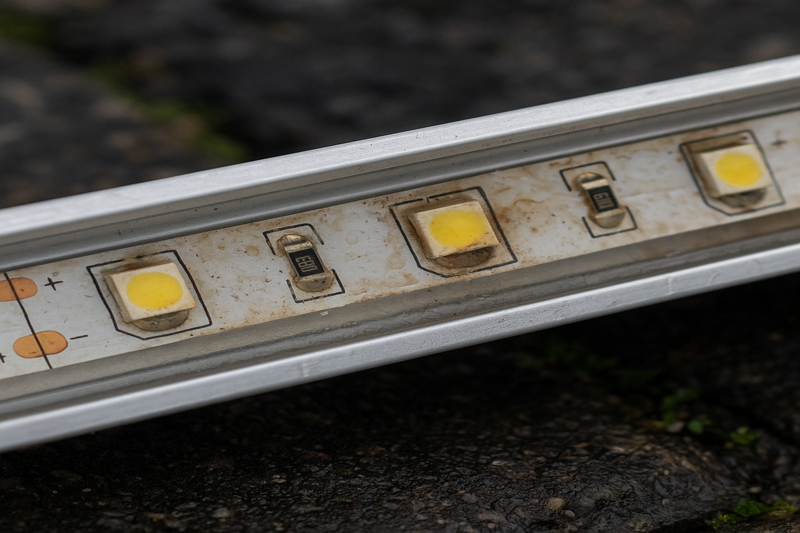
This is a critical point I often stress to clients, especially those new to LED strip installations or those looking for the absolute lowest price. While an aluminum channel with a diffuser can offer some physical protection and improve aesthetics, it typically does not provide a sufficient weatherproof seal for a non-IP-rated indoor LED strip against the rigors of an outdoor environment. Tom, with his experience, likely knows this, but it’s a common pitfall for others.
Why Channels Alone Aren’t Enough for Indoor Strips Outdoors:
- Moisture Ingress3: Standard aluminum channels and diffusers are not hermetically sealed.
- Condensation: Temperature fluctuations outdoors can cause condensation to form inside the channel, directly on the indoor LED strip. This is a major cause of failure.
- Humidity: Humid air can still penetrate gaps and affect the unprotected circuitry of an indoor strip.
- Capillary Action: Water can seep in through end caps or mounting holes if not perfectly sealed.
- Dust and Debris: While a diffuser might block larger debris, fine dust can still accumulate inside the channel over time, potentially leading to overheating or short circuits on an unprotected strip.
- Corrosion4: The exposed copper tracks, solder joints, and components on an indoor LED strip (like IP20, which has no protection) are highly susceptible to corrosion when exposed to outdoor humidity and moisture, even if not directly rained on.
- UV Degradation5: The PCB and components of indoor strips are not typically designed to withstand UV exposure, which can occur even with a diffuser.
- Lack of Certified Protection: The combined assembly (indoor strip + channel) will not have a certified IP rating unless the channel manufacturer specifically designs and tests their system with a strip to achieve a certain IP rating, which is rare for standard channels intended for indoor strips.
The "Waterproof Channel" Caveat:
There are some specialized "waterproof" or "IP-rated" aluminum profiles/channels on the market. These are designed with gaskets, sealed end caps, and specific assembly instructions to potentially house an LED strip and provide an overall IP rating to the assembly (e.g., making the assembly IP65 or IP67).
- If using such a system: You must ensure the channel system itself is certified to the desired outdoor IP rating and that it is compatible with the strip you intend to use. The assembly process is critical.
- Often, it’s simpler and more reliable to use an inherently outdoor-rated LED strip (e.g., an IP67 Rhlite strip) from the start. This removes the complexity and potential points of failure associated with trying to weatherproof an indoor strip using a channel.
I had a potential OEM client who was considering packaging our indoor IP20 strips with a standard aluminum channel and marketing it as an "outdoor-ready kit" to cut costs. I strongly advised against this, explaining the high likelihood of field failures and damage to their brand reputation. It’s always better to use a product explicitly designed and rated for the intended environment.
| Approach | Pros | Cons | Recommendation |
|---|---|---|---|
| Indoor Strip (IP20) in Standard Channel Outdoors | Lower initial strip cost | High risk of failure (condensation, moisture, dust), no certified IP rating, corrosion, short lifespan | Not Recommended |
| Indoor Strip in Certified Waterproof Channel | Potentially cleaner look if channel is sleek | More expensive channel, assembly critical, overall IP rating depends on channel, still a point of failure | Risky; prefer dedicated outdoor IP-rated strip |
| Outdoor-Rated Strip (e.g., IP67 Rhlite) | Designed for outdoor, certified IP rating | Slightly higher initial strip cost | Highly Recommended for Reliability & Safety |
| Outdoor-Rated Strip in Standard Channel | Enhanced aesthetics, extra physical protection | Adds cost of channel | Good if aesthetics/diffusion are also desired |
Using an indoor LED strip outdoors, even with some covering, is generally a false economy that can lead to more significant expenses and headaches later.
Conclusion
Choosing the right IP rating—IP65 for sheltered spots, IP67 for most exposed areas, or IP68 for submersion—is key for durable, safe outdoor LED strip lighting. Always match the rating to the environment.
-
Understanding the Dust Tight rating can help you choose lighting that withstands dust and moisture, ensuring longevity and performance. ↩
-
Learn about Temporary Immersion Protection to ensure your lighting can handle unexpected water exposure, enhancing durability and safety. ↩
-
Understanding moisture ingress is crucial for maintaining LED lighting systems and preventing failures due to condensation and humidity. ↩
-
Learn about the impact of corrosion on LED strips and discover effective prevention methods to extend their lifespan. ↩
-
Explore the effects of UV degradation on LED strips to ensure proper protection and longevity of your lighting solutions. ↩