You installed beautiful LED strips on a client’s patio, but they failed after the first rainstorm. Or, you used waterproof strips indoors for "extra durability," but now they’re overheating, yellowing, and failing prematurely.
Choose non-waterproof (IP20) strips for all dry, indoor locations. Use water-resistant (IP65) for kitchens and bathrooms where splashing may occur. Select fully waterproof (IP67/IP68) strips only for direct outdoor exposure, landscape, or submersible installations.
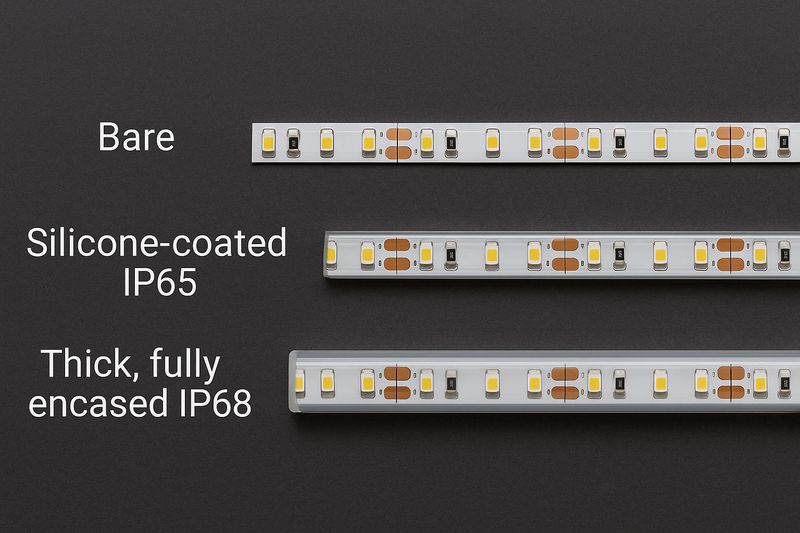
I once had a conversation with a seasoned contractor, a guy very much like Tom, who was adamant about using silicone-coated IP65 strips for a huge indoor cove lighting project. His logic was, "It’s more durable, it’ll last longer." I had to stop him. I explained that by encasing the strip in silicone, he was wrapping it in an insulating blanket. Inside a tight cove, with no airflow, that trapped heat had nowhere to go. It would drastically shorten the lifespan of the LEDs and could cause the color to shift in a matter of months. He was shocked. He thought he was choosing the "better" product, but for that specific application, he was choosing the wrong product. It’s a lesson we’ve all had to learn: more protection is not always better. The environment dictates the choice, and using the wrong IP rating can be just as bad as using a cheap strip.
What Are Non-Waterproof (IP20) LED Strips?
You’re working on an indoor project in a completely dry area like a bedroom, living room, or office. You need the best performance and heat management, and paying extra for waterproofing that isn’t needed is just wasting your client’s money.
Non-waterproof strips, rated IP20, are the baseline standard. They have no protection against moisture and are designed exclusively for clean, dry, indoor environments. Their open design offers the best possible heat dissipation and light quality.
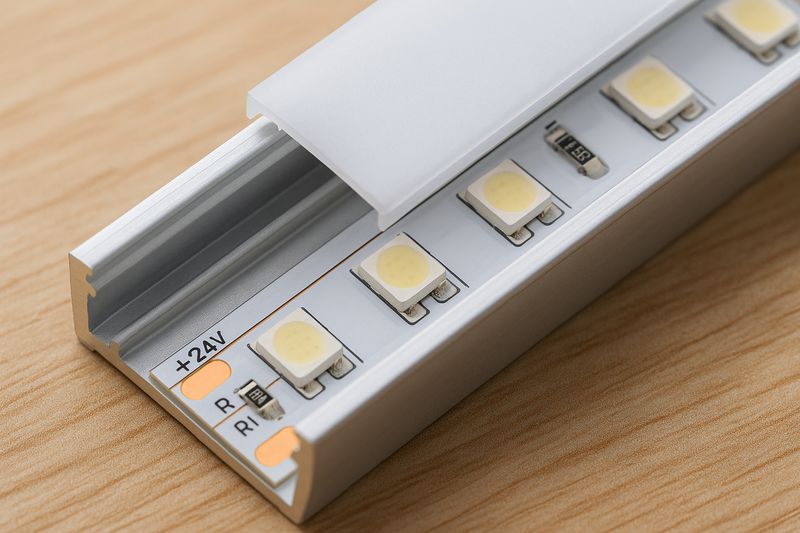
I tell my clients, including experienced buyers like Tom, that the IP20 strip is their default, their go-to for 80% of indoor jobs. Its biggest advantage is something people don’t think about: thermal performance. LEDs generate heat, and heat is the enemy of their lifespan and color consistency. An IP20 strip’s bare circuit board can breathe. When you mount it in one of our aluminum channels, the channel acts as a giant heat sink, pulling heat away from the LEDs and protecting your investment. You get the truest color, the highest brightness, and the longest possible life. Don’t let a client talk you into "upgrading" to a waterproof strip for a dry living room ceiling cove. You’re not adding durability; you’re adding an unnecessary layer of insulation that will slowly cook the LEDs.
The Professional’s Indoor Standard
The IP rating system1 is an international standard that classifies the degree of protection an electrical enclosure provides against intrusion from solid objects (like dust) and liquids (like water). The first digit rates solid protection (from 0 to 6), and the second rates liquid protection (from 0 to 8). An IP20 rating means the strip is protected against solids larger than 12.5mm (the "2," essentially protecting against fingers) but has zero protection against liquids (the "0"). This isn’t a flaw; it’s a design choice for a specific environment. For indoor spaces, this "unprotected" design is a significant advantage. Heat is the primary killer of LEDs, and the open-air design of an IP20 strip allows for maximum thermal transfer. When paired with an aluminum profile, it creates a complete thermal management system that ensures the LEDs operate at their optimal temperature, providing stable performance and the longest possible lifespan. Overlooking this for a misguided sense of "durability" by using a coated strip indoors is one of the most common and costly mistakes an installer can make.
| Feature | Non-Waterproof (IP20) | Waterproof Counterparts (IP65+) | Why it Matters to an Installer (Tom) |
|---|---|---|---|
| Heat Dissipation2 | Excellent. The open design allows heat to radiate away from the LEDs and PCB freely. Ideal for use in aluminum channels. | Poor to Fair. Silicone, epoxy, or PVC coatings act as an insulator, trapping heat around the LEDs. | Trapped heat drastically shortens the LED’s L70 lifespan and causes color shift, leading to premature failure and costly callbacks. IP20 is the most durable choice for dry indoor locations. |
| Light Quality & Color3 | Highest Quality. No coating to interfere with the light. The color temperature and CRI are exactly as specified. | Potential for Color Shift. Lower-quality silicone coatings can yellow over time due to heat and UV exposure, altering the white light’s CCT. | A client who paid for a 3000K warm white doesn’t want it to look like 2700K yellow in a year. IP20 ensures long-term color stability. |
| Cost | Most Cost-Effective4. There are no additional materials or processes for waterproofing. | Higher Cost. The waterproofing materials and manufacturing processes add significant cost. | Using IP20 where appropriate saves the client money, making your bid more competitive without sacrificing quality for the application. |
| Flexibility & Repair | Very Flexible & Easy to Repair. The strip is pliable, and solder pads are exposed for easy cutting, splicing, and repairs. | Stiff & Difficult to Repair. Coatings make the strip stiffer. Repairing a connection means cutting away the sealant, which is messy and compromises the IP rating. | On a complex job with many cuts and connections, the ease of working with IP20 strips saves significant time and labor on site. |
What are Water-Resistant (IP65) LED Strips?
You’re installing under-cabinet lighting in a kitchen, above a vanity in a bathroom, or in a laundry room. The area is generally dry, but there’s a real chance of occasional splashes, steam, or high humidity.
An IP65-rated LED strip is water-resistant, protected by a clear silicone coating on top. It can withstand low-pressure jets and splashes of water from any direction, making it ideal for damp indoor locations, but it is not fully waterproof or submersible.
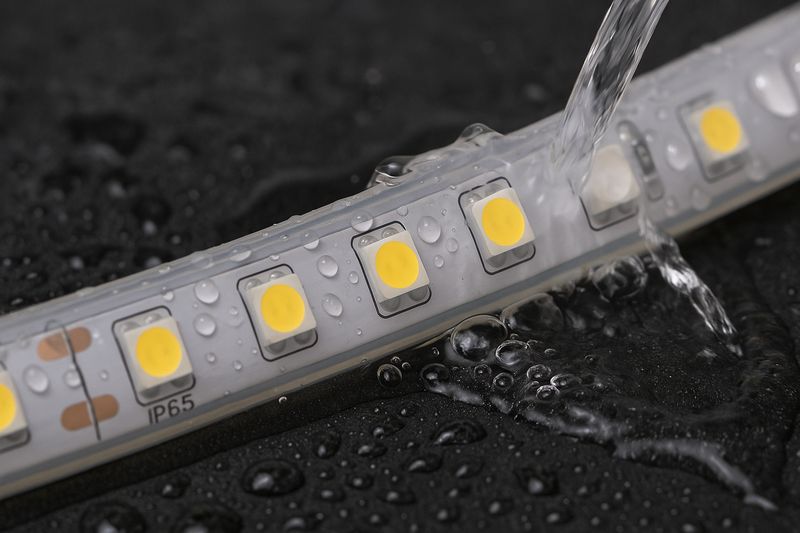
I got a call from a contractor who was having issues with lights failing over a hotel bathroom vanity. He had used standard IP20 strips, and the steam from the showers was causing corrosion over time. I told him this is the perfect textbook case for an IP65 strip. The silicone coating creates a protective shield over the electronic components. It prevents moisture from steam or an accidental splash from reaching the circuitry. I sent him our IP65 product, which uses a high-quality, non-yellowing silicone. He installed them, and the problem was solved. But I also cautioned him: these are for damp locations, not for outdoor rain. There’s a big difference between resisting a splash and resisting a downpour. Using IP65 outdoors is a gamble that will eventually fail.
The Shield for Damp Locations
An IP65 rating5 signifies that the strip is fully protected against dust ingress (the "6") and protected against low-pressure water jets from any angle (the "5"). This is typically achieved by applying a thin, flexible, transparent layer of silicone over the top surface of the strip. This method effectively seals the LEDs, resistors, and solder joints from incidental contact with moisture. However, it’s crucial to understand that the back of the strip, where the adhesive is, and the cut ends are not inherently protected. The IP65 rating only applies to the strip as it comes from the factory. Once you cut it, that cut end is effectively IP20. To maintain the water resistance, the connection must be meticulously sealed with silicone sealant6 and properly insulated with heat-shrink tubing7. Because of the silicone coating’s heat-trapping properties, using IP65 strips with lower-power-density LEDs is generally safer to prevent overheating, especially if they are not installed in a substantial heat-sinking channel.
| Feature | Water-Resistant (IP65) | Non-Waterproof (IP20) | Fully Waterproof (IP67/68) | Why it Matters to an Installer (Tom) |
|---|---|---|---|---|
| Primary Use Case | Damp indoor locations like kitchens, bathrooms, laundry rooms. | Dry indoor locations only. | Outdoor, landscape, and submersible applications. | Using IP65 in the right damp location prevents failures and callbacks. Using it outdoors is a misapplication that will lead to failure. |
| Moisture Protection | Resists splashes and jets. Protects against steam, humidity, and accidental splashes. | None. Fails immediately with water contact. | Fully submersible. Can be submerged in water for extended periods. | It provides the exact level of protection needed for kitchens and baths without the extreme cost and installation difficulty of IP67/68. |
| Sealing Method | Surface Coating. A layer of silicone is applied over the top of the strip. | None. The circuit board is bare. | Full Encasement. The strip is inside a hollow silicone tube or fully potted in silicone/epoxy. | The top coating is sufficient for splash protection, but installers must know that the cut ends are a weak point that they are responsible for sealing themselves. |
| Installation Notes | Must seal all cut ends and connections with silicone glue and heat-shrink tubing to maintain resistance. Heat dissipation is a concern. | Easiest to install, cut, and solder. | Connections are difficult and often require special connectors or over-molding kits. Power feed points are critical weak points. | The extra labor to seal connections on an IP65 installation is a required step. Skipping it voids the protection and guarantees failure in a damp environment. |
What are Fully Waterproof (IP67/IP68) LED Strips?
You have a major outdoor project: lining a walkway, illuminating a building facade, lighting a deck railing, or even placing lights inside a fountain. The strips will be directly exposed to rain, snow, sprinklers, or even full submersion.
Fully waterproof strips (IP67/IP68) are designed for total exposure to the elements. They are completely sealed within a robust silicone or PVC jacket, making them impervious to dust and capable of being submerged in water.
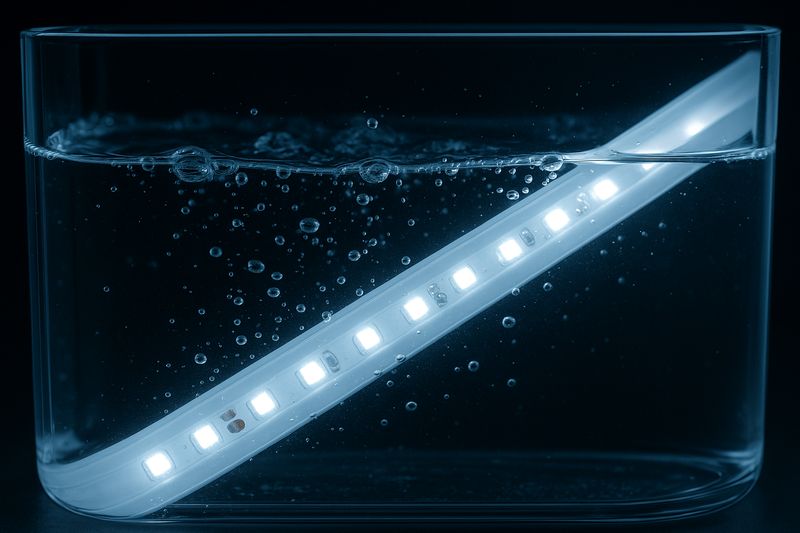
One of my clients, a landscape architect, was designing the lighting for a resort’s main water feature. He needed a product that could handle being constantly wet and fully submerged in chlorinated water. This was a zero-fail-tolerance project. We specified our highest-grade IP68 strips. But more importantly, we worked with him on the connection plan. For IP68, you can’t just slap on some silicone. We supplied custom-length strips with factory-molded, injection-sealed power feeds. This meant the most vulnerable point—where the wires connect to the strip—was sealed in our factory under controlled conditions. The installer only had to make connections with the waterproof extension cables, far away from the water. This is the level of detail required for true waterproof installations. It’s not just about the strip; it’s about engineering a complete, sealed system.
Engineering for the Harshest Environments
The distinction between IP678 and IP68 is the level of water immersion they can handle. IP67 strips (the "7") are protected against temporary immersion in water up to 1 meter deep for 30 minutes. IP68 strips (the "8") are protected against continuous, long-term submersion under pressure, with the exact depth and duration specified by the manufacturer (us). These strips are not merely coated; they are fully encased9. Two common methods are a hollow silicone sleeve that the strip is fed into (with the ends sealed), or "full-jacket" extrusion where the entire strip is potted in a thick, solid block of transparent silicone or PVC. While this provides maximum protection, it also comes with significant trade-offs. They are the most expensive, the most difficult to install, and suffer from the worst heat dissipation10. Therefore, they should only be used when absolutely necessary. Using an IP68 strip on a porch that only sees occasional rain is massive overkill in both cost and engineering.
| Feature | Fully Waterproof (IP67/IP68) | Water-Resistant (IP65) | Why it Matters to an Installer (Tom) |
|---|---|---|---|
| Immersion Capability | Submersible. IP67 allows for temporary immersion, while IP68 allows for continuous submersion. | Not Submersible. Will fail quickly if submerged. Designed for splashes only. | For pools, fountains, and water features, IP68 is the only choice. For landscape lighting exposed to rain and sprinklers, IP67 is a robust and safe option. |
| Construction | Fully Encased. The strip is sealed inside a solid or hollow silicone/PVC tube. | Top-Coated. Only the top surface is coated with silicone. | This robust construction provides total environmental protection but makes the strip very stiff and almost impossible to field-repair. Measurements must be exact. |
| Connections | Critical Weak Point. Must use factory-sealed connectors11, injection molding, or specialized waterproof connector kits. Field connections are high-risk. | Requires Manual Sealing. Connections must be manually sealed with silicone and heat shrink. | Tom needs to know that for IP67/68, planning is key. He should order custom lengths with factory-made connections from a reliable supplier like Rhlite to eliminate the biggest point of failure. |
| Heat & Lifespan | Worst Heat Dissipation. The thick jacket is a powerful insulator. Often, power levels are derated (lower brightness) to manage heat and prolong life. | Fair Heat Dissipation. Better than IP67/68, but still worse than IP20. | A high-power IP67/68 strip may have a shorter lifespan than a low-power one due to heat. Understanding this trade-off is key to setting client expectations. |
Conclusion
The IP rating is not a measure of quality; it’s a specification for an application. Match the IP rating precisely to the environment: IP20 for dry, IP65 for damp, and IP67/68 for wet or outdoor.
-
Understanding the IP rating system is crucial for selecting the right electrical enclosures for various environments. ↩
-
Exploring heat dissipation in LED lighting can help you ensure optimal performance and longevity of your installations. ↩
-
Learn how light quality impacts your projects, ensuring clients receive the exact color temperature they desire. ↩
-
Discover how cost-effective solutions can enhance your bids and satisfy clients without compromising quality. ↩
-
Understanding the IP65 rating is crucial for ensuring proper installation and protection against moisture. ↩
-
Learn how to effectively use silicone sealant to maintain water resistance in your installations. ↩
-
Discover the benefits of heat-shrink tubing for insulation and sealing connections in electrical applications. ↩
-
Understanding the differences between IP67 and IP68 can help you choose the right waterproofing for your project. ↩
-
Learn about the benefits and drawbacks of fully encased waterproofing solutions for better project decisions. ↩
-
Explore how heat dissipation impacts the lifespan of LED strips to make informed choices for your installations. ↩
-
Discover why using factory-sealed connectors can prevent failures and ensure longevity in waterproof lighting installations. ↩