Planning an outdoor LED strip light project and stuck on whether to choose 12V or 24V? This decision significantly impacts run length, wire thickness, power supply size, and overall system efficiency, especially outdoors.
24V LED strip lights are generally better for longer outdoor runs due to lower voltage drop, allowing for more consistent brightness and requiring thinner wires compared to 12V. However, 12V strips may offer shorter cutting increments.
As the owner of Rhlite, a factory specializing in comprehensive LED strip light solutions, I often discuss voltage choices with clients like Tom, who could be a lighting designer, contractor, or OEM/ODM partner. Whether it’s for projects in North America, Japan, or Singapore, selecting the correct voltage is fundamental for a successful, reliable, and cost-effective outdoor lighting installation. Let’s delve into the advantages and disadvantages of each.
What is Voltage Drop and How Does It Affect 12V vs 24V Outdoor LED Strips?
Before comparing 12V and 24V directly, it’s crucial to understand a key electrical principle that heavily influences this decision, especially for outdoor installations which can involve longer distances: voltage drop.
Voltage drop is the gradual loss of electrical voltage along the length of a wire or LED strip. For the same power, 24V systems experience less percentage voltage drop over distance than 12V systems, leading to more consistent brightness on longer strip runs.
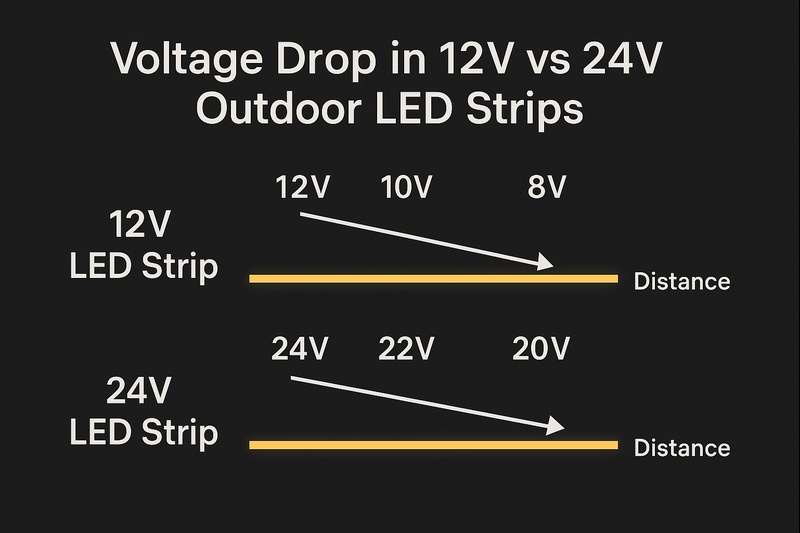
Understanding voltage drop is paramount. It’s a common pain point if not managed correctly, leading to dimming at the far end of a strip – something no client wants. At Rhlite, we educate our B2B customers, including wholesalers and installers, on how voltage choice directly combats this issue for robust outdoor performance.
The Science Behind Voltage Drop1
Voltage drop isn’t a fault; it’s a natural consequence of electrical resistance in conductors (the copper traces in the LED strip and the connecting wires).
- Ohm’s Law2 in Play: Voltage (V) = Current (I) x Resistance (R). The longer the wire/strip, the higher the resistance.
- Power Equation3: Power (P) = Voltage (V) x Current (I).
- For a 12W LED strip:
- If it’s a 12V strip, it draws 1 Ampere (12W / 12V = 1A).
- If it’s a 24V strip, it draws 0.5 Amperes (12W / 24V = 0.5A).
- For a 12W LED strip:
- The Key Difference: For the same power output (brightness), a 24V system draws half the current of a 12V system.
- Impact on Voltage Drop: Since voltage drop is directly proportional to current (V_drop = I x R), the lower current in a 24V system results in a lower absolute voltage drop for the same length and conductor size.
- Percentage Matters More: Even if the absolute voltage drop in volts was similar, the percentage drop is much more significant for a 12V system. For example:
- A 2V drop in a 12V system is a 16.7% loss ( (2V/12V)*100% ) – this will be very noticeable as dimming.
- A 2V drop in a 24V system is an 8.3% loss ( (2V/24V)*100% ) – less noticeable.
- In reality, because current is halved for 24V (for the same power), the actual voltage drop in volts will also be roughly halved for 24V over the same distance, making its percentage drop even smaller.
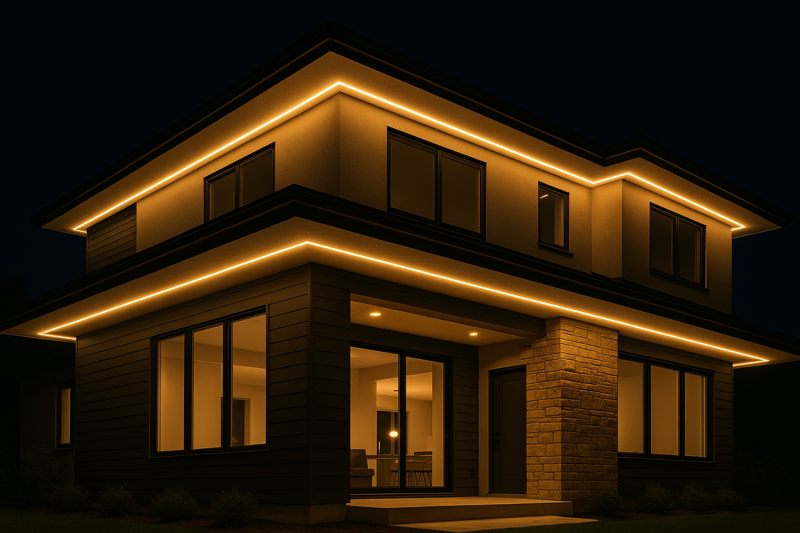
I recall a project where an installer used a long run of 12V LED strip for under-eave outdoor lighting. The end of the strip was visibly dimmer than the start. Switching to a 24V version of a similar Rhlite strip (and appropriate power supply) solved the issue immediately, ensuring consistent brightness across the entire length. This is a practical example Tom would appreciate avoiding.
| Aspect | 12V System (e.g., 1A for 12W) | 24V System (e.g., 0.5A for 12W) | Outdoor Implication |
|---|---|---|---|
| Current (for same Power) | Higher | Lower (half of 12V) | Less current means less voltage drop & heat. |
| Absolute Voltage Drop | Higher for same length/wire | Lower for same length/wire | 24V maintains voltage better over distance. |
| Percentage Voltage Drop | More significant impact on brightness | Less significant impact on brightness | 24V allows longer runs before noticeable dimming. |
| Conductor Size Requirement | Thicker wires needed for longer runs | Thinner wires can be used for same length/power | Potential cost saving on wiring for 24V. |
| Heat Generation in Wires | More due to higher current | Less due to lower current | Important for enclosed outdoor fixtures/conduits. |
Understanding voltage drop clearly shows why 24V systems inherently offer advantages for longer outdoor LED strip installations.
What Are the Advantages of Using 24V LED Strip Lights Outdoors?
Given the impact of voltage drop, it’s clear that 24V systems have inherent benefits, especially for outdoor projects which often involve greater distances than indoor applications. But what are the specific upsides?
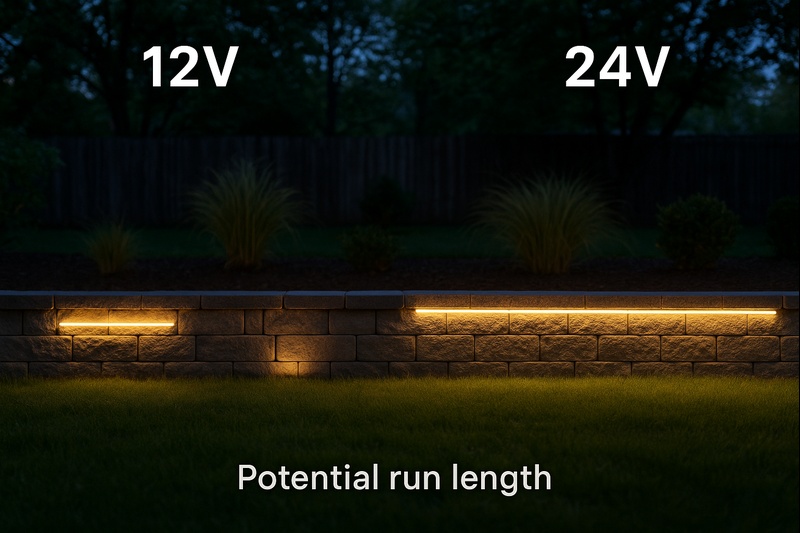
24V LED strip lights allow for significantly longer maximum run lengths before voltage drop causes dimming, require thinner (and often cheaper) wiring for the same power, and generally result in more efficient power supply usage due to lower current draw.
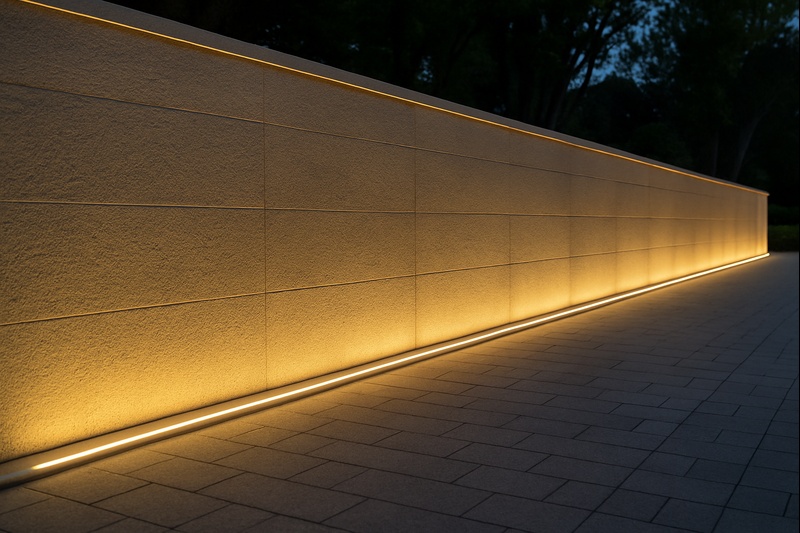
For Rhlite, promoting our 24V outdoor LED strip range to clients like contractors and lighting designers means emphasizing these performance and installation benefits. Tom, who sources for various projects, would find these advantages compelling for larger-scale or demanding outdoor lighting jobs.
Why 24V Excels Outdoors
Let’s break down the key benefits:
-
- This is the primary advantage. Because 24V systems draw half the current for the same power output compared to 12V, the voltage drop is substantially less over a given distance.
- This means you can power a much longer continuous length of 24V LED strip from a single power feed point before the light at the far end starts to dim noticeably.
- For example, a typical 12V strip might have a maximum recommended run of 5 meters (16.4 feet) before needing re-feeding power. A comparable 24V strip might easily go 10 meters (32.8 feet) or even 15-20 meters for certain types (like constant current strips), significantly reducing wiring complexity and the number of power supplies needed for large outdoor installations.
-
- Lower current (amperage) means you can use thinner (higher gauge number) wires for connecting the strips to the power supply without excessive heat buildup or voltage drop within the wires themselves.
- Thinner wires are generally less expensive, more flexible, and easier to conceal, which is often desirable in outdoor aesthetic installations.
-
Increased Power Supply Efficiency6 (Potentially):
- Power supplies often operate more efficiently when not pushed to their maximum current capacity. Since 24V systems draw less current for the same wattage, a power supply might run cooler and more efficiently.
- Also, for a large project requiring a certain total wattage, you might be able to use fewer, higher-capacity 24V power supplies instead of many smaller 12V power supplies, which can simplify installation and potentially reduce costs.
-
Reduced Component Stress:
- Lower current flow means less thermal stress on the strip’s components (like resistors and PCB traces) and connectors, potentially contributing to a longer lifespan, especially in outdoor environments where temperature fluctuations can be significant.
I’ve worked with landscape architects designing lighting for extensive garden pathways. Using 24V LED strips from Rhlite allowed them to minimize the number of buried power supply boxes and simplify the overall wiring scheme, making the installation cleaner and more cost-effective.
| 24V Advantage | Detailed Explanation | Benefit for Outdoor Projects | Rhlite Focus |
|---|---|---|---|
| Longer Max Run Length | Significantly less voltage drop allows for longer single-feed strip runs. | Fewer power feeds, simpler wiring, less labor for large areas. | Offering extended run 24V outdoor strip series. |
| Thinner Wires | Lower current permits smaller wire gauges for the same power transmission. | Cost savings on wiring, easier installation and concealment. | Advising on appropriate wire gauges. |
| Power Supply Efficiency | Can lead to more efficient PSU operation; potentially fewer PSUs needed for large projects. | Simplified power infrastructure, potentially lower PSU costs. | Providing high-quality, efficient 24V PSUs. |
| Reduced Component Stress | Lower current reduces heat and stress on strip components and connections. | Potentially increased longevity and reliability in harsh conditions. | Designing robust 24V strips for durability. |
For most substantial outdoor LED strip lighting projects, 24V is often the superior technical choice.
Are There Any Downsides to 24V LED Strip Lights for Outdoor Use?
While 24V offers significant advantages for outdoor applications, particularly concerning run length and efficiency, are there any potential drawbacks or situations where 12V might still be considered?
The primary potential downside of 24V LED strips is that they usually have longer cutting increments (the distance between cut marks) compared to 12V strips. Also, 12V power supplies are sometimes more readily available in smaller wattages or specific form factors for very small projects.
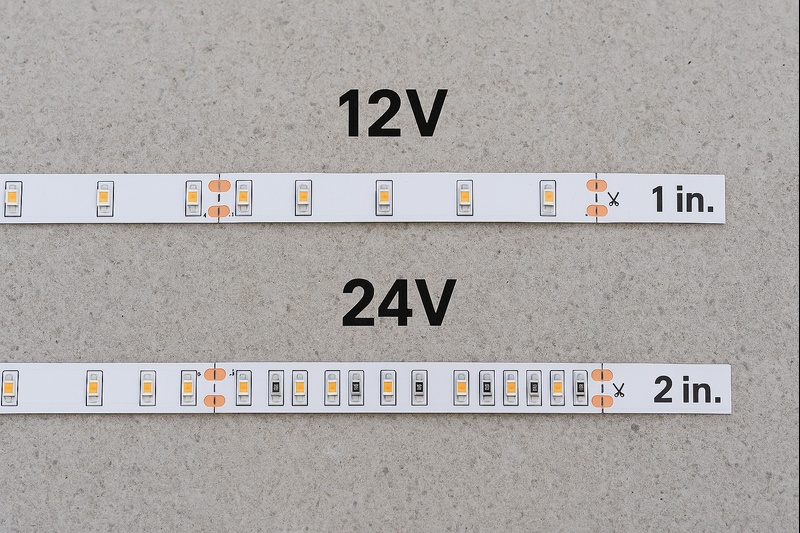
While the benefits of 24V often outweigh these points for outdoor use, it’s important for clients to be aware of them. For Rhlite, providing a balanced view ensures customers like Tom can make the best decision for their specific outdoor application, even if it occasionally points to a 12V solution for very particular needs.
Considerations for 24V Systems
Let’s examine these potential limitations:
-
Longer Cutting Segments:
- LED strips are designed in segments (a small series of LEDs with their resistors). To maintain the correct voltage across each LED, 24V strips typically have twice as many LEDs per segment as an equivalent 12V strip (e.g., 6 LEDs per segment for 24V vs. 3 LEDs for 12V).
- This means the physical length of each segment, and therefore the distance between cut marks, is often longer on 24V strips.
- For example, a 12V strip might be cuttable every 2.5cm or 5cm, while a comparable 24V strip might only be cuttable every 5cm or 10cm.
- Outdoor Implication: If an outdoor installation requires extremely precise length customization to fit into very specific, small coves or channels, the longer cutting increments of a 24V strip could be a minor constraint. However, for most outdoor architectural or landscape lighting, this difference is often negligible.
-
Power Supply Availability (Historically, Less So Now):
- In the past, 12V DC power supplies were extremely common due to their use in automotive and other industries, making them readily available in a vast array of sizes and types.
- While 24V power supplies are now also very common and widely available, especially for industrial and professional lighting applications (Rhlite offers a comprehensive range), for very small, niche DIY outdoor projects, one might find a tiny 12V power supply more easily off-the-shelf in some local retail settings. This is becoming less of an issue.
-
Brightness per Segment (Minor Point):
- Because a 24V segment has more LEDs, if one LED in that segment fails, a longer section of the strip will go dark compared to a 12V strip. However, with the high reliability of modern LEDs from quality manufacturers like Rhlite, this is a rare occurrence. The overall reliability benefits from lower current in 24V systems generally counteract this.
I encountered a situation where a client was designing very short, intricate under-step lighting for an outdoor staircase, with each step needing a precise 33cm strip. A 12V strip with 2.5cm cut marks offered more flexibility to hit that exact length than a 24V strip with 5cm cut marks. This is a niche case but illustrates the point about cutting increments.
| 24V Consideration | Description | Potential Outdoor Impact | Rhlite’s Approach |
|---|---|---|---|
| Longer Cut Segments | Typically twice the LEDs per segment vs 12V, so longer distance between cut marks. | Less granular length adjustment; may matter for very precise, short fits. | Clearly stating cut increments for all strip types. |
| PSU Availability | Historically, 12V PSUs were more ubiquitous in very small wattages. | Less of an issue now; 24V PSUs are widely available for professional use. | Offering a wide range of high-quality 24V outdoor PSUs. |
| Dark Segment Length | If one LED fails, a longer segment (e.g., 6 LEDs) goes dark than on 12V (e.g., 3 LEDs). | More noticeable if a single LED failure occurs. | Using high-reliability LEDs to minimize failure rates. |
While these points are valid to consider, the substantial advantages of 24V, especially reduced voltage drop for longer outdoor runs, usually make it the preferred choice.
When Might 12V LED Strip Lights Still Be Suitable for Outdoor Projects?
Despite the strong case for 24V outdoors, are there specific scenarios or reasons why 12V LED strip lights might still be a viable or even preferable option for certain outdoor applications?
12V LED strips can be suitable for very short outdoor runs where voltage drop is negligible, if extremely precise, short cutting lengths are paramount, or if integrating with existing 12V outdoor systems (like some landscape lighting or automotive/RV applications).
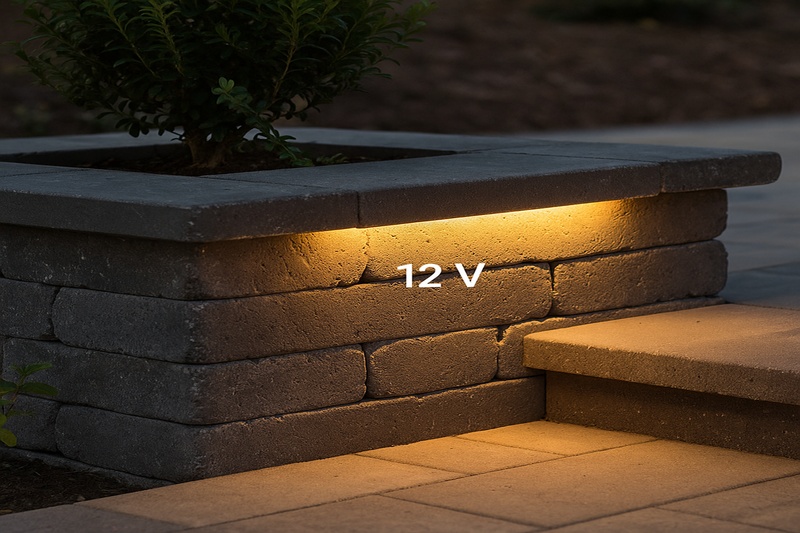
While Rhlite often steers clients towards 24V for new, extensive outdoor projects, we recognize that 12V has its place. For a detail-oriented client like Tom, knowing when 12V is appropriate is also part of a complete understanding.
Niche Applications for 12V Outdoors
Here are situations where 12V could still be the right call:
-
Very Short, Isolated Runs:
- If you’re only lighting a very small outdoor feature – a single step, a small sign, interior of a compact weatherproof enclosure – where the total strip length is less than, say, 2-3 meters, voltage drop on a 12V strip will likely be minimal and unnoticeable.
- In such cases, if a small 12V power supply is readily available or more cost-effective for that tiny load, it can be perfectly adequate.
-
Critical Cutting Increments:
- As mentioned, 12V strips7 generally offer shorter cutting segments (e.g., every 2.5cm vs. 5cm or 10cm for 24V).
- If your outdoor design involves fitting strips into very tight, predefined short lengths where every centimeter counts (e.g., custom-built outdoor furniture with integrated lighting channels, small display niches), the finer cutting resolution of 12V might be beneficial.
-
Integration with Existing 12V Systems:
- Many low-voltage landscape lighting systems8 already operate on 12V AC or DC. If you’re adding LED strips as an accent to an existing 12V outdoor setup, using 12V strips can simplify power supply consistency (though AC landscape transformers usually need a rectifier for DC strips).
- Similarly, for RVs, boats, or off-grid outdoor applications running on 12V battery systems, 12V LED strips9 are a natural fit, directly utilizing the existing power source.
-
Specific Low-Power Density Strips:
- For some very low-power decorative 12V strips (e.g., those with fewer LEDs per meter, designed for subtle glow rather than bright illumination), the current draw might be low enough that voltage drop isn’t a major concern even over moderate lengths. However, it’s always best to calculate or test.
A client once needed to add small accent lights inside several sealed, custom-made outdoor art pieces, each requiring less than 1 meter of strip. They already had a multi-output 12V weatherproof power supply from a previous project. In this specific case, using 12V Rhlite strips was practical and cost-effective for them.
| 12V Suitability Factor | Scenario Description | Why 12V Might Be Chosen Outdoors | Rhlite Guidance |
|---|---|---|---|
| Very Short Runs | Installations under ~2-3 meters total length. | Voltage drop often negligible; may use smaller, common 12V PSU. | Confirm calculations if brightness consistency is critical. |
| Precise Short Cut Lengths | Needing cuts every ~2.5cm for very specific fits. | 12V offers finer cutting resolution than most 24V strips. | Balance cutting needs with potential voltage drop. |
| Existing 12V System | Adding to 12V landscape lighting, RV/marine systems, off-grid 12V setups. | Simplifies power integration, leverages existing infrastructure. | Ensure PSU compatibility (AC vs DC, capacity). |
| Very Low Power Strips | Some decorative strips with very low LED density. | Lower current draw might mitigate voltage drop over moderate lengths. | Always verify specifications and test for brightness consistency. |
While 24V is generally the go-to for new, significant outdoor LED strip projects, 12V remains a valid option in these more specific circumstances.
Conclusion
For most outdoor LED strip projects, especially longer runs, 24V is superior due to less voltage drop and wiring advantages. However, 12V can suit very short runs or when ultra-fine cutting increments are essential.
-
Understanding voltage drop is crucial for optimizing electrical systems and ensuring efficiency. Explore this link to learn more. ↩
-
Ohm’s Law is fundamental in electrical engineering. Discover its application in voltage drop to enhance your knowledge. ↩
-
The power equation is key to understanding energy consumption. Learn more about it to improve your electrical projects. ↩
-
Explore how longer run lengths can simplify installations and enhance performance in outdoor lighting projects. ↩
-
Learn about the advantages of using thinner wires, including cost savings and ease of installation in outdoor settings. ↩
-
Discover how improved efficiency can lead to cost savings and better performance in large outdoor lighting projects. ↩
-
Explore the benefits of 12V strips for outdoor lighting, including efficiency and integration with existing systems. ↩
-
Learn about low-voltage landscape lighting systems and how they can enhance your outdoor spaces effectively. ↩
-
Discover best practices for using LED strips outdoors, ensuring durability and optimal performance in various conditions. ↩