Choosing between solar and plug-in power for a project can be confusing. Making the wrong choice can lead to failed installations, unhappy clients, and unforeseen costs.
For professional, large-scale projects, plug-in outdoor LED strips are the superior choice due to their consistent brightness, reliability, and design flexibility. Solar-powered strips are best suited for small, temporary, or decorative applications where performance demands are low and access to power is impossible.
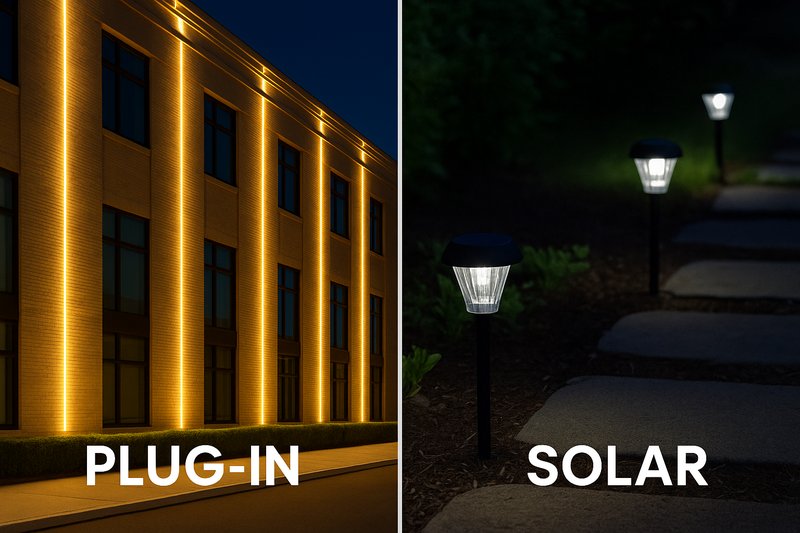
As a factory owner who provides lighting solutions for professionals, this is a question I get a lot. Many of my clients, especially those in North America focusing on high-end projects, are curious about solar options. They see the marketing about being "eco-friendly" and "easy to install." But in my years of experience, I always urge them to look past the surface. For a serious project where your reputation is on the line, the choice between solar and plug-in isn’t just about a power source. It’s about reliability, performance, and control. In this guide, I’ll break down the pros and cons from a manufacturer’s perspective, so you can make the best decision for your business.
How Does Their Light Output and Consistency Compare?
Are your clients complaining about dim or flickering lights just a few hours after sunset? This is a common failure of solar lighting that can ruin a project’s intended effect.
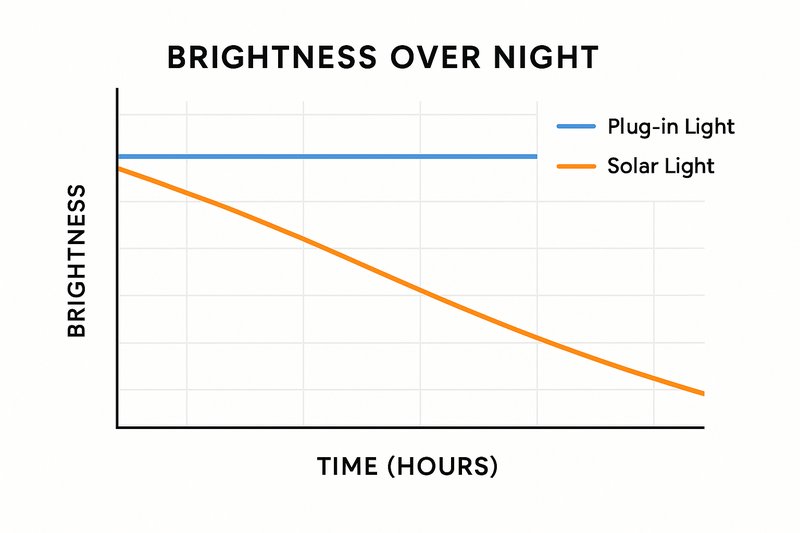
Plug-in LED strips provide constant, high-lumen output for as long as they are powered on. Solar strips deliver variable, lower brightness that depends entirely on the day’s sunlight and battery charge, often dimming and failing over a few hours.
I once had a conversation with a potential client, an architect named Tom from the United States. He was designing a lighting scheme for a luxury boutique hotel’s landscape. He was initially determined to use solar to get a "green" building credit. I had to be very direct with him. I asked, "Will the hotel owners be happy if their beautiful, expensive landscaping is perfectly lit until 10 PM, but looks dim and uneven for the rest of the night?" The question made him pause. The reality is, for any commercial or high-end residential application, consistency is not a feature; it’s a requirement. The lighting must look exactly as designed, every single night, for the entire duration it’s on. This is something solar power simply cannot guarantee.
The Engineering of Consistent Performance: Plug-in Systems
Plug-in (low-voltage) LED strip systems are designed for stability.
- Stable Power Delivery: A high-quality LED power supply (transformer) takes the building’s main AC voltage and converts it to a stable, reliable 12V or 24V DC. This ensures every single LED on the strip receives the exact voltage and current it needs to perform at its peak specified brightness.
- Guaranteed Lumens: When we sell you a 1200 lumen-per-meter strip light, you are getting 1200 lumens-per-meter, consistently, from the moment you turn it on to the moment you turn it off. This predictability is essential for lighting designers who use software and calculations to plan their designs. They need to know the light output is a fixed variable.
- Full Control: These systems are fully compatible with professional control systems. You can dim them precisely, schedule them, or integrate them with other automation systems. The performance is entirely under your control.
The Engineering of Consistent Performance: Plug-in Systems
Plug-in (low-voltage) LED strip systems are designed for stability.
- Stable Power Delivery1: A high-quality LED power supply (transformer) takes the building’s main AC voltage and converts it to a stable, reliable 12V or 24V DC. This ensures every single LED on the strip receives the exact voltage and current it needs to perform at its peak specified brightness.
- Guaranteed Lumens2: When we sell you a 1200 lumen-per-meter strip light, you are getting 1200 lumens-per-meter, consistently, from the moment you turn it on to the moment you turn it off. This predictability is essential for lighting designers who use software and calculations to plan their designs. They need to know the light output is a fixed variable.
- Full Control3: These systems are fully compatible with professional control systems. You can dim them precisely, schedule them, or integrate them with other automation systems. The performance is entirely under your control.
The Unpredictable Nature of Solar Power
Solar-powered LED strips are a completely different beast. Their performance is a chain of dependencies, and each link is a potential point of failure.
- Sunlight Collection: The small solar panel must receive several hours of direct, intense sunlight. A cloudy day, shade from a tree, or even a layer of dust can drastically reduce the energy collected.
- Battery Storage: The collected energy is stored in a small, typically low-quality lithium-ion battery. These batteries have a limited capacity and a limited number of charge cycles before they degrade.
- Light Output: The light output is directly tied to the battery’s charge. To conserve power and last longer, most solar units are intentionally designed with low-lumen LEDs. Even then, they often start dimming significantly after just 3-4 hours of use as the battery drains.
Here’s a practical comparison for a professional buyer.
| Feature | Plug-in LED Strip System | Solar-Powered LED Strip4 | Professional Implication |
|---|---|---|---|
| Brightness (Lumens) | High, consistent, and specifiable (e.g., 100 to 2000+ lm/m) | Low, variable, and often not specified accurately | Plug-in systems meet professional design requirements. Solar is a gamble. |
| Consistency | 100% brightness as long as switched on | Starts bright (if fully charged), then dims over 3-6 hours | Your lighting design will look inconsistent and fail with solar. |
| Color Rendering (CRI) | Typically high (80+, 90+ available) | Usually very low (sub-70) to maximize efficiency | Colors will look washed out and inaccurate under most solar lights. |
For any project where quality and aesthetics are key, the unpredictable and inferior light output of solar strips makes them an unprofessional choice.
Which System Holds Up Better to Outdoor Elements and Long-Term Use?
Are you tired of replacing "weatherproof" lights that failed after one season? The materials and components in a lighting system determine its true lifespan, an area where solar and plug-in differ vastly.
Professionally-grade plug-in LED strips, with IP67 silicone jacketing and robust power supplies, are built for longevity. Most consumer-grade solar strips use cheap plastics and low-capacity batteries that degrade quickly from UV exposure and charge cycles, often failing within 1-2 years.
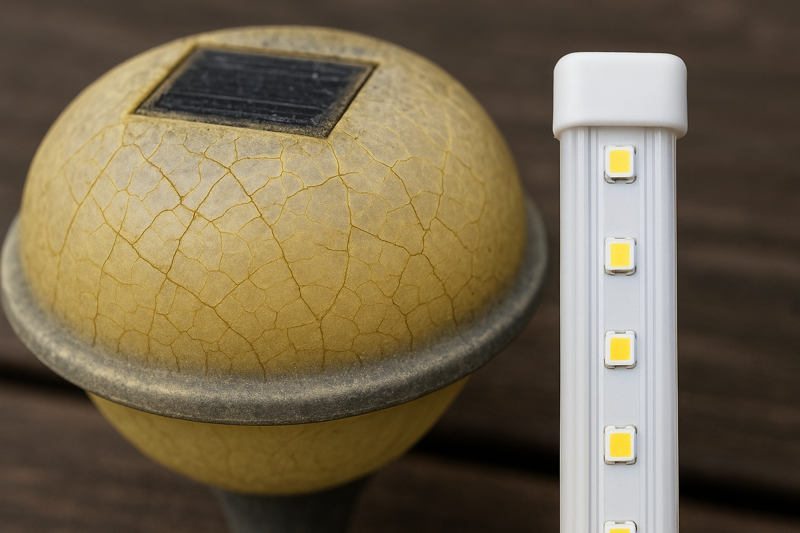
This is a point I am very passionate about because it comes down to manufacturing quality. Many buyers focus only on the initial price and get burned by poor durability. A contractor client of mine in Singapore learned this firsthand. He tried to save money on a residential project by using some cheap solar stake lights along a garden path. They looked fine for the first few months. After a year of tropical sun and rain, the plastic housings were yellow and brittle, the solar panels were clouded over, and more than half of the lights had stopped working altogether. The homeowner was angry, and my client had to pay out of his own pocket to replace them with one of our proper IP67 plug-in systems. He told me, "Jermey, I learned my lesson. The cheap product cost me twice as much in the end."
The Anatomy of a Durable Plug-in System
A professional outdoor lighting system is designed as a long-term investment.
- Strip Construction: Our Rhlite outdoor strips use high-grade, UV-stable silicone5 for encapsulation. This material does not yellow or crack. The PCB inside is a thick 2oz or 3oz copper board that manages heat effectively, prolonging the life of the LEDs to 50,000 hours or more.
- Power Supply: The power supplies are the heart of the system. We use units with high-quality components6, sealed in IP67-rated aluminum housings7. They are designed to withstand temperature fluctuations, humidity, and vibration for years.
- Fewer Failure Points: A plug-in system has simple, robust components: the power supply, the wiring, and the strip. There are no complex electronics like charge controllers or batteries exposed to the elements.
Inherent Weaknesses of All-in-One Solar Units
Consumer-grade solar products are almost always built down to a price point, not up to a quality standard.
- Materials: The housing is typically cheap ABS or PVC plastic. This plastic is not UV-stable and will degrade rapidly in direct sunlight, becoming brittle and allowing water to get inside.
- Solar Panel: The panel itself is often covered with a layer of epoxy or cheap plastic that clouds over, reducing its efficiency over time.
- Battery: This is the most common point of failure. The small batteries used have a lifespan of maybe 300-500 charge cycles. In a daily-use product, this means the battery’s ability to hold a charge will be significantly reduced after just one year. Replacing them is often impossible as the units are sealed shut.
This table shows the expected lifespan of components.
| Component | Professional Plug-in System | Typical Consumer Solar Unit | Business Impact |
|---|---|---|---|
| LED Strip | 50,000+ hours | 10,000-15,000 hours | You will be replacing the solar product 3-5 times before the plug-in system degrades. |
| Housing/Jacket | IP67 UV-stable silicone | IP44 non-UV-stable plastic | The solar unit will likely fail from water damage due to material degradation. |
| Power Source | High-quality IP67 power supply (10+ year design life) | Integrated low-capacity battery (1-2 year lifespan) | Solar products create a cycle of replacement and unhappy customers. |
For a business like yours, selling or installing a product that is designed to fail is a direct threat to your reputation. A reliable plug-in system protects your brand and ensures client satisfaction.
What Are the Installation Challenges and Design Limitations of Each Type?
Is the promise of an "easy" solar installation limiting your creative lighting designs? The power source dictates not just installation, but the entire scope and flexibility of what you can achieve.
Solar strips require placing a bulky panel in direct sunlight, which severely restricts placement and design options. Plug-in systems offer complete freedom to place light anywhere, run long continuous lines, and conceal wiring for a clean, professional aesthetic.
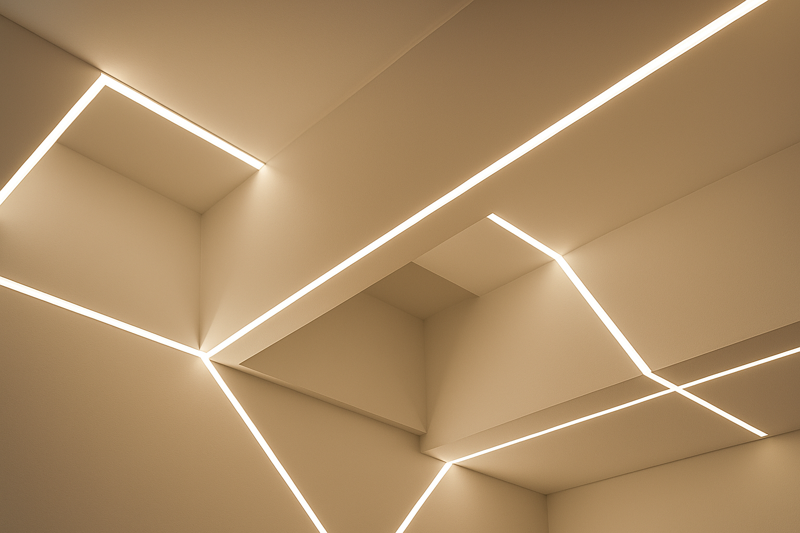
I often work with talented lighting designers and architects. Their biggest frustration with solar is the creative handcuffs it puts on them. Imagine you want to create a beautiful "wall wash" effect on a north-facing facade of a building. With a plug-in system, it’s simple. You run the low-voltage wire and install the strip. With solar, it’s impossible. The solar panel needs to be on the south-facing roof, and you would have to run an ugly wire from the panel all the way to the fixture. The same problem applies to lighting under trees, beneath deck railings, or in covered porticos. The very locations that benefit most from accent lighting are often in the shade. The "no wires" benefit of solar is a myth; you are simply trading a power cord for a very restrictive solar panel cord.
The Design Freedom of Plug-in Systems
This is where plug-in systems truly shine for professionals.
- Place Light Anywhere: You are not limited by the sun. You can install strips in any orientation, on any surface, in any location where you can run a small low-voltage wire.
- Long, Continuous Runs: With the right power supply and gauge of wire, you can power very long, unbroken lines of light, which is essential for architectural outlines, cove lighting, and long pathways. Solar strips are almost always short, self-contained units of just a few meters.
- Clean and Hidden Installation: Professional installation is about making the hardware disappear, so all you see is the light. Low-voltage wires are small and can be easily hidden in channels, behind trim, or buried in a shallow trench. A solar panel is an ugly, bulky piece of hardware that must be out in the open, ruining the aesthetic.
- Customization: As a factory, we can produce plug-in strips in any length, color temperature, or brightness you need for the project. The system is fully customizable.
The Practical Limitations of Solar Installation
While solar seems simple on the surface, it comes with major constraints.
- The Panel Problem: The solar panel dictates the placement of the light. The panel and the light are tethered by a short wire. You cannot place the light in a shady spot and the panel in a sunny spot 20 meters away.
- Aesthetic Compromise: You must install a utilitarian-looking solar panel in a visible location. This is often an unacceptable compromise in a high-end landscape or architectural design.
- Lack of Scalability: You cannot easily link multiple solar strips together to create a single, long, continuous line of light controlled by one source. Each unit is an independent, and often inconsistent, island of light.
Here’s how these factors influence project types.
| Consideration | Plug-in Systems | Solar Systems | Project Suitability |
|---|---|---|---|
| Placement Flexibility | Unlimited. Any surface, any orientation. | Severely restricted. Light must be near a sunny spot for the panel. | Plug-in is for any designed professional project. Solar is only for open, sunny areas. |
| Aesthetics | Wires and hardware can be completely hidden. | The solar panel is always visible and often unattractive. | Plug-in is required for high-end aesthetics. Solar compromises the design. |
| Scalability | Can power hundreds of meters from a single control point. | Not scalable. Each short unit operates independently. | Plug-in is for large-scale architectural and landscape projects. Solar is for small garden stakes. |
For any project larger than a few decorative garden lights, the installation and design limitations of solar make it a fundamentally flawed choice for a professional.
What is the True Cost Beyond the Initial Purchase Price?
Are you choosing solar based on a perceived saving on electricity and installation costs? The total cost of ownership, including replacement and maintenance, often tells a very different story.
While a single solar unit may seem cheaper upfront, its short lifespan and frequent replacement needs make it far more expensive over time. A professional plug-in system has a higher initial cost but is a long-term asset with a much lower total cost of ownership.
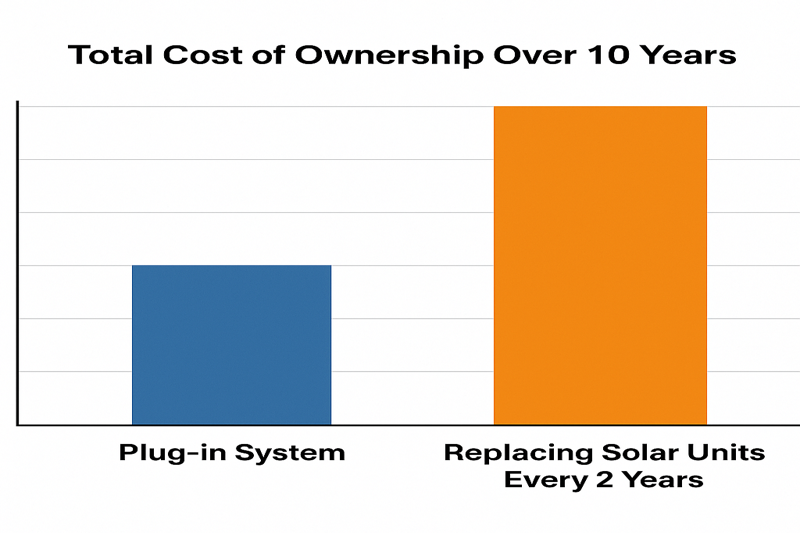
Talking about cost is critical for my B2B clients. They are running a business, and ROI is everything. A product manager for a large distributor in the US, another "Tom" archetype, once analyzed this with me. He was considering carrying a line of solar landscape lights. On paper, the initial margin looked good. But then we calculated the "true cost." We factored in the high probability of customer returns, the cost of warranty replacements, and the reputational damage from selling a product that doesn’t last. When he saw that the cost of servicing failures could wipe out his entire profit margin, he quickly abandoned the idea. He realized that selling a durable, reliable plug-in system was actually the more profitable long-term strategy.
Breaking Down the Full Cost of a Plug-in System
The initial investment for a professional system is higher because you are buying quality components designed to last.
- Upfront Costs8: This includes the IP67-rated LED strips, a properly sized IP67 LED driver, and appropriate outdoor-rated wiring. There may also be a higher labor cost for a more considered installation (e.g., burying wires).
- Operating Costs9: The electricity cost is minimal. A 10-meter, 10W/m installation (total 100W) running for 6 hours a night uses only 0.6 kWh. In the US, this costs only a few cents per day.
- Maintenance & Replacement Costs10: Virtually zero for many years. A well-installed system using quality components should be maintenance-free for 5-10 years or more.
The Hidden Costs of Solar Lighting
The low sticker price of a solar unit is deceptive.
- Upfront Costs: Very low per unit. This is its primary marketing advantage.
- Operating Costs: No electricity cost. This is the other main selling point.
- Maintenance & Replacement Costs: Extremely high. This is the hidden trap. Because the battery and components are designed to fail in 1-2 years, you are not buying a light; you are subscribing to a cycle of replacement. The labor cost to replace a failed unit multiple times, plus the cost of the new units, quickly adds up.
Let’s look at a 10-year cost analysis for lighting a 15-meter pathway.
| Cost Component | Professional Plug-in System | Consumer Solar System | 10-Year Cost Winner |
|---|---|---|---|
| Initial Hardware | $400 (Strip, PSU, Wire) | $150 (5x 3-meter kits) | Solar (Initially) |
| Initial Labor | $300 | $50 | Solar (Initially) |
| Electricity (10 yrs) | ~$150 | $0 | Solar |
| Replacements (10 yrs) | $0 | $600 (4 full replacements) | Plug-in |
| Replacement Labor | $0 | $200 (4x trips) | Plug-in |
| Total 10-Year Cost | $850 | $1,000 | Plug-in |
As you can see, the initial savings of the solar system are completely erased by the high cost of repeated replacement. And this calculation doesn’t even include the cost of client dissatisfaction and the damage to your professional reputation. For any permanent installation, a plug-in system is not only the higher-quality choice but also the more financially sound investment.
Conclusion
For professional projects, plug-in systems are the clear winner, offering the reliability, performance, and design flexibility your clients expect. Solar is a consumer gadget, not a professional tool.
-
Understanding stable power delivery is crucial for ensuring optimal LED performance and longevity. ↩
-
Explore guaranteed lumens to ensure your lighting design meets professional standards and expectations. ↩
-
Learn about full control features to enhance your lighting design and automation capabilities. ↩
-
Discover the limitations of solar-powered LED strips to make informed decisions for your projects. ↩
-
Explore the advantages of using high-grade UV-stable silicone for durability and longevity in outdoor lighting systems. ↩
-
Discover how high-quality components enhance the reliability and efficiency of outdoor lighting systems. ↩
-
Learn how IP67-rated aluminum housings protect outdoor equipment from environmental factors, ensuring long-lasting performance. ↩
-
Understanding upfront costs helps you budget effectively for quality lighting solutions. ↩
-
Explore this to see how operating costs impact long-term savings and efficiency. ↩
-
This insight reveals the hidden expenses that can affect your overall investment. ↩