You quoted a color-changing LED strip for a project, but when the client asks for a clean, warm white, the light looks bluish and cheap. Or worse, they want a dynamic rainbow effect, and your strip can only show one solid color at a time.
RGB is for basic, single-color effects. RGBWW adds dedicated white chips for high-quality, tunable white light alongside colors. RGBIC uses special chips to allow multiple colors and animated effects to display on a single strip at the same time.
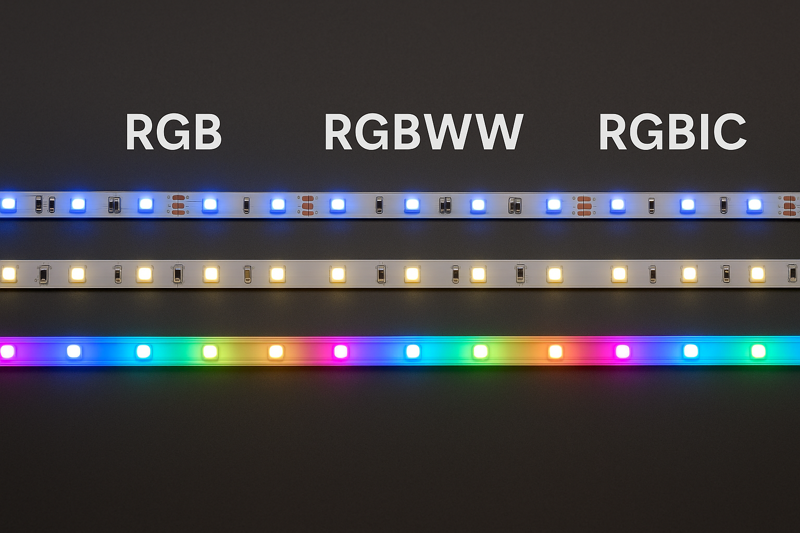
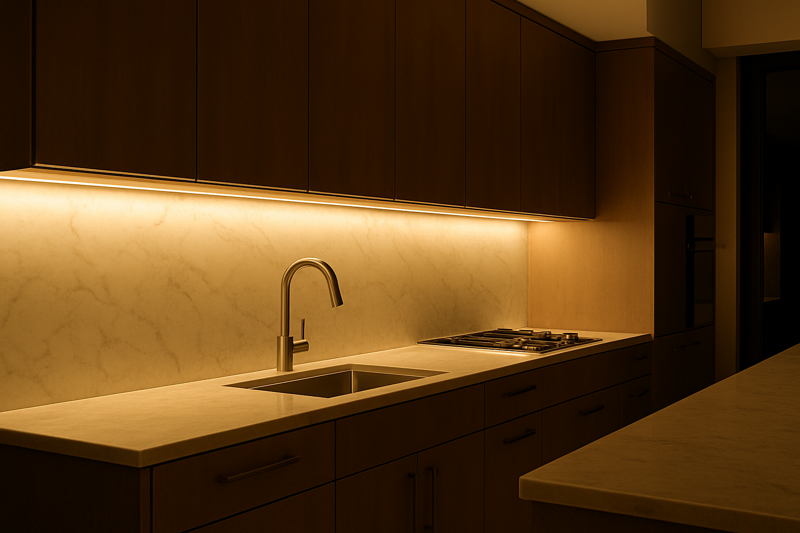
I’ll never forget a meeting with a high-end kitchen designer. He wanted "color-changing" under-cabinet lights. I brought three samples: a standard RGB, an RGBIC, and our 5-in-1 RGBWW strip. First, I showed him the RGB. He asked for white, and I showed him the pastel-blue color it created by mixing. He grimaced. Then I showed him the RGBIC rainbow effects. He said, "That’s a fun gimmick, but I’d never use it here." Finally, I powered on the RGBWW strip. I dialed in a perfect, warm 3000K white light with a high CRI that made the granite countertop look incredible. Then, with the same remote, I changed it to a deep, saturated blue for an evening "mood" setting. His eyes lit up. "That’s it," he said. "I need both. I need perfect white light and perfect color." That’s when I knew that explaining this difference is one of the most important jobs I have.
What is a Standard RGB LED Strip?
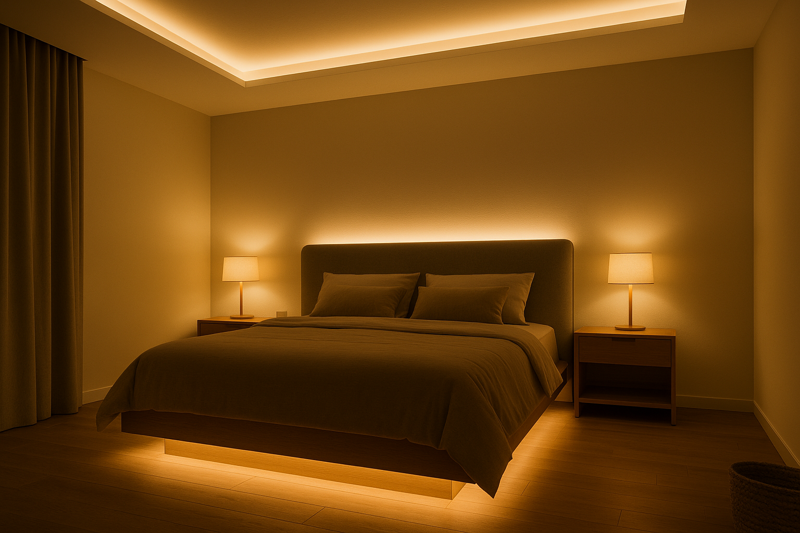
Your client wants to add basic accent colors to a space, like a bar backlighting or a child’s bedroom. You need a reliable, cost-effective solution without features they’ll never use. Over-specifying is a waste of money.
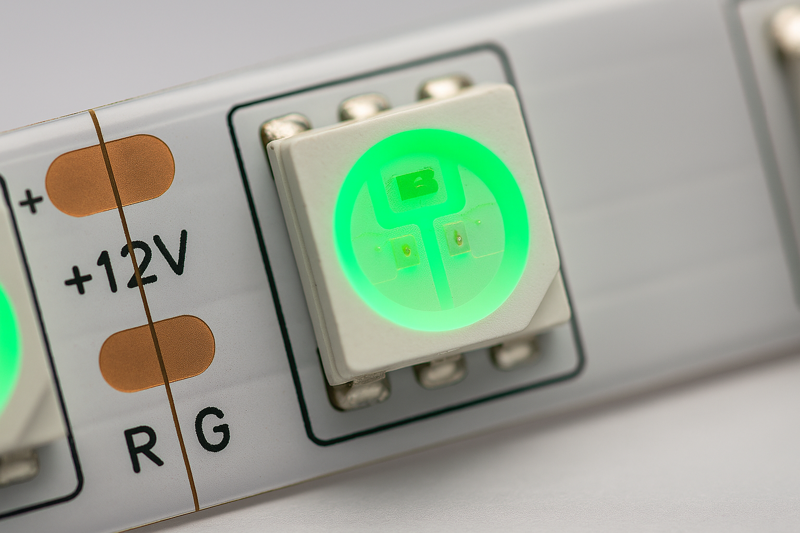
An RGB LED strip is the original color-changing technology. It uses a 3-in-1 chip containing red, green, and blue diodes to mix millions of colors. The key limitation is that the entire strip can only display one single color at a time.
A long-time contractor client, Tom, called me for a large hotel project. They were outfitting 200 sports bar-style rooms. They needed a simple, robust strip to go behind the TVs and under the bar counters to glow with the colors of the home sports team on game nights. He asked if he should use our "best" RGBWW strip. I told him absolutely not. For this job, a standard RGB strip was the perfect tool. It was cost-effective, easy to control with a simple remote, and delivered the exact functionality the hotel needed: solid, uniform colors. Using a more complex strip would have just added unnecessary cost and complexity. It’s a workhorse product, and knowing when to use it is the mark of a smart installer.
The Foundation of Color-Changing Light
The standard RGB strip is the foundation of all color-changing linear lighting. It’s a simple, effective, and mature technology. The magic happens within a single component, the SMD 5050 chip1, which houses three separate light-emitting diodes: one red, one green, and one blue. By varying the intensity of these three primary colors through a controller, you can create a vast spectrum of secondary and tertiary colors. However, its biggest strength—simplicity—is also its biggest limitation. The commands from the controller are sent to the entire strip at once, meaning every single chip does the exact same thing.
How It Works: Additive Color Mixing
The principle is the same as the pixels on your computer screen. It’s called additive color mixing2. When all three LEDs are off, the result is black (no light). When all three are at 100% intensity, their light mixes to create a "white" light. A deep purple is created by mixing a high intensity of red and blue with little to no green. This system is effective for producing vibrant, saturated colors.
The "White Light" Problem
The most significant drawback of a standard RGB strip is the quality of its white light. Because it has no dedicated white LED, it can only approximate white by blending red, green, and blue at full power. This composite white often has a noticeable blue or pink tint and always has a very poor Color Rendering Index (CRI)3. A low CRI means the light makes colors look unnatural and washed out. For any application where high-quality white light is needed for tasks or general illumination, a standard RGB strip is the wrong choice.
| Aspect | Description | Best Suited For | Not Recommended For |
|---|---|---|---|
| Functionality | Displays one uniform color across the entire length of the strip. | Accent lighting, cove lighting, holiday decorations, mood lighting in bars and clubs, signage. | Task lighting, under-cabinet lighting, retail displays, vanity lighting, any space requiring accurate color representation. |
| Pros | Cost-Effective: The most affordable color-changing option. Simple: Easy to install and control with basic controllers. Widely Available: A mature and common technology. | Projects with a tight budget where the primary need is for colored light, not white light. | High-end architectural projects where light quality is paramount. |
| Cons | Poor White Light: Composite white has a low CRI and a blue/pink tint. No White Adjustment: You cannot change the color temperature of the white light. | Applications where the "white" light will be used frequently for general illumination. | Anywhere the client is sensitive to light quality and color accuracy. |
What Makes an RGBWW LED Strip Different?
Your client wants it all: vibrant, saturated colors for parties and entertaining, but also high-quality, functional white light for everyday tasks like cooking or reading. A standard RGB strip fails the "white light" test completely.
An RGBWW strip combines the standard RGB diodes with two additional, dedicated white chips: one Warm White (WW) and one Cool White (CW). This 5-in-1 chip allows for both full-color mixing and tunable, high-CRI white light.
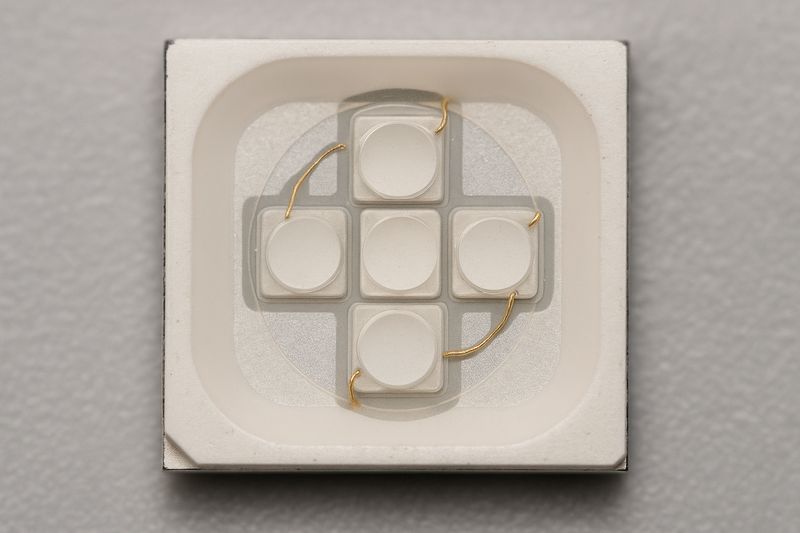
I was working with a lighting designer for a luxury home theater. Her client wanted the ceiling cove to be able to turn a deep blue for "movie mode" but also produce a beautiful, inviting warm white (around 2700K) for when guests were settling in or cleaning up. This was a perfect application for RGBWW. I explained to her that with a 5-channel controller, she could have total control. She could run a pure, high-CRI warm white from the dedicated WW chip, a pure cool white from the CW chip, blend the two for any temperature in between, or use the RGB chips for any color she could imagine. She specified it for the project, and the result was stunning. It delivered the "wow" factor of color and the functional elegance of premium architectural lighting from a single, seamless source.
The Best of Both Worlds: Color and Quality White
The "WW" in RGBWW (sometimes called RGBCCT or RGB+TW) stands for Warm White and Cool White/Tunable White. It represents the evolution of RGB technology to solve its greatest weakness: poor white light. By integrating dedicated white light diodes directly onto the same chip as the RGB diodes, a single strip can now serve two distinct purposes. It can be a vibrant, color-changing accent light, and it can be a high-performance, specification-grade white light4 source. This makes it the ideal choice for high-end residential and commercial applications where both versatility and light quality are non-negotiable.
Tunable White Technology5
The magic of the "WW" is in the two dedicated white chips, often one at a warm 2700K and one at a cool 6500K. With a proper controller, you can activate and dim these two white channels independently. By blending them, you can "tune" the white light output to any color temperature between these two points. Want a cozy, incandescent glow? Use 100% of the warm white chip. Need a crisp, daylight-like light for focus? Use 100% of the cool white chip. Want a neutral 4000K for an office? Blend them 50/50.
The CRI Advantage
Because RGBWW strips use dedicated white phosphorescent LEDs6 (the same technology found in high-quality, single-color white strips), they can produce white light with a much higher Color Rendering Index (CRI)7, often 90+ or 95+. This means that when the white light is on, the colors of objects, food, and skin tones in the room will appear natural and accurate—a critical factor in kitchens, bathrooms, and retail environments that standard RGB can never achieve.
| Aspect | Description | Best Suited For | Not Recommended For |
|---|---|---|---|
| Functionality | Can produce millions of colors, OR a high-quality, tunable white light (from warm to cool). | Kitchens, bathrooms, high-end coves, home theaters, retail spaces, any multi-use space needing both ambient color and functional white light. | Simple applications where only basic colors are needed and cost is the primary driver (e.g., promotional lighting). |
| Pros | Excellent White Light: High CRI (90+) and tunable CCT. Versatile: One product for both ambient color and primary white lighting. Professional Grade: Meets the demands of high-end architectural and design projects. | Clients who are discerning about light quality and want maximum flexibility from a single fixture. | Projects where the additional cost and more complex 5-channel controller are not justified by the client’s needs. |
| Cons | Higher Cost: More expensive than standard RGB due to the more complex chip. Requires 5-Channel Controller: Needs a more advanced controller and 5-conductor wire to function correctly. | Ultra-budget projects. Installations where the strip will only be used for color and never for white light. |
What Does the "IC" in RGBIC Really Mean?
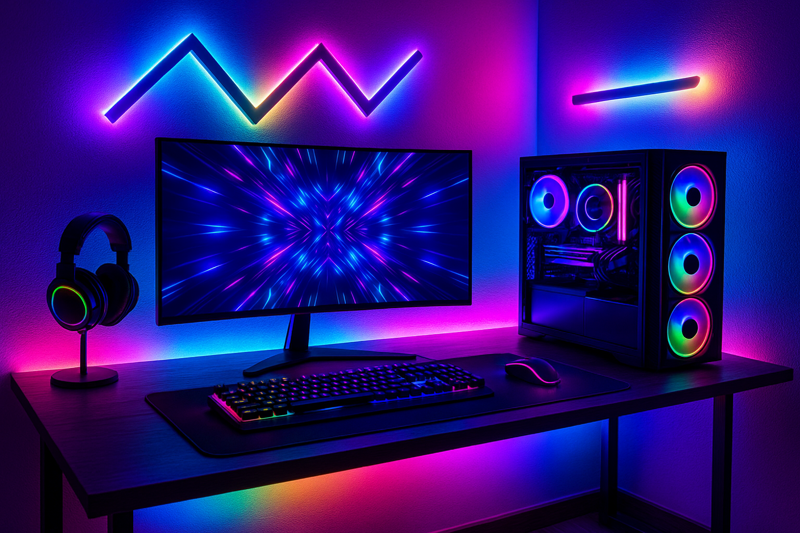
Your client saw a video of lights that chase, flow, and dance with multiple colors moving along the strip at once. They want that exact "rainbow" effect for their gaming room or entertainment space, and a standard RGB strip can’t do it.
The "IC" in RGBIC stands for "Independent Control" chip. Each RGBIC strip has microchips distributed along its length that allow every small section (or even every single LED) to be controlled individually and display a different color and brightness.
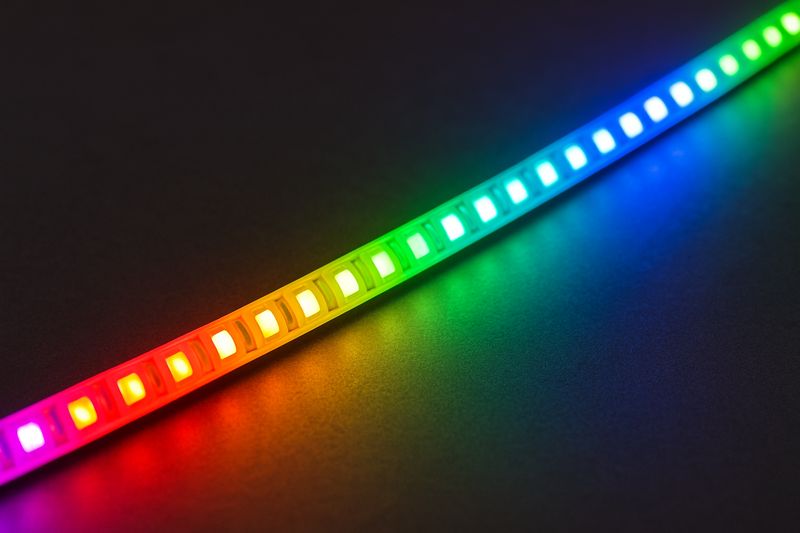
We had an OEM client, Tom, who was developing a product for a new chain of family entertainment centers. They wanted to create these massive, dynamic light displays that could pulse and flow with the music. He initially thought he needed a complex DMX system, which was hugely expensive. I introduced him to our addressable RGBIC strips. Using a relatively simple SPI (Serial Peripheral Interface) controller, he could program amazing sequences—chasing rainbows, sparkling effects, color wipes—at a fraction of the cost of a full DMX setup. The IC chip was the key. He could command "Segment 1, turn red; Segment 2, turn green; Segment 3, turn blue" all at the same time. This technology opened up a whole new world of creative possibilities for his project.
Unleashing Dynamic Control
RGBIC technology8 fundamentally changes the relationship between the controller and the strip. In a standard RGB system, the controller sends out one command ("turn blue"), and the entire strip obeys. In an RGBIC system, the controller sends out a complex stream of data. The first IC chip on the strip reads the first piece of data ("you turn blue"), acts on it, and then passes the rest of the data stream down the line to the next chip, which reads the next instruction. This daisy-chain of information allows for the incredible animated effects that define RGBIC products. These are also known as "addressable," "pixel," or "digital" LED strips.
The Power of Segmentation
The "addressable" unit can vary. In some strips, a single IC chip controls a small segment of 3 LEDs. In more advanced strips, each individual LED has its own IC chip. This density of control points (or "pixels") determines the smoothness and resolution of the lighting effects. For large-scale effects viewed from a distance, a lower pixel density is fine. For close-up, high-resolution video-like effects, a higher pixel density9 is required.
Controller Complexity and Limitations
The trade-off for this amazing functionality is complexity. You can’t use a simple RGB controller with an RGBIC strip. You need a dedicated IC controller10 that speaks the correct protocol (like WS2811, WS2812B, SK6812, etc.). While many of these controllers come with pre-programmed scenes, creating fully custom effects11 requires more advanced software. A key limitation is that you cannot cut and reconnect RGBIC strips anywhere you like. You must cut them at designated points and be mindful of the data signal’s directionality12 (there is an "in" and an "out"). Finally, if one IC chip fails, it can stop passing data down the line, causing the rest of the strip to go dark.
| Aspect | Description | Best Suited For | Not Recommended For |
|---|---|---|---|
| Functionality | Displays multiple colors on the strip at the same time. Capable of animated, flowing, and chasing effects. | Entertainment spaces, gaming rooms, home theaters, nightclubs, stage lighting, festival decorations, statement architectural pieces. | General illumination, task lighting, or any application that requires a single, uniform, static color. |
| Pros | Dynamic Effects: Creates stunning, eye-catching animated scenes. Highly Creative: Offers limitless possibilities for custom lighting designs. Visually Impressive: The "wow" factor is extremely high. | Projects where the primary goal is dynamic, moving, and multi-colored light art. | Anywhere that a simple, static color is required. The complexity is overkill and can be a point of failure. |
| Cons | Complex Control: Requires a specific IC/SPI controller. Cutting/Splicing is difficult: Must be done carefully to maintain data flow. Single Point of Failure: A dead IC can affect the rest of the strip. Generally poor white light quality similar to standard RGB. | High-end kitchens or bathrooms where high-quality white light is more important than rainbow effects. |
Conclusion
Choose your technology based on the project’s primary need. Use RGB for basic color, RGBIC for dynamic effects, and RGBWW for projects demanding both vibrant color and superior quality white light.
-
Understanding the SMD 5050 chip will enhance your knowledge of color-changing technology and its applications. ↩
-
Exploring additive color mixing will deepen your grasp of how colors are created in lighting systems. ↩
-
Learning about CRI is crucial for anyone interested in lighting quality and its impact on color perception. ↩
-
Discover the characteristics of high-performance white light and its applications in design and architecture. ↩
-
Explore this link to understand how Tunable White Technology enhances lighting versatility and quality. ↩
-
Find out how dedicated white phosphorescent LEDs improve lighting quality and efficiency. ↩
-
Learn about CRI and its significance in achieving accurate color representation in various environments. ↩
-
Explore this link to understand the innovative RGBIC technology that enhances LED strip lighting. ↩
-
Find out how pixel density impacts the quality and smoothness of lighting effects in LED strips. ↩
-
Discover the role of IC controllers in managing LED strips and enabling complex lighting effects. ↩
-
Unlock your creativity by learning how to design custom lighting effects for RGBIC LED strips. ↩
-
Understand the importance of data signal directionality in maintaining the functionality of RGBIC strips. ↩