Your outdoor lighting project fails after one season, turning a beautiful design into an ugly, costly problem. Losing money and your client’s trust is the painful result.
True weatherproofing requires a system: an IP67 silicone-encased strip for water, UV-stable materials to fight sun damage, and proper mounting in aluminum channels to manage extreme temperatures. Selecting the right components from the start prevents failures.
I get calls every week from frustrated contractors and lighting designers. They tell me a similar story: they bought "weatherproof" LED strips from another supplier, installed them, and within a year, they were a complete disaster. The client is mad, and they’re facing the cost of replacing everything. The problem is that the word "weatherproof" is used too loosely. It’s not a single feature; it’s a combination of specific protections against the three main enemies of any outdoor installation: water, sun, and temperature. As a manufacturer, my job is to build products that defeat all three. In this article, I’ll show you exactly what to look for, so your next outdoor project is built to last.
What IP Rating Is Truly Best for Outdoor LED Strips?
You installed "waterproof" strips, but now they are flickering and full of condensation. A project that was supposed to last for years has failed in months, creating an embarrassing callback.
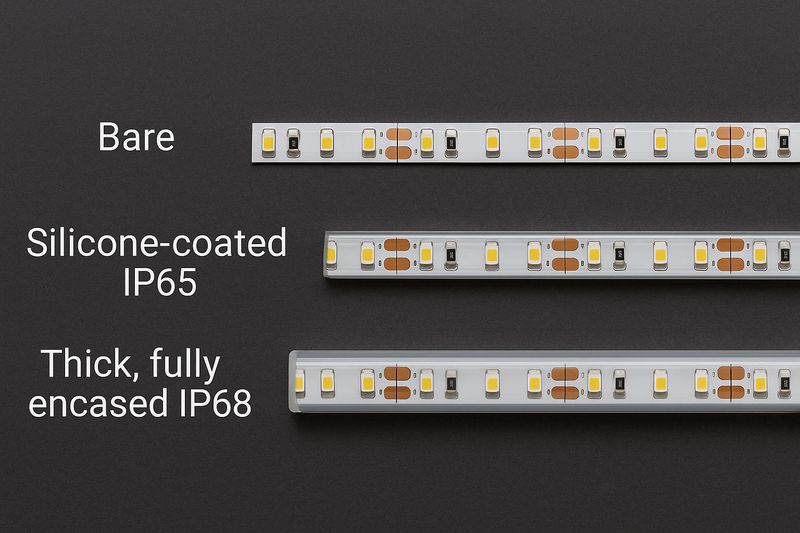
For most outdoor applications like patios, facades, and landscapes, an IP67 rating is the professional standard. It offers full protection against dust and temporary water immersion. IP68 is only necessary for permanent underwater use in pools or fountains.

One of my clients, a distributor named Tom from the United States, learned this the hard way. He used to source IP65-rated strips for landscape projects to save a little money on each meter. He thought "water-resistant" was good enough for accent lighting along a garden wall. But after a few seasons of heavy rain and melting snow, water found its way past the simple coating. The strips started failing in sections. He realized that the small upfront savings resulted in huge replacement costs and a damaged relationship with his installer clients. Now, he only stocks IP67 silicone strips from our factory. He tells his customers, "Don’t gamble with water. IP67 is your insurance policy for outdoor lighting." He’s right. It’s the most critical specification for ensuring longevity.
IP65: Not Suitable for True Outdoor Exposure
Many suppliers will try to sell you IP65 strips for outdoor use because they are cheaper to produce. An IP65 rating means the product is protected against low-pressure water jets from any direction. This is fine for an indoor location that might get wiped down with a wet cloth, like a kitchen backsplash, but it is not sufficient for the outdoors. Rain is not a gentle, low-pressure jet. It can be driving, wind-blown, and can form puddles where a strip might sit for hours. A thin spray-on or silicone tube coating on an IP651 strip simply does not provide a robust enough seal against persistent moisture, humidity, and standing water. Over time, water vapor will penetrate the seals, condense inside, and corrode the electronics.
IP67: The Professional Standard for Reliability
An IP67 rating signifies two things: "6" means it is completely sealed against dust, and "7" means it is protected against the effects of temporary immersion in water up to 1 meter deep for 30 minutes. This is the specification you should demand for 95% of outdoor projects. A true IP672 strip, like our Rhlite products, is not just coated; it is fully encapsulated or co-extruded in a solid block of high-grade silicone. There are no hollow tubes or thin coatings. This solid construction means there is physically no space for water to enter or condense. It can withstand heavy rainstorms, puddles, and direct contact with wet ground, making it the reliable choice for architectural and landscape lighting.
IP68: For Underwater Applications Only
The highest standard rating is IP683. The "8" means the product is suitable for continuous immersion in water under conditions specified by the manufacturer (usually deeper than 1 meter). This is a specialized product designed specifically for use inside swimming pools, ponds, and fountains. While it offers the ultimate water protection, it is often more expensive and unnecessary for general outdoor lighting. Using an IP68 strip where an IP67 will do is over-engineering and adds needless cost to your project.
Here’s a simple selection guide:
| IP Rating | Protection Level | Common Misuse | Recommended Application |
|---|---|---|---|
| IP65 | Dust-tight, splash/jet resistant | Sold as "outdoor" or "weatherproof" | Indoor use only (e.g., kitchens, bathrooms). Unsuitable for rain exposure. |
| IP67 | Dust-tight, temporary water immersion | Not specified when needed | Decks, patios, facades, landscape lighting, signage. The go-to for professionals. |
| IP68 | Dust-tight, continuous water immersion | Used in non-submerged areas | Underwater use only (pools, fountains, ponds). |
By insisting on a minimum of an IP67 rating from your supplier, you eliminate water ingress4 as a point of failure. Always ask for the product’s official test reports to verify the certification is legitimate.
How Does Sunlight Degrade Outdoor LED Strips?
You installed brilliant white lights a year ago, but now they look yellow, cloudy, and cheap. The sun’s UV radiation has destroyed the protective coating, ruining the aesthetic and reducing light output.
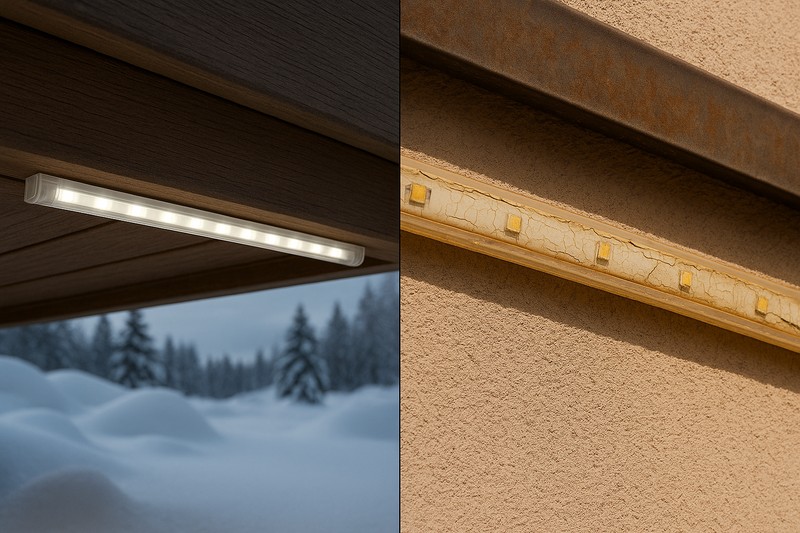
Sunlight, specifically UV radiation, breaks down the polymers in low-quality jacketing materials like PVC and epoxy. This causes them to turn yellow, become brittle, and crack, allowing moisture to enter and creating a poor appearance.
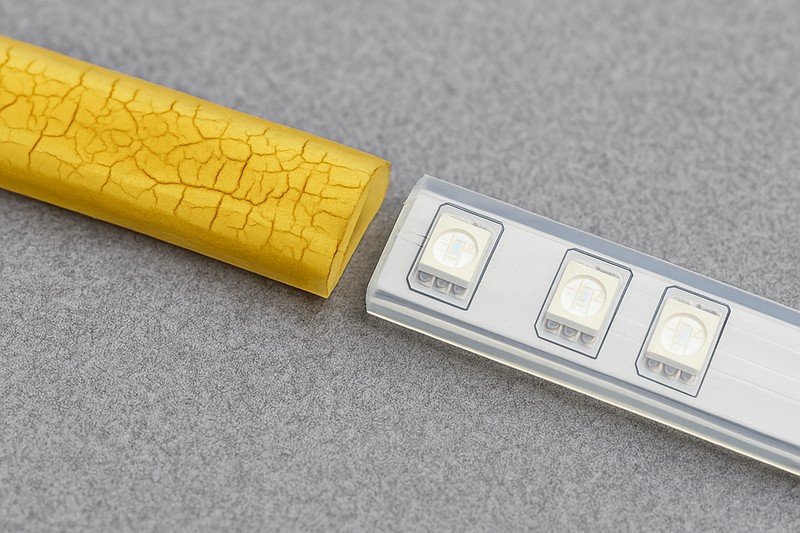
I once had a potential client in North America send me a sample of a competitor’s "outdoor" LED strip. It had been installed on the south-facing side of a building for just over a year. The strip was supposed to be white, but it was a sickly brownish-yellow. It was stiff and brittle, and when I bent it slightly, the outer jacket cracked open like an eggshell. This is the classic result of using cheap PVC or epoxy for the waterproof coating. These materials are not inherently UV-stable. Manufacturers use them because they are very inexpensive. For us at Rhlite, this is unacceptable. We use only high-grade, UV-stabilized silicone for our outdoor products because we know that long-term color stability and material flexibility are just as important as the IP rating.
The Wrong Materials: PVC and Epoxy Resin
Low-cost suppliers often use Polyvinyl Chloride (PVC)5 or epoxy resin to achieve a waterproof seal. While technically waterproof when new, these materials have a critical weakness: they are highly susceptible to damage from ultraviolet (UV) radiation from the sun.
- PVC: This material becomes hard and brittle with prolonged UV exposure. It loses its flexibility, making it prone to cracking, especially as it expands and contracts with daily temperature changes.
- Epoxy Resin6: This is often poured over an indoor strip to create a "waterproof" layer. Epoxy yellows significantly under UV light, sometimes in as little as 6-12 months. This discoloration not only looks unprofessional but also acts as a filter, trapping heat and reducing the amount of light that escapes, which lowers the efficiency and lifespan of the LEDs. These materials are a recipe for short-term failure.
The Right Material: High-Grade Silicone7
The professional solution is to use LED strips that are fully encapsulated in high-grade silicone. Silicone is a superior material for outdoor environments for several key reasons:
- UV Stability8: Silicone is inherently resistant to UV radiation. It will not yellow, cloud, or become brittle over time, ensuring a clean look and consistent light transmission for years.
- Temperature Flexibility: Silicone remains flexible across a wide range of temperatures, from extreme cold to high heat. This prevents the cracking that plagues PVC when it gets cold and brittle.
- Chemical Inertness: Silicone is largely inert, meaning it doesn’t react with pollutants or acid rain, further enhancing its durability.
When you source outdoor LED strips, the material of the protective jacket is a critical specification. A supplier who cannot tell you exactly what material they use, or who just says "plastic," is likely using a low-grade option.
Here is a material comparison chart for outdoor use:
| Material | UV Stability | Flexibility (Cold) | Long-Term Appearance | Professional Choice? |
|---|---|---|---|---|
| Epoxy Resin | Poor (Yellows quickly) | Poor (Can become brittle) | Becomes yellow and cloudy | No – for cheap, short-term use only. |
| PVC | Poor (Becomes brittle) | Poor (Cracks when cold) | Cracks and discolors over time | No – fails due to material degradation. |
| High-Grade Silicone | Excellent (Remains clear) | Excellent (Stays flexible) | Stays clear and stable for years | Yes – the industry standard for durability. |
Always ask for a material data sheet. A quality-focused factory like Rhlite will be happy to provide documentation proving our use of superior, UV-stable silicone. This is your guarantee against the sun.
How Do Extreme Temperatures Affect LED Strip Performance?
Your strips are failing prematurely in hot climates or peeling off in the cold. Extreme temperatures are attacking your installations, causing both electronic failure and physical mounting failure, making your work look unprofessional.
High heat accelerates the aging of LEDs and can cause adhesive failure. Extreme cold makes cheap materials like PVC brittle and prone to cracking. Proper heat dissipation and secure mechanical mounting are essential for managing temperature extremes.

A lighting designer from an area with very hot summers and cold winters once consulted with me. He had a major issue with LED strips installed under the metal railings of a large outdoor patio. In the summer, the direct sun would heat the metal railings to extreme temperatures, and the strips, which had no-name brand LEDs and were stuck directly to the metal, were failing in less than a year. The heat was literally cooking the LED chips. In the winter, the adhesive would get cold and fail, causing the strips to sag. The project was a constant source of maintenance problems. The root cause was a complete failure to plan for thermal management. We replaced the entire system with our high-quality strips mounted inside aluminum channels, which solved both problems permanently.
Managing High Heat: The Importance of Heat Sinks
Heat is the enemy of all electronics, including LEDs. While LED strips don’t produce as much heat as old incandescent bulbs, they do generate some, and high ambient temperatures can push the components past their safe operating limits.
- The Problem: Overheating drastically reduces the lifespan (L70) and color consistency of LEDs. It’s the primary cause of premature dimming and failure. The peel-and-stick adhesive on the back of the strip is also not a good thermal conductor and will fail in high heat.
- The Solution: You must use an aluminum mounting channel9 (also called an extrusion). Aluminum is an excellent heat conductor. By mounting the strip inside the channel, you create a large surface area that acts as a heat sink, drawing heat away from the LEDs and dissipating it into the air. This can lower the operating temperature of the LEDs significantly, extending their life by thousands of hours. For any installation in a hot climate or in direct sun, a mounting channel is not optional; it is a requirement.
Managing Cold and Temperature Cycles
Extreme cold presents different challenges, primarily related to the physical materials.
- The Problem: As mentioned, PVC materials and low-quality adhesives become very brittle in freezing temperatures. The daily cycle of warming and cooling causes materials to expand and contract. This thermal cycling10 puts immense stress on the strip and its adhesive, leading to cracking of the jacket and adhesive failure.
- The Solution: Once again, silicone and mechanical mounting are the answer. Silicone remains flexible even in deep cold, so it will not crack. More importantly, relying on mechanical fasteners11 like mounting channels (which are screwed in) or mounting clips provides a secure hold that is completely unaffected by temperature. The adhesive tape is then only needed for initial positioning, not for permanent support.
Here’s how to build a temperature-proof system:
| Temperature Challenge | Low-Quality Method (Fails) | Professional Solution | Why It Works |
|---|---|---|---|
| High Ambient Heat | Sticking strip directly to surface | Install strip inside an aluminum channel | The channel acts as a heat sink, dissipating heat and prolonging LED life. |
| Cold / Freezing | Using PVC strips and adhesive only | Use silicone strips12 and mechanical fasteners (channels/clips) | Silicone stays flexible. Screws provide a permanent hold that won’t fail in the cold. |
| Temperature Cycling | Relying on adhesive tape bond | Use screw-in channels or clips for primary mounting | Mechanical fastening physically prevents failure from expansion/contraction cycles. |
By thinking about thermal management from the beginning, you protect the strip’s electronics from heat and its physical structure from cold. This system-based approach is the hallmark of a true lighting professional.
Conclusion
True weatherproofing goes beyond a simple IP rating. It requires a system: IP67 silicone for water, UV-stable materials for sun, and aluminum channels for temperature extremes. Choose components wisely.
-
Understanding the limitations of IP65 can help you avoid costly mistakes in outdoor lighting projects. ↩
-
Learn why IP67 is essential for outdoor projects and how it ensures reliability against water exposure. ↩
-
Discover the specific scenarios where IP68 is necessary, ensuring you choose the right product for your needs. ↩
-
Explore effective strategies to prevent water ingress, ensuring the longevity and safety of your outdoor lighting. ↩
-
Understanding the drawbacks of PVC can help you make informed decisions for outdoor projects. ↩
-
Discover how UV exposure impacts Epoxy Resin to avoid short-term failures in your projects. ↩
-
Explore the benefits of High-Grade Silicone to ensure durability and performance in outdoor lighting. ↩
-
Learn about UV Stability to choose materials that withstand harsh outdoor conditions. ↩
-
Explore how aluminum mounting channels effectively dissipate heat, prolonging the life of your LED strips. ↩
-
Learn about thermal cycling and its impact on LED performance to ensure your installations are durable. ↩
-
Understand the role of mechanical fasteners in securing LED strips, ensuring reliability in various temperatures. ↩
-
Discover the advantages of silicone strips in cold environments and how they enhance LED longevity. ↩