You need bright, temporary lighting for an outdoor event, a pop-up display, or a campsite, but there isn’t a power outlet in sight. Using long, ugly extension cords is a tripping hazard, and cheap, all-in-one battery lights are dim and unreliable.
To professionally power LED strips with batteries, you need a low-voltage (12V or 24V) LED strip, a rechargeable battery with enough capacity (Watt-hours), and the correct, safe connectors. Success depends on matching the battery to the strip’s power draw.
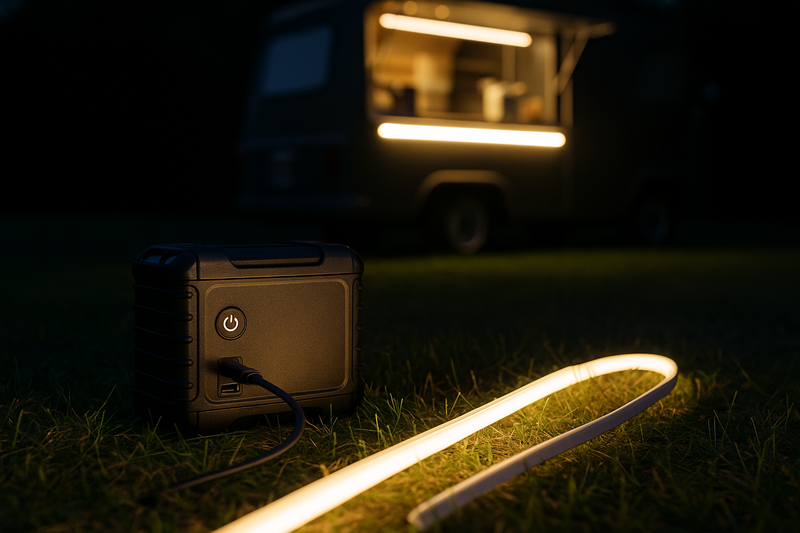
As an LED lighting solutions factory, I often get requests for systems that go beyond fixed installations. My clients need flexibility. Building a reliable, portable battery-powered system is straightforward when you understand the key components. It’s about creating freedom and professional-grade light, anywhere you need it.
What Are the Best Battery Types for Portable LED Strips?
You’re looking for a battery solution, but you’re faced with countless options: tiny USB power banks, heavy car batteries, and sleek rechargeable packs. You’re not sure which is safe, reliable, or powerful enough for your needs.
For small, short-term tasks, a high-output USB power bank with a 12V step-up converter can work. For professional use, a dedicated 12V LiFePO4 or Lithium-Ion battery pack is the best choice for its stability, safety, and long life.
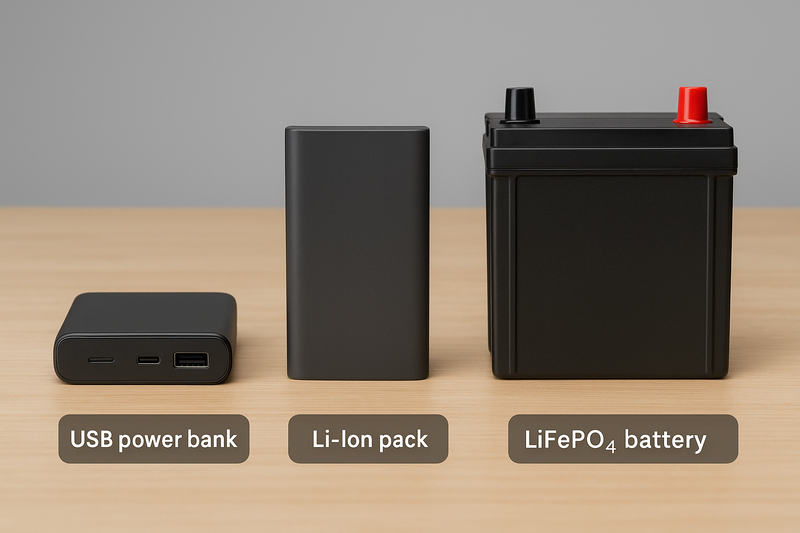
I always advise my clients to match the battery to the job. A small battery for a small job is fine, but for professional applications where failure is not an option, investing in a purpose-built battery pack is essential. It’s the difference between a hobby-grade solution and a commercial-grade tool.
Comparing Your Power Options
Let’s look at the pros and cons of the most common choices.
1. USB Power Banks (5V)
These are common for charging phones. To use them for 12V strips, you need a special "step-up converter" cable that changes the 5V output to 12V. This is only suitable for very short, low-power strips (typically under 2 meters). The conversion process is inefficient and the power output is very limited.
2. Sealed Lead Acid (SLA)
This is older technology, often found in emergency lighting or uninterruptible power supplies (UPS). They are inexpensive and can provide high current, but they are extremely heavy and have a very limited cycle life, meaning they wear out after a few hundred charge cycles. They also don’t like to be drained completely.
3. Lithium-Ion (Li-Ion) / Lithium-Polymer (LiPo)
This is the modern standard for portable electronics. These batteries offer excellent energy density, meaning they pack a lot of power into a lightweight package. They are a great all-around choice.
4. Lithium Iron Phosphate (LiFePO41)
For professionals, this is the ultimate choice. LiFePO41 batteries are a type of lithium-ion battery that is incredibly safe, thermally stable, and offers an extremely long cycle life2—often several thousand charge cycles. They are slightly heavier than standard Li-Ion but are the most durable and reliable choice for long-term, repeated use.
| Battery Type | Portability | Cycle Life (Charges) | Safety | Best Use Case |
|---|---|---|---|---|
| USB Power Bank | Excellent | Medium (~500) | Good | Tiny strips for a few hours of accent light. |
| SLA Battery | Poor (Heavy) | Low (~200-400) | Good | Inexpensive, high-power, but not portable. |
| Li-Ion/LiPo | Very Good | Medium (~500-800) | Good | General-purpose portable lighting. |
| LiFePO41 | Good | Excellent (2000+) | Excellent | Professional, repeated, heavy-duty use. |
How Do You Calculate How Long the Battery Will Last?
The worst-case scenario is your lighting rig dying halfway through a wedding reception or a night market. You’re just guessing how long the battery will last, creating a huge risk for your project’s success and your reputation.
To calculate runtime, divide the battery’s capacity in Watt-hours (Wh) by the LED strip’s total power consumption in Watts. For a safety margin, assume you will only use 80% of the battery’s capacity.

This is the most important calculation for any portable lighting project. I walk my clients through this to take the guesswork out of the system. Knowing your runtime gives you and your customer confidence that the lights will stay on for the entire duration they are needed.
The Simple Math of Runtime
Follow these steps to get a reliable estimate.
Step 1: Find Your Strip’s Total Power (Watts)
This is how much energy the strip consumes.
- Formula: (Strip Power in Watts/meter) x (Total Length in meters) = Total Watts.
- Example: You have a 4-meter strip that uses 5 Watts per meter. Your calculation is: 5 W/m * 4m = 20 Watts.
Step 2: Find Your Battery’s Capacity (Watt-hours)
Battery capacity is often listed in Amp-hours (Ah) or milliamp-hours (mAh). You must convert this to Watt-hours (Wh).
- Formula: (Amp-hours) x (Voltage) = Watt-hours.
- Example: You have a 10Ah, 12V battery. Your calculation is: 10Ah * 12V = 120 Wh.
Step 3: Calculate the Ideal Runtime
- Formula: (Battery Wh) / (Strip Watts) = Runtime in Hours.
- Example: 120 Wh / 20 W = 6 Hours.
Step 4: Apply the Professional Safety Margin3 (80% Rule)
You should never drain a rechargeable battery completely, as this shortens its life. Plan to only use 80% of its capacity.
- Formula: (Ideal Runtime) x 0.8 = Realistic Runtime4.
- Example: 6 Hours * 0.8 = 4.8 Hours of reliable runtime.
| Battery Capacity (12V) | Strip Power | Ideal Runtime | Realistic Runtime (80%) |
|---|---|---|---|
| 5 Ah (60 Wh) | 10 Watts | 6 Hours | 4.8 Hours |
| 10 Ah (120 Wh) | 20 Watts | 6 Hours | 4.8 Hours |
| 20 Ah (240 Wh) | 20 Watts | 12 Hours | 9.6 Hours |
Which LED Strips Work Best with Battery Power?
You connect a power-hungry, ultra-bright LED strip to your new battery pack. It looks fantastic for about an hour, but then the battery is completely dead, long before your event is over.
The best LED strips for battery power are highly efficient 12V models. Look for strips with a high lumen-per-watt (Lm/W) rating and consider using lower-wattage strips designed for accents to maximize your runtime.

As a manufacturer, I always guide my clients to see the system as a whole. For battery applications, the strip’s efficiency is just as important as the battery’s capacity. A more efficient strip is like getting a bigger battery for free, because it makes the power you have last so much longer.
Choosing the Right Light Load
Every watt you save on the strip directly translates to more runtime.
Efficiency Is Your #1 Priority
We’ve discussed luminous efficacy (Lumens per Watt) before, and for battery power, it is the most critical factor. A strip that produces 120 Lm/W will run 50% longer on the same battery than a strip that only manages 80 Lm/W while producing the exact same amount of light. The small extra cost for a high-efficiency strip pays for itself instantly in extended runtime.
Lower Wattage for Longer Life
Not every application needs blinding light. For many portable uses—like lighting inside a tent, under a market stall counter, or along a decorative frame—a lower-power accent strip is perfect. A strip that consumes only 2-4 Watts per meter will run three to five times longer than a bright, 10-15 Watt per meter strip on the same battery.
12V is the Convenient Choice
While 24V is more efficient for very long permanent installations, most portable applications use shorter strip lengths and prioritize convenience. 12V batteries5 and accessories are extremely common, widely available, and generally less expensive, making 12V the practical standard for most portable, battery-powered systems.
| Strip Type | Power Draw (per meter) | Best For | Impact on Battery Life |
|---|---|---|---|
| High-Power Strip | 10-15 Watts | Bright task lighting, but for short durations. | Drains battery quickly. |
| Low-Power Accent Strip6 | 2-5 Watts | Ambiance, accents, indirect glows. | Excellent, long runtime. |
| High-Efficacy Strip | 5-8 Watts | Achieving good brightness efficiently. | Very Good. |
How Do You Safely Connect Everything Together?
You have your battery and your LED strip, but you’re just looking at a set of bare red and black wires. You know that a wrong connection could create a spark, damage your components, or even be a safety risk.
To connect them safely, use polarized connectors like DC barrel plugs. Most importantly, always install a correctly-rated in-line fuse between the battery’s positive terminal and the LED strip to protect against short circuits.

This step is non-negotiable for any professional system. As a factory owner, I am obsessed with safety and reliability. A fuse is the cheapest insurance you can buy for your equipment. It protects the battery from dangerous shorts and protects your expensive LED strip from potential damage.
Your Safety and Connection Checklist
A clean, fused, and secure connection is the mark of a pro.
1. Use Proper Connectors
Don’t just twist wires together and wrap them in electrical tape. This is unreliable and unsafe. Use standard connectors that are easy to plug and unplug.
- DC Barrel Plugs (5.5mm x 2.1mm): This is the most common and convenient type. The center pin is positive, and the outer shell is negative.
- SAE Connectors: These are robust, weatherproof, and great for outdoor use.
2. The Critical In-Line Fuse
A fuse is a simple device designed to blow and break the circuit if the current gets too high (e.g., if the wires short out). This prevents the battery from overheating and causing a fire.
- How to Size it: Calculate your strip’s current draw (Amps = Watts / Volts). Choose a fuse rated slightly higher than that. For a 20-Watt, 12V strip that draws 1.67A, a 2A or 3A fuse is perfect.
3. Check Polarity
LED strips are diodes; electricity only flows one way. Connecting positive to negative and negative to positive will not work and can sometimes damage the strip. Always match the red wire (+) from the battery to the positive wire/pad on the strip, and black (-) to negative.
| Connection Step | Why It’s Important | Professional Tool/Component |
|---|---|---|
| Use Connectors7 | Ensures a reliable, secure, and safe connection. | DC Barrel Plugs, SAE Connectors |
| Check Polarity (+/-)8 | LEDs won’t work if wired backward. | Multimeter, looking at wire colors (red/black) |
| Install Fuse | CRITICAL: Protects against fire from short circuits. | In-line fuse holder and correctly rated fuse. |
| Waterproof | Prevents shorts and corrosion in outdoor use. | Heat-shrink tubing, weatherproof enclosure. |
Conclusion
Battery power provides the ultimate freedom for lighting. By choosing an efficient LED strip, correctly calculating your runtime, selecting the right battery, and using safe, fused connections, you can create a reliable, professional-grade portable lighting solution.
-
Explore the advantages of LiFePO4 batteries for safety and longevity, ideal for professionals seeking reliable energy solutions. ↩ ↩ ↩
-
Understanding cycle life is crucial for selecting the right battery; this resource will help you make informed decisions. ↩
-
Understanding the Professional Safety Margin can help you maximize battery life and efficiency. ↩
-
Learning to calculate Realistic Runtime ensures you get the most out of your rechargeable batteries. ↩
-
Explore the benefits of 12V batteries, including cost-effectiveness and availability, for your portable power needs. ↩
-
Discover how Low-Power Accent Strips can enhance ambiance while conserving battery life, perfect for your lighting projects. ↩
-
Exploring the importance of connectors can enhance the reliability and safety of your LED strip projects. ↩
-
Understanding the consequences of incorrect wiring can help prevent damage to your LED strips. ↩