Your client’s master bedroom has beautiful furniture and high-end finishes, but at night, it feels cold and uninviting. The harsh overhead light kills the mood, and the bedside lamps create pools of intense glare, failing to create a true sanctuary.
Use indirect, dimmable LED strips to layer soft, warm light from hidden sources. Focus on backlighting furniture, illuminating coves, and highlighting architectural details to transform the bedroom from a simple sleeping space into a personal, five-star retreat.
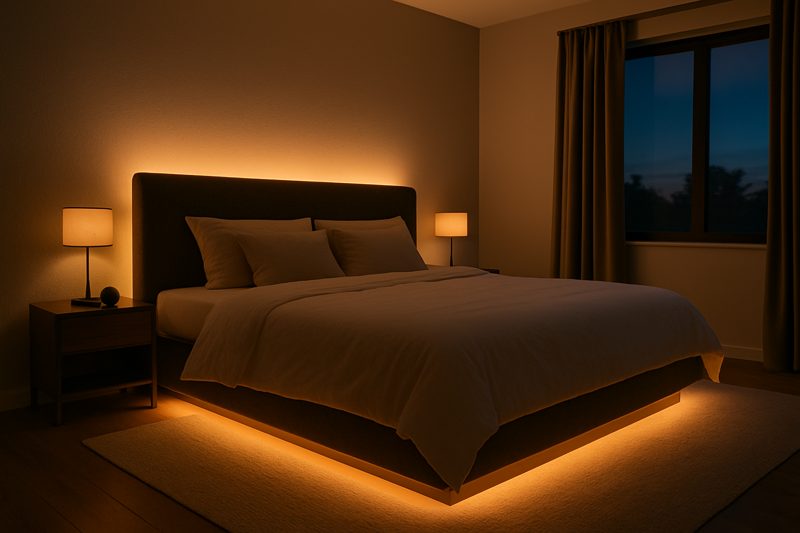
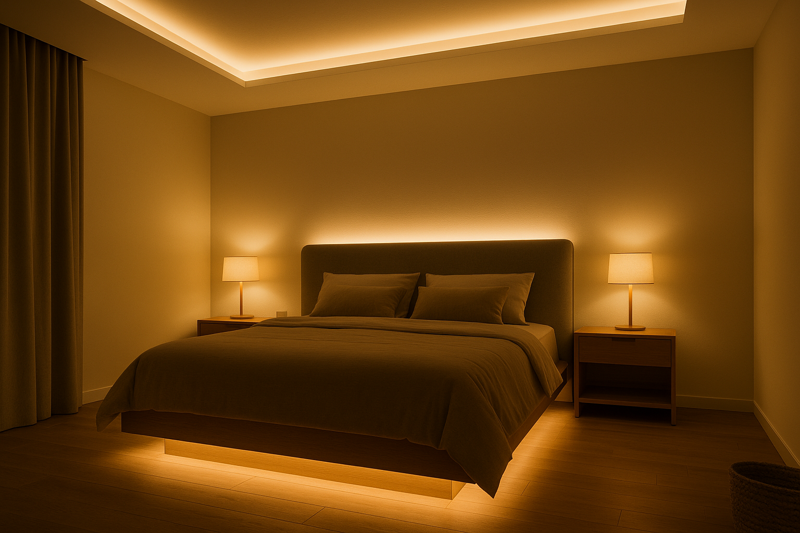
I once consulted on a luxury apartment project. The lead designer was very particular. For the master suites, she said, "Jermey, I don’t want anyone to see a light fixture. I want the room to simply glow." She wanted the light to feel like it was a natural part of the architecture. We ended up using LED strips in just three places: a continuous line hidden in a ceiling cove, a soft halo behind the upholstered headboards, and a gentle light source under the floating nightstands. The result was breathtaking. The room felt calm, spacious, and incredibly luxurious. It taught me a powerful lesson: in a bedroom, the most effective light is often the light you can’t see.
What’s the Best Way to Use LED Strips Around the Headboard?
The bedside lamps are too bright for one partner to read while the other sleeps. They take up valuable space on the nightstand and create harsh, functional light instead of a soft, relaxing glow that helps you wind down.
Install a dimmable, warm-white LED strip on the back of the headboard to create a "halo" of soft, indirect light. This provides perfect, low-glare ambient lighting for reading and relaxation, frees up nightstand space, and adds a high-end, "hotel-chic" design element.
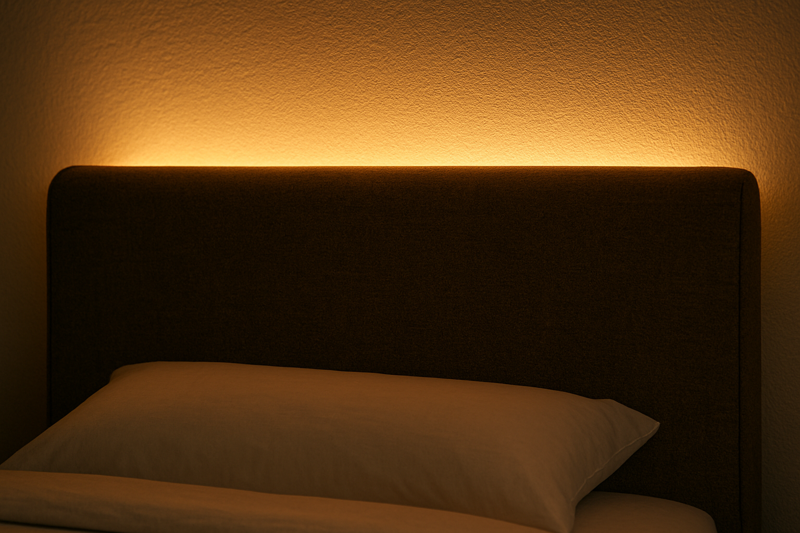
A hotel designer I supply is a master of this technique. He told me that a backlit headboard is one of his signature moves because it achieves three things at once. First, it creates an instant focal point and makes the bed the hero of the room. Second, it provides functional reading light that is soft and diffuse, so it’s less likely to disturb a sleeping partner. Third, he connects it to a separate, easy-to-reach switch, so guests don’t have to fumble for a lamp switch in the dark. For his projects, we supply a 3000K, 90+ CRI strip. He insists on the high CRI because it makes the colors and textures of the expensive wall finishes and fabrics behind the bed look rich and accurate. It’s a simple detail that signals quality and thoughtful design to every guest who stays in the room.
The Headboard Halo: Your Blueprint for a Focal Point
Backlighting the headboard is the single most impactful LED strip application in the bedroom. It’s relatively simple to execute but delivers a dramatic and sophisticated result. Getting it perfect requires attention to a few key details.
-
Product Selection is Crucial:
- Color Temperature: For a bedroom, a warm color temperature is almost always the right choice. A 2700K or 3000K1 strip mimics the warm, calming glow of incandescent bulbs or candlelight, which can help promote relaxation and signal to your brain that it’s time to wind down. A cooler temperature like 4000K can feel too sterile or energetic for a primary relaxation space.
- Brightness (Lumens): You don’t need intense brightness here. The goal is a soft glow, not a task light. A strip with an output of around 200-300 lumens per foot2 is typically sufficient. The key is to pair it with a good quality dimmer so the user can adjust the intensity from a gentle nightlight level to a comfortable reading level.
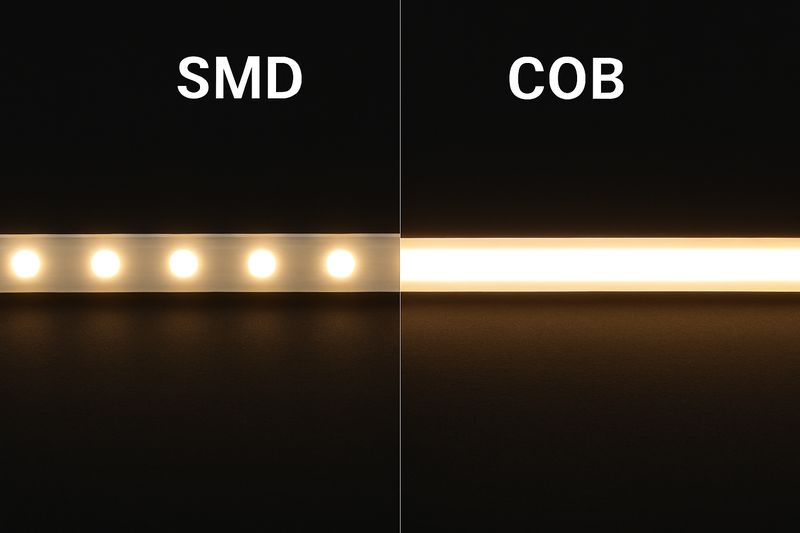
- Diffusion: Even though the strip is hidden, using a strip with a frosted cover or a COB strip (Chip on Board) can help if the wall behind the headboard has a slight sheen. It ensures the light that washes up the wall is perfectly smooth and even.
-
Installation Technique:
- Placement: The goal is to create an even "wash" of light on the wall. Mount the strip a few inches in from the edges of the headboard. You can run it along the top and the two sides. Use a small aluminum channel to help with heat dissipation and to angle the light slightly away from the headboard and onto the wall.
- Wiring: The wiring must be completely hidden. The easiest way is to drill a small hole through the headboard or position the strip so the lead wire can drop down behind it, completely out of sight. The low-voltage wire can then run under the bed or behind the baseboard to the power supply and controller.
- Control: Control needs to be intuitive. A wireless RF remote kept on the nightstand is a good option. An even better one is a low-profile switch or dimmer that can be discreetly mounted on the side of the headboard or the nightstand. For a fully integrated smart home, a Zigbee or Wi-Fi controller allows the headboard light to be part of a "Goodnight" scene.
| Aspect | Recommendation | Why It Matters |
|---|---|---|
| Color Temp (CCT) | 2700K – 3000K | Promotes relaxation and a cozy atmosphere conducive to sleep. |
| CRI | 90+ | Renders wall colors, paint textures, and fabric tones accurately. |
| Control | Dimmable is essential3 | Allows user to adjust light from reading level to a subtle nightlight. |
| Placement | 2-3 inches from the edge, facing the wall | Creates a soft, even halo effect and avoids visible hot spots. |
How Can "Invisible" Light Make a Bedroom Feel Larger?
The client has a smaller bedroom or a room with low ceilings. They’re worried it will feel cramped and claustrophobic, especially at night. Direct light from ceiling fixtures or lamps seems to shrink the space and create harsh shadows.
Use concealed LED strips in ceiling coves and under furniture to create indirect light. This technique washes light across ceilings and floors, blurring the room’s hard edges and creating an illusion of height and depth. The room feels more spacious, open, and serene.
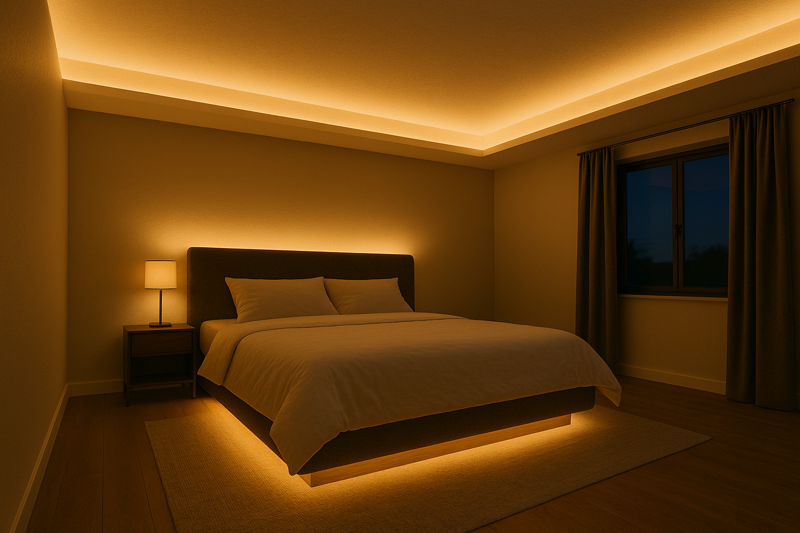
I worked with an architect who was designing a series of modern, minimalist homes. The bedrooms were not huge, so creating a sense of spaciousness was his top priority. Instead of standard ceiling lights, he designed a simple perimeter cove, about 6 inches down from the ceiling and 6 inches out from the wall. We installed our 24V strips inside this cove, pointing upwards. When the lights were on, the entire ceiling plane was bathed in a soft, even glow. This technique, called uplighting, completely draws your eye upward, making the ceiling feel much higher than it actually is. We paired this with strips under the "floating" bed frames. By illuminating both the highest and lowest horizontal planes of the room with hidden sources, the walls seemed to recede. The rooms felt double their actual size.
The Art of Architectural Integration
This is about using light as a building material. By hiding the source and focusing on the effect, you can fundamentally change the perception of a space.
-
Ceiling Cove Lighting4: This is the most effective way to add ambient light and a sense of height.
- How it Works: A cove is a ledge or trough built along the perimeter of the room, typically a few inches below the ceiling. The LED strip is placed inside, aimed at the ceiling. The light bounces off the ceiling and reflects down, filling the entire room with soft, shadowless ambient light.
- Best Practices: Always aim the strip up and slightly away from the back wall of the cove to get the smoothest gradient of light across the ceiling. Use a 24V system to ensure consistent brightness on long, continuous runs around the entire room. A dimmable, warm-white strip (3000K) is a perfect choice to create a relaxing atmosphere.
-
The "Floating" Bed Effect:
- How it Works: This involves mounting LED strips to the underside of the bed frame, recessed a few inches from the edge. It’s especially effective on modern platform beds. The light spills out onto the floor, creating a glowing perimeter that makes the bed appear to be levitating.
- Practical Benefits: This is not just a cool design trick; it’s an amazing nightlight. It provides just enough light to see for a late-night trip to the bathroom without being jarring or waking a partner. Connecting it to a motion sensor is a popular high-end upgrade, so the light fades on automatically when you get out of bed.
-
Floating Nightstands and Dressers5:
- How it Works: The same principle as the floating bed applies to wall-mounted furniture. Placing a strip on the underside of a floating nightstand or a long, wall-hung dresser enhances the effect and provides another layer of soft, low-level accent light. It turns a simple piece of furniture into a deliberate architectural feature.
These techniques work because they focus light on the surfaces of the room (the ceiling, the floor) rather than projecting it directly into the space. This indirect approach6 is always easier on the eyes and creates a more sophisticated and calming environment.
Why is High-CRI Lighting Essential for a Walk-In Closet?
Your client has invested in a beautiful, custom walk-in closet. But under the standard overhead light, a navy blue suit looks black, and a beige sweater looks grey. Getting dressed becomes a guessing game, and the luxurious closet feels functionally useless.
Use High-CRI (90+) LED strips for all closet lighting. This is the only way to ensure that the colors of clothing, shoes, and accessories are rendered accurately. It transforms a simple storage space into a functional and elegant personal boutique.
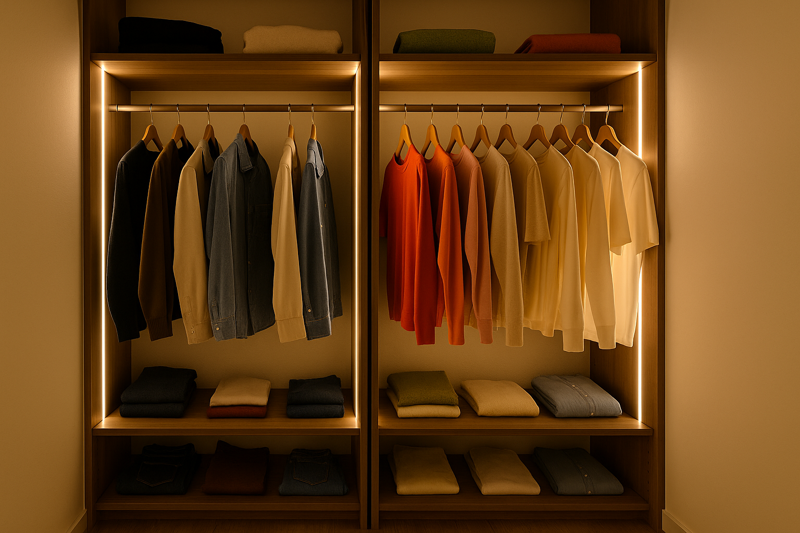
I supply a company that specializes in building custom closets for multi-million dollar homes. Their owner is a fanatic about light quality. He told me, "My clients are spending a fortune on designer clothes and handbags. My job is to make those items look as good in their closet as they did in the showroom." For him, high-CRI lighting is not an option; it’s a requirement. We developed a system for him using our 95 CRI strips integrated directly into the vertical standards of the closet system and under each hanging rod. The light is perfectly even, with no shadows. When a client can clearly see the difference between their five black sweaters, or match a handbag to a pair of shoes perfectly, the value of the closet system becomes undeniable.
Building a Personal Showroom
A modern luxury closet is more than storage; it’s a dressing room and a display space. The lighting must perform accordingly.
-
The CRI Imperative: As we’ve discussed, Color Rendering Index (CRI)7 is key. Natural daylight has a CRI of 100. For a closet, you want to get as close to that as possible. A CRI of 90 or above is the professional standard. An 80 CRI light might be acceptable in a hallway, but in a closet, it will fail. It will distort colors, making it impossible to coordinate outfits. When you pitch this to your client Tom, frame it as a functional necessity: "High-CRI lighting ensures your investment in your wardrobe is protected because you can see the true colors."
-
Strategic Placement: Don’t rely on a single overhead fixture. That’s the worst possible choice, as it will be blocked by your own body, casting shadows on the very clothes you’re trying to see. The best approach is to integrate light vertically.
- Vertical Illumination8: Mount LED strips on the front interior edge of the closet partitions, running from top to bottom. This illuminates the entire height of the clothing, from the shelf above to the shoes on the floor.
- Integrated Rod Lighting9: Use an aluminum channel with a built-in closet rod profile. The LED strip sits inside the rod, shining down directly onto the shoulders of the hanging clothes. This is the ultimate in high-end, integrated design.
- Shelf Lighting: For shelves displaying shoes, handbags, or folded sweaters, place a strip at the front of each shelf, hidden behind a small lip or inside a 45-degree channel to direct light onto the items.
-
Color Temperature: While bedrooms benefit from warm light, a closet is a decision-making space. A more neutral color temperature, like 4000K10, is often the best choice. It mimics natural daylight and provides clean, clear light for color matching. Some clients may still prefer the warmth of 3000K to match the bedroom, but 4000K is arguably more functional.
| Location | Recommended Strip | Why it Works |
|---|---|---|
| Vertical Cabinet Edges | 4000K, 95 CRI, Medium Output | Provides even, shadowless light on hanging clothes, ensuring true color. |
| Under Hanging Rods | 4000K, 95 CRI, in a Rod Profile | A sleek, integrated solution that puts light exactly where it’s needed. |
| Shelves for Shoes/Bags | 3000K/4000K, 95 CRI, Low Output | Turns stored items into a beautiful, boutique-style display. |
| Drawer Interiors | 3000K, Lowe Output, with Sensor | A touch of luxury that makes finding small items like socks or ties easy. |
Conclusion
Bedroom lighting should be personal, comfortable, and intuitive. By layering indirect light from hidden LED strips, you move beyond simple illumination and begin designing with ambiance itself. It’s how you create a true sanctuary for your clients.
-
Understanding color temperature can help you create a relaxing atmosphere in your bedroom. ↩
-
Learn about lumens to ensure your bedroom lighting is soft and inviting, perfect for relaxation. ↩
-
Discover the benefits of dimmable lighting for creating the perfect ambiance in your bedroom. ↩
-
Explore how Ceiling Cove Lighting can transform your space with ambient light and enhance the overall aesthetic. ↩
-
Learn about the benefits of Floating Nightstands and Dressers and how they can elevate your interior design. ↩
-
Understand the significance of an indirect approach in lighting design for creating a sophisticated and calming environment. ↩
-
Understanding CRI is crucial for achieving accurate color representation in your luxury closet. ↩
-
Explore how vertical illumination can eliminate shadows and enhance visibility in your closet. ↩
-
Discover how integrated rod lighting provides sleek, functional illumination for your clothing. ↩
-
Learn why 4000K mimics natural daylight and is ideal for color matching in closets. ↩