Planning an outdoor LED lighting project and wondering if any LED power supply will do? Using the wrong one can lead to flickering lights, premature failure, or even serious safety hazards in wet conditions.
Yes, outdoor LED strips generally require special power supplies, often called drivers. These power supplies should be IP-rated (e.g., IP67) for water and dust resistance if exposed to the elements, and must match the voltage and wattage requirements of the LED strips.
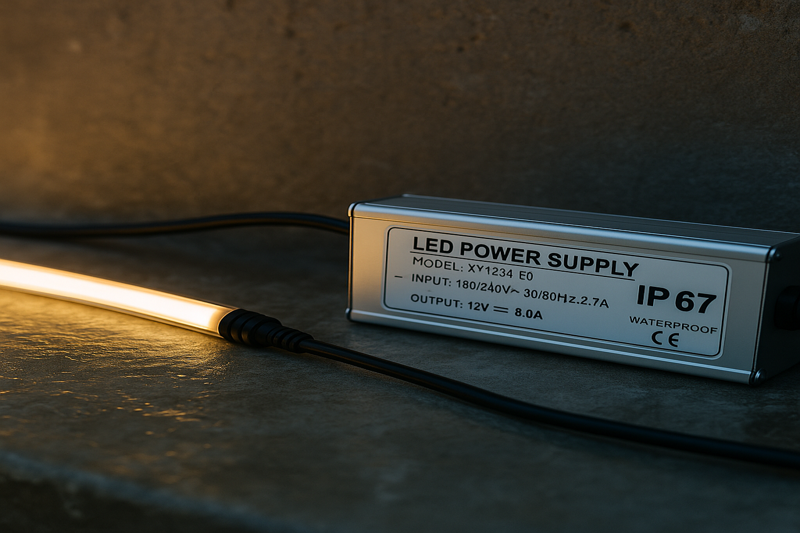
As a factory owner at Rhlite, providing complete LED strip light solutions, I’ve seen countless projects. The success of an outdoor installation hinges just as much on the power supply as on the LED strips themselves. Clients like Tom, who source lighting for significant projects in North America or Japan, understand that a high-quality, appropriate power supply isn’t an optional extra; it’s a critical component for reliability and safety, especially when dealing with outdoor environments. Let’s explore why.
What Makes a Power Supply "Special" for Outdoor Use?
You’ve selected your IP67 LED strips for that beautiful garden path. But can you just grab any leftover 12V or 24V power adapter you have lying around? The answer is a firm no, especially if you want it to last and be safe.
A power supply "special" for outdoor use must primarily offer robust protection against environmental factors like water and dust (indicated by its IP rating). It also needs stable voltage output, adequate wattage, and safety certifications suitable for the region of installation.
When we talk about "special" power supplies for outdoor LED strips, we’re not just talking about a fancy label. We’re referring to specific design and construction features that enable them to withstand the harsh conditions found outdoors. For my B2B clients like distributors and contractors, providing the correct power supply is as crucial as the LED strip quality itself. An unsuitable power supply can undermine even the best LED strips, leading to callbacks and unhappy customers – a major pain point.
Key Features of Outdoor-Rated LED Power Supplies:
-
Ingress Protection (IP Rating): This is paramount.
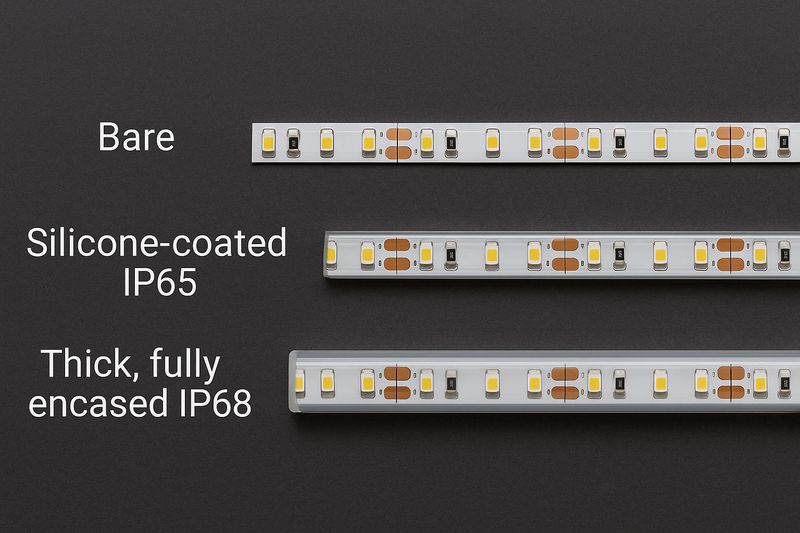
- An outdoor power supply, if it’s going to be exposed to rain, sprinklers, or dust, needs a high IP rating, typically IP65, IP67, or even IP681 in some cases.
- IP65: Dust-tight and protected against water jets (e.g., rain, hose).
- IP67: Dust-tight and protected against temporary immersion in water (up to 1m for 30 mins). This is a common and reliable choice for many outdoor LED power supplies we offer at Rhlite.
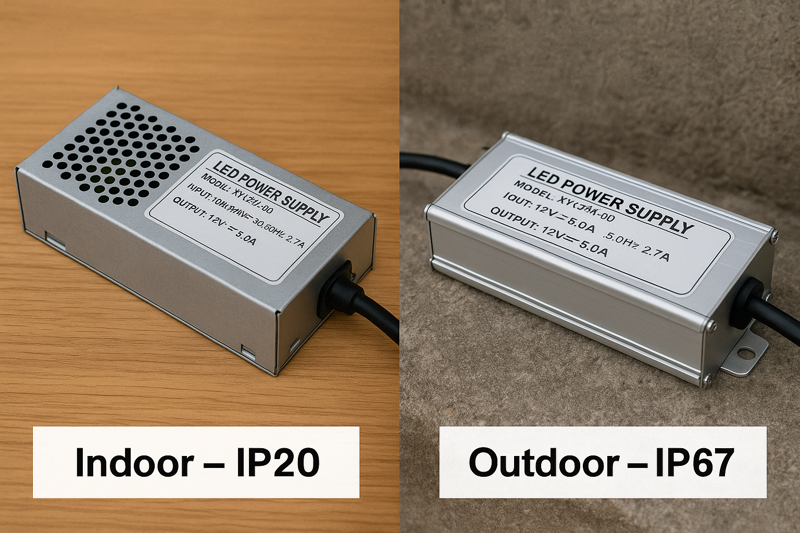
- An indoor power supply (e.g., IP20, which has no water protection) will fail quickly if exposed to moisture. Even if installed in a "sheltered" outdoor spot, condensation can be a killer.
-
Durable Housing and Components2:
- The casing is often made from robust materials like sealed aluminum or high-impact, UV-stabilized plastic.
- Internal components may be potted (encapsulated in resin) to protect them from moisture and vibration.
- Connectors and cable entry points must be waterproof (e.g., using sealed cable glands).
-
Stable Voltage and Current Output:
- LEDs are sensitive to voltage fluctuations. A quality outdoor power supply provides consistent DC voltage (e.g., 12V or 24V) as specified for the LED strips.
- Poor quality power supplies can have unstable output, leading to flickering, reduced LED lifespan, or color shifts.
-
Appropriate Wattage Capacity (with a buffer):
- The power supply must be able to handle the total wattage of the connected LED strips. It’s recommended to choose a power supply with about 20% more wattage capacity than the total load to prevent overworking and ensure longevity.
-
- Look for certifications relevant to your region (e.g., UL for North America, CE for Europe, PSE for Japan). This indicates the power supply has been tested for safety and compliance. This is a key sourcing point for clients like Tom who need to ensure products meet local standards.
Using a standard indoor power supply outdoors, even if you try to protect it in a makeshift enclosure, is risky. These enclosures might not be truly waterproof, and the power supply itself isn’t designed for the temperature swings and humidity levels of an outdoor environment.
| Feature | Standard Indoor Power Supply (e.g., IP20) | Outdoor-Rated Power Supply (e.g., IP67) | Why it Matters for Outdoor LED Strips |
|---|---|---|---|
| IP Rating | Low (IP20-IP44), no/little water protection | High (IP65-IP68), dust & water protection | Essential for survival against rain, moisture, dust |
| Housing Material | Often plastic, ventilated | Sealed aluminum, robust plastic, potted internals | Durability, corrosion resistance, moisture barrier |
| Connectors/Cables | Open terminals, standard cables | Waterproof connectors, sealed cable glands | Prevents water ingress at critical points |
| Temperature Tolerance | Limited range | Wider operating temperature range | Handles outdoor temperature swings better |
| Safety Certifications | May be basic or region-specific | Region-specific (UL, CE, PSE), more rigorous | Ensures safety and compliance for outdoor use |
The "special" nature of an outdoor power supply is all about its ability to reliably and safely deliver power in challenging conditions.
Why is the IP Rating of a Power Supply Crucial for Outdoor LED Strips?
We’ve mentioned IP ratings, but why is this specific feature so absolutely vital when choosing a power supply for your outdoor LED strip lights? It might seem like just a number, but it represents a critical defense mechanism.
The IP rating of a power supply is crucial because it indicates its level of protection against solid objects (like dust) and liquids (like rain or sprinklers). An inadequate IP rating for an outdoor environment will lead to rapid failure and potential electrical safety hazards.
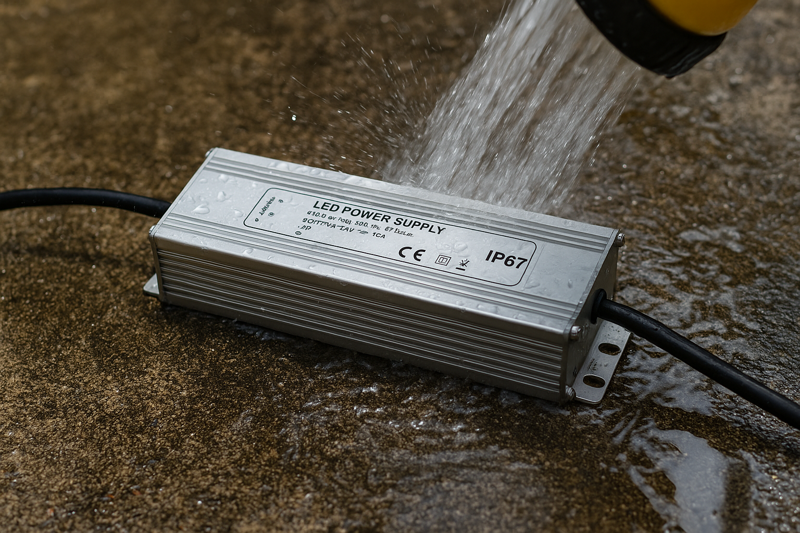
Imagine this: you’ve installed beautiful, high-quality Rhlite outdoor LED strips. But the power supply, hidden away, is a standard indoor model. The first heavy rainstorm, or even persistent high humidity, and that power supply is compromised. This is a scenario I always caution my clients against. For someone like Tom, sourcing for projects where reliability is key, a power supply failure due to incorrect IP rating means costly call-backs and reputational damage.
Breaking Down the IP Rating Impact:
-
First Digit (Solids Protection):
- For outdoor power supplies, you’ll typically see a ‘6’ (e.g., in IP67). This means it’s Dust Tight4.
- Why it matters: Dust, especially when combined with moisture, can become conductive, leading to short circuits. It can also clog any ventilation (though outdoor PSUs are often fully sealed) and cause overheating in non-sealed units.
-
Second Digit (Liquids Protection): This is where the major differences lie for outdoor use.
- IPX4 (Splash Proof): Might survive a light splash but not direct rain or jets. Generally insufficient for exposed outdoor power supplies.
- IPX5 (Water Jets)5: Protected against water jets from any direction (e.g., rain, garden hose). A common minimum for "weatherproof" power supplies if somewhat sheltered.
- IPX7 (Temporary Immersion)6: Protected against immersion in water up to 1 meter for 30 minutes. This is a very common and robust rating for outdoor LED power supplies, like many Rhlite models. It handles heavy rain, puddles, and accidental brief submersion.
- IPX8 (Continuous Immersion): For use when the power supply might be continuously submerged (conditions specified by manufacturer). Less common for general LED strip lighting power supplies, more for specialized underwater junction boxes.
Consequences of Using an Incorrectly Rated Power Supply Outdoors:
- Short Circuits and Electrical Faults: Water ingress is the primary enemy. It can bridge electrical contacts, leading to short circuits.
- Corrosion: Moisture accelerates corrosion of internal components and connectors, leading to intermittent operation or complete failure.
- Safety Hazards: A compromised power supply can pose a risk of electric shock, especially in wet outdoor environments. This is a critical safety concern.
- Reduced Lifespan of LEDs: Unstable or fluctuating power from a failing power supply can damage the connected LED strips.
- Voided Warranties: Using an indoor power supply in an outdoor application will almost certainly void the warranty of both the power supply and potentially the LED strips.
I recall a case where a landscape contractor in the US tried to save money by using indoor-grade power supplies housed in what they thought were waterproof boxes. However, the boxes weren’t truly sealed against driving rain, and condensation also formed inside. Multiple power supplies failed within the first season, leading to significant costs to replace them with proper IP67 units. This highlights how crucial the inherent IP rating of the power supply itself is.
| IP Rating Example | Solid Protection | Liquid Protection | Suitability for Exposed Outdoor PSU | Rhlite Recommendation |
|---|---|---|---|---|
| IP20 | Touch by fingers | No protection | Unsuitable | For indoor, dry locations ONLY |
| IP44 | Tools, wires | Splashing water | Marginal; only for very sheltered, indirect exposure spots | Not recommended for reliable outdoor use |
| IP65 | Dust Tight | Water jets (e.g., rain, hose) | Good for many outdoor uses, especially if slightly sheltered | A good baseline for some Rhlite PSUs |
| IP67 | Dust Tight | Temporary Immersion (up to 1m for 30 mins) | Excellent for most exposed outdoor locations | Preferred Rhlite PSU rating for outdoor |
| IP68 | Dust Tight | Continuous Immersion (conditions specified by mfr.) | Overkill for most PSUs unless it’s in a flood-prone pit | Specialized applications |
The IP rating isn’t just a feature; it’s a fundamental requirement for the safety and longevity of outdoor LED power supplies.
What Voltage and Wattage Considerations are Important for Outdoor LED Power Supplies?
Beyond just being weatherproof, the power supply must also be electrically compatible with your outdoor LED strips. Getting the voltage and wattage wrong can be just as detrimental as water ingress.
The power supply’s output voltage (e.g., 12V DC or 24V DC) must exactly match the LED strip’s required voltage. Its wattage capacity should be at least 20% greater than the total wattage of all connected LED strips to ensure safe, efficient operation.
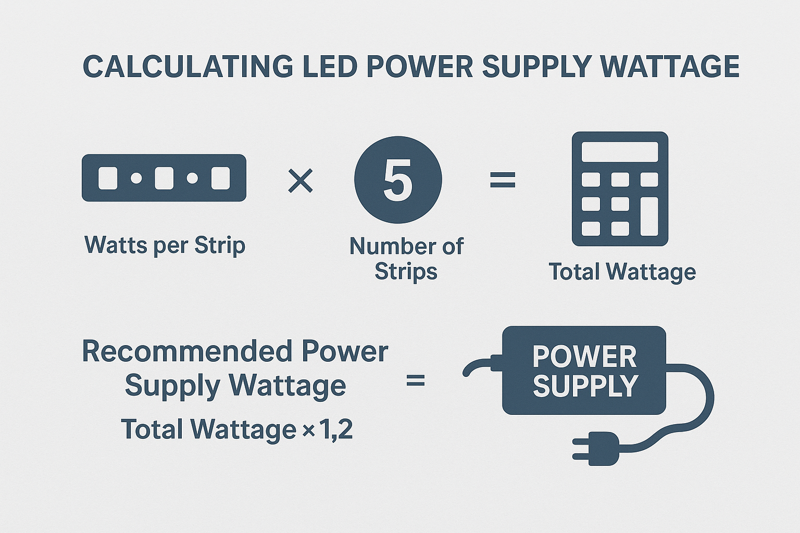
This is a technical aspect where precision matters. At Rhlite, we always ensure our clients understand these calculations, as it’s vital for system performance and longevity, whether they’re lighting designers planning intricate layouts or distributors stocking products. Incorrect voltage or insufficient wattage can lead to immediate problems or slow degradation of the LED system – pain points for any buyer.
Voltage Matching:
- Check Your LED Strip: LED strips are designed to operate at a specific DC voltage, most commonly 12V DC or 24V DC. This will be clearly marked on the strip or its packaging.
- Match the Power Supply: The output voltage of the power supply must match this.
- Using a 24V power supply with a 12V LED strip will instantly destroy the strip.
- Using a 12V power supply with a 24V LED strip will result in very dim light or no light at all.
- Why 24V is Often Preferred for Longer Runs Outdoors: For longer outdoor LED strip runs, 24V systems are often preferred over 12V. This is because 24V systems experience less voltage drop over distance, meaning brightness remains more consistent along the length of the strip. They also allow for thinner gauge wires for the same power delivery, which can be an advantage in outdoor cabling. Many of Rhlite’s professional-grade outdoor strips are 24V.
Wattage Calculation and Safety Buffer:
- Determine LED Strip Wattage per Unit Length: This is usually specified in watts per meter (W/m) or watts per foot (W/ft). For example, a strip might be 14.4 W/m.
- Calculate Total Strip Wattage: Multiply the wattage per unit length by the total length of LED strip you’ll be connecting to one power supply.
- Example: 5 meters of 14.4 W/m strip = 5m * 14.4 W/m = 72 Watts.
- Add a Safety Buffer (Crucial!): Never run a power supply at its maximum rated capacity. This leads to overheating and drastically shortens its lifespan. The industry best practice is to load a power supply to no more than 80% of its rated capacity. This means choosing a power supply with at least 20% more wattage than your calculated load.
- Example: For a 72W load, you need a power supply of at least 72W / 0.8 = 90 Watts. So, a 100W power supply would be a good choice.
- Multiple Power Supplies for Large Installations: For very long runs or extensive outdoor lighting projects, it’s often necessary to use multiple power supplies. Each power supply will power a segment of the LED strips according to its wattage capacity.
A client once tried to power a very long run of our 24V outdoor LED strips with a single power supply that was technically just above the total wattage of the strips, without the 20% buffer. While it worked initially, the power supply ran very hot and failed within a few months. Splitting the run onto two appropriately sized power supplies solved the issue and ensured long-term stability.
| Voltage/Wattage Aspect | Action/Consideration | Why It’s Important | Rhlite Product Info Example |
|---|---|---|---|
| Voltage Matching | PSU Output Voltage = Strip Input Voltage (e.g., 24V=24V) | Prevents damage to strip or poor performance | Rhlite strips clearly state 12V or 24V requirement |
| Strip Wattage per Meter/Foot | Check product specification | Basis for total load calculation | e.g., "Rhlite X-Series: 10W/meter" |
| Calculate Total Load | (W/m) * Total Length (m) | Determines minimum PSU capacity needed | Essential step for any installation |
| Add 20% Wattage Buffer | Total Load / 0.8 = Min. PSU Wattage | Prevents PSU overheating, ensures longevity, safety | Standard Rhlite recommendation for all PSUs |
| Consider 24V for Long Runs | Reduces voltage drop, allows thinner wires | Better brightness consistency for extended lengths | Many Rhlite outdoor strips are 24V for this reason |
Getting voltage and wattage right is fundamental for a well-performing and long-lasting outdoor LED lighting system.
Can I Use an Indoor Power Supply Outdoors if it’s Placed in a Waterproof Enclosure?
This is a common question, often driven by attempts to save costs or use existing components. You have an indoor-rated LED power supply, and you’re thinking, "If I just put it in a good waterproof box, it’ll be fine outdoors, right?"
While technically possible if the enclosure is genuinely and reliably waterproof (e.g., NEMA 4X or IP67/IP68 rated), using an indoor power supply in an outdoor enclosure is generally not recommended due to risks of condensation, overheating, and compromised long-term reliability compared to a dedicated outdoor-rated power supply.
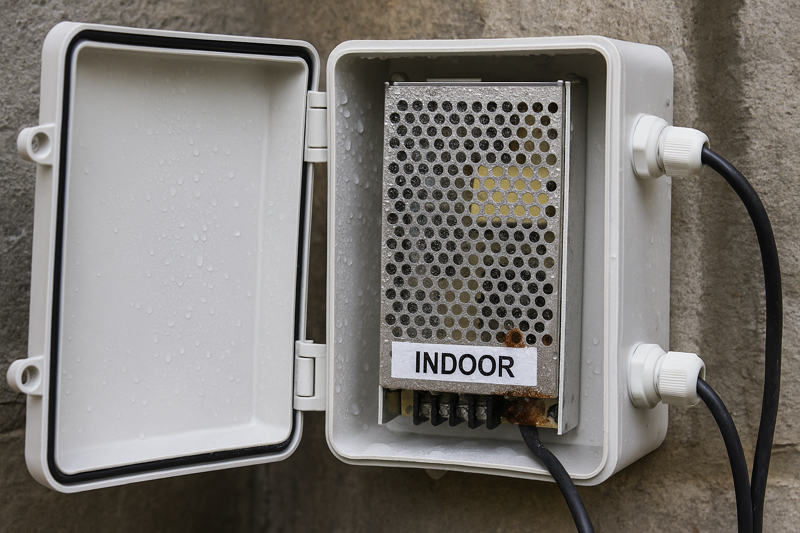
I understand the temptation. However, as a manufacturer (Rhlite) focused on quality and long-term solutions, this approach introduces variables and potential failure points that are best avoided. Even Tom, who looks for competitive prices, is sensitive to quality and would likely recognize the risks of such a workaround for critical projects.
Why This Approach is Risky:
- Condensation: This is the biggest enemy. Even if the enclosure is waterproof from the outside, temperature fluctuations between day and night can cause moist air trapped inside the enclosure to condense directly onto the indoor power supply. Indoor power supplies are not designed to handle this internal moisture.
- Heat Dissipation: Indoor power supplies often rely on ventilation holes for cooling. Placing them in a sealed enclosure can restrict airflow, leading to overheating and a significantly shortened lifespan or even failure. Dedicated outdoor power supplies are designed for sealed operation, often using the casing itself as a heat sink.
- Seal Integrity of the Enclosure:
- Achieving a truly long-term waterproof seal on an enclosure with cable entries can be tricky. Cable glands must be correctly sized and tightened. The enclosure’s gasket must be high quality and properly compressed.
- Over time, gaskets can degrade, or the enclosure might be inadvertently opened, compromising the seal.
- Component Tolerance: Indoor power supplies use components rated for a more stable indoor temperature and humidity range. Outdoor environments experience much wider swings, which can stress these components.
- Warranty Issues: Using an indoor power supply outside its intended environment, even in an enclosure, will likely void its warranty. If it fails and damages the LED strips, those warranties might also be affected.
- Certification Mismatch: The safety certifications (like UL or CE) for an indoor power supply are based on its use in an indoor environment. Its safety is not certified for outdoor conditions, even if boxed.
When Might It Be Barely Acceptable (with extreme caution)?
If, and only if:
- The enclosure is absolutely top-quality, IP67 or IP68 rated, with properly sealed cable glands.
- The indoor power supply is significantly de-rated (used at much less than its max wattage) to reduce heat.
- The climate is very mild with low humidity and minimal temperature swings (unlikely for most outdoor scenarios).
- You include desiccant packs inside the enclosure and check/replace them regularly (adds maintenance).
However, the cost of a high-quality IP67/IP68 enclosure, plus the risk and hassle, often makes it more economical and far more reliable to simply purchase a dedicated IP67 LED power supply from the outset. At Rhlite, we produce these precisely because they eliminate these headaches.
For instance, I’ve consulted on projects where cost-cutting led to indoor power supplies being used in junction boxes outdoors. The failure rate due to condensation, particularly in humid climates like Singapore or parts of North America, was unacceptably high. The cost of repeat site visits and replacements quickly negated any initial savings.
| Factor | Dedicated Outdoor PSU (e.g., Rhlite IP67) | Indoor PSU in "Waterproof" Enclosure | Recommendation |
|---|---|---|---|
| Moisture Protection | Designed & sealed against external & internal moisture | Relies entirely on enclosure; VULNERABLE TO CONDENSATION | Dedicated outdoor PSU is far superior |
| Heat Dissipation | Designed for sealed operation, often uses case as heatsink | Can overheat if enclosure restricts airflow | Outdoor PSU designed for this |
| Reliability & Lifespan | Generally higher due to robust design | Often lower due to stress from heat/moisture | Outdoor PSU for better ROI |
| Warranty | Valid for outdoor use | Likely voided | Clear advantage for outdoor PSU |
| Installation Simplicity | Simpler, fewer components | More complex (PSU + enclosure + sealing) | Outdoor PSU is easier and more foolproof |
| Overall Risk | Low | High | Strongly prefer dedicated outdoor power supply |
It’s almost always better to use a power supply specifically designed and certified for the demands of the outdoor environment.
Conclusion
Outdoor LED strips do need special, IP-rated power supplies that match their voltage and wattage, ensuring protection against weather and safe operation. Don’t compromise on this critical component.
-
Understanding these ratings helps ensure you choose the right outdoor power supply for your needs, protecting your investment. ↩
-
Durable housing ensures longevity and reliability in harsh outdoor conditions, making it essential for outdoor installations. ↩
-
Knowing the right certifications ensures compliance and safety, protecting both users and equipment in various regions. ↩
-
Understanding the significance of ‘Dust Tight’ can help you choose the right outdoor power supply for your needs. ↩
-
Discover the importance of the IPX5 rating to ensure your power supply is protected against water jets and rain. ↩
-
Learn about the IPX7 rating to ensure your outdoor power supply can withstand heavy rain and brief submersion. ↩