Choosing outdoor LED strips can be confusing with all the technical terms. Brightness, LED density, and power ratings are key, but what do they really mean for your outdoor project?
Understanding an LED strip’s brightness (lumens), LED density (LEDs per meter), and power consumption (watts per meter) is vital. These specs determine its light output, visual smoothness, and energy use for outdoor applications.
As the owner of Rhlite, a factory committed to one-stop LED strip solutions, I often guide clients through these specifications. For professionals like Tom, whether he’s a lighting designer in the US or an OEM client sourcing for projects in Japan, grasping these details ensures the chosen outdoor LED strip performs exactly as needed. Let’s break them down.
What Does LED Brightness (Lumens) Tell Us About Outdoor LED Strips?
When you think about lighting an outdoor space, the first question is usually "How bright will it be?" This is where lumens come in, but it’s more than just a number.
LED brightness, measured in lumens per meter (lm/m) or lumens per foot (lm/ft), quantifies the total visible light output from a section of the LED strip. More lumens mean a brighter light, essential for effective outdoor illumination.
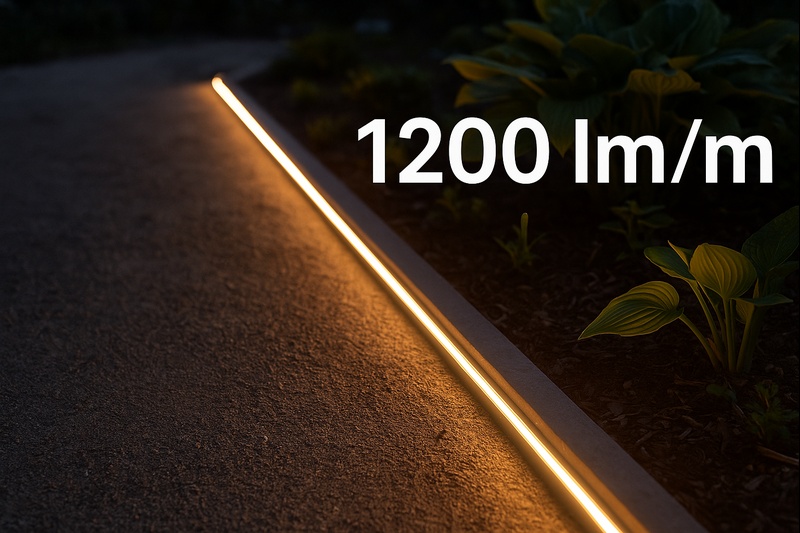
Lumens are the industry standard for comparing light output. At Rhlite, we ensure our outdoor LED strip specifications clearly state lumen values. This helps clients like Tom, who manage lighting projects, to accurately compare products and ensure they get the right illumination level for safety, ambiance, or accent lighting in outdoor designs.
Understanding Lumens and What Affects Them
The lumen rating1 is a starting point, but several factors influence the actual brightness and its quality:
- What is a Lumen? A lumen (symbol: lm) is the SI unit of luminous flux, a measure of the total quantity of visible light emitted by a source per unit of time. Simply put, more lumens equal more light.
- Lumens per Meter (or Foot): This is critical for linear light sources like LED strips. It tells you how much light you get over a standard length, making comparisons easier. For example, a 1000 lm/m strip is brighter than a 500 lm/m strip.
- Factors Influencing Lumen Output:
- LED Chip Type and Efficiency2: Different LED chips (e.g., SMD 2835, 5050, 3528) have different efficiencies, meaning some produce more lumens per watt of electricity consumed. Rhlite focuses on using high-efficiency chips for better performance.
- LED Density: The number of LEDs per meter (which we’ll discuss next) also directly impacts the total lumens. More LEDs usually mean more light.
- Driving Current: LEDs can be driven at different currents. Higher currents can mean more brightness but also more heat, which can affect lifespan if not managed. Our strips are designed for an optimal balance.
- Color Temperature (CCT): Generally, cooler white LEDs (e.g., 6000K) can have slightly higher lumen outputs than warmer white LEDs (e.g., 3000K) for the same power, due to how phosphors work and human eye sensitivity.
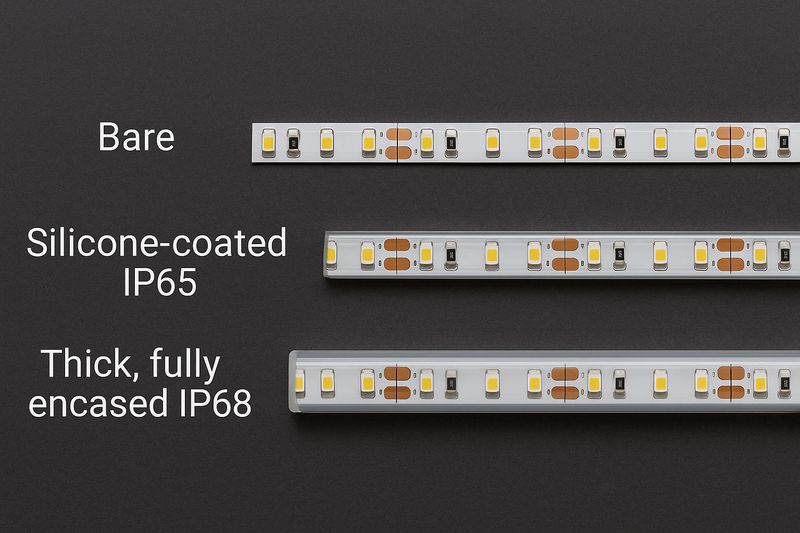
- Outdoor Encapsulation: The protective silicone or PU coating on outdoor IP-rated strips can absorb a small percentage of light. Rhlite uses high-transparency, UV-resistant materials to minimize this loss.
- Color Rendering Index (CRI)3: While not a direct measure of brightness, a high CRI (e.g., >90) makes colors appear more vibrant and natural. A high CRI light might be perceived as "better" or even "brighter" in terms of quality, even if its raw lumen output is similar to a lower CRI strip.
I once had a client in North America, a lighting designer, who was specifying lights for a hotel’s outdoor terrace. He was focused solely on the highest lumen output. I showed him two Rhlite options: one with very high lumens but standard CRI, and another with slightly fewer lumens but a CRI of 95+. For illuminating the rich wood textures and colorful plantings, the high CRI strip made everything look so much more vivid and appealing. He chose the high CRI option, realizing quality of light often trumps sheer quantity for such applications.
| Brightness Factor | Description | Outdoor Relevance | Rhlite Focus |
|---|---|---|---|
| Unit of Measurement | Lumens per meter (lm/m) or per foot (lm/ft). | Primary indicator of light intensity for paths, facades, landscapes. | Clear, tested lumen data for all products. |
| LED Chip Quality | Efficiency (lm/W) and reliability of individual LEDs. | Determines overall brightness and energy efficiency of the strip. | Sourcing high-quality, efficient LED chips. |
| Driving Current | Amount of electricity supplied to the LEDs. | Balanced for optimal brightness and longevity, especially in outdoor heat. | Engineering for stable current delivery. |
| CRI Impact | High CRI makes colors look natural and vibrant. | Crucial for landscape and architectural features where color accuracy matters. | Offering high CRI (>90) outdoor options. |
| Encapsulation Effect | Protective outdoor layers can slightly reduce light transmission. | Important to account for when choosing brightness for weatherproof strips. | Using premium, high-transparency materials. |
Choosing the right lumen output depends on the specific outdoor task – subtle accent lighting will need fewer lumens than general area illumination or wall washing.
How Does LED Density (LEDs/Meter) Affect Outdoor Light Quality?
So you know how bright a strip is overall, but how is that light distributed? This is where LED density becomes important, especially for achieving a professional look outdoors.
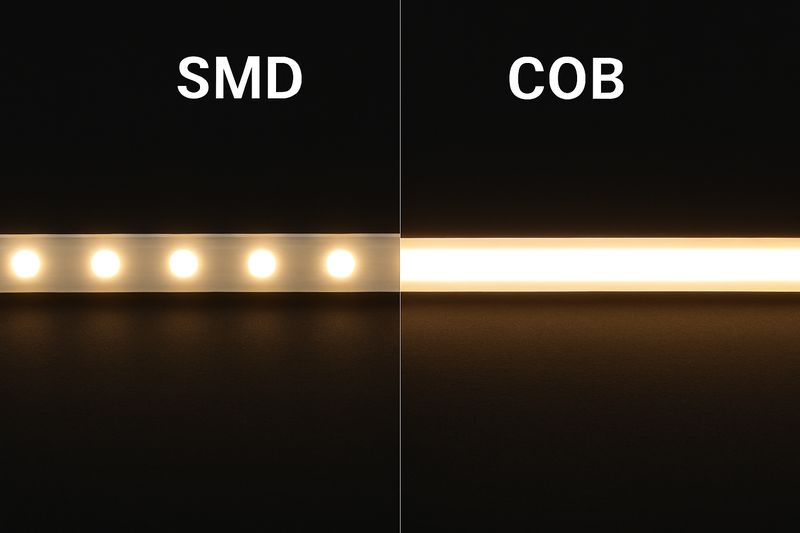
LED density is the number of individual LED chips populated per meter (or per foot) of the LED strip. Higher density generally means a more uniform, smoother line of light with fewer visible "dots," and often, higher brightness.
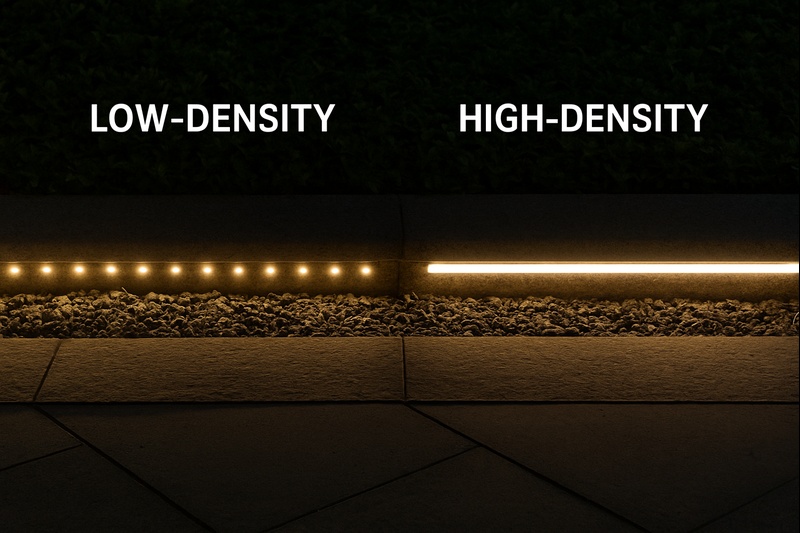
For many outdoor applications, especially where the strip might be directly visible or its reflection can be seen (like on a wet patio or a glass railing), a smooth, dot-less line of light is highly desirable. At Rhlite, we offer a range of LED densities, including COB (Chip on Board) options, to help clients like Tom achieve this seamless look for high-end outdoor installations.
The Importance of LED Spacing
The number of LEDs per meter impacts several aspects of performance and aesthetics:
- Light Uniformity (Avoiding Hotspots)4:
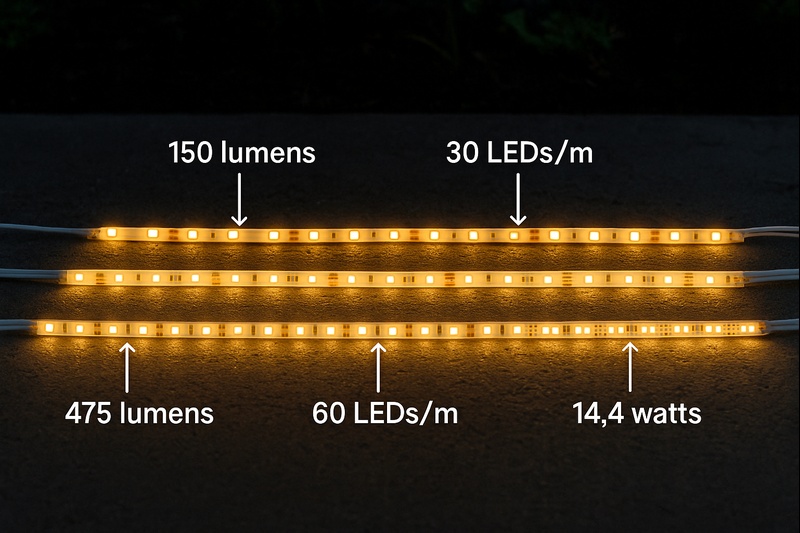
- Low Density (e.g., 30 or 60 LEDs/m): LEDs are spaced further apart. This can create visible bright spots (dots) with darker areas in between. This might be acceptable if the strip is hidden and only its indirect light is seen, or if a dotted effect is intended.
- Medium Density (e.g., 90 or 120 LEDs/m): Offers a better compromise, with less noticeable dotting, especially if used with a diffuser or positioned slightly away from the illuminated surface.
- High Density (e.g., 180, 240 LEDs/m, or more): LEDs are very close together, creating a much more even and continuous line of light. This is often preferred for direct view applications or when a smooth wash of light is needed on an outdoor surface.
- COB (Chip on Board) Strips5: These are the ultimate in high density. Many tiny LED chips are mounted directly onto the circuit board and covered by a continuous layer of phosphor. This results in a completely uniform, dot-free line of light, perfect for premium outdoor architectural details. Rhlite has seen growing demand for outdoor COB strips.
- Overall Brightness6: If using the same type of LED chip, a strip with more LEDs per meter will naturally produce more total lumens per meter.
- Power Consumption: Higher density usually means higher power consumption (which we’ll cover next).
- Heat Dissipation: More LEDs in a small space generate more heat. For outdoor strips, especially high-density ones exposed to sun, good thermal management (quality PCB, proper encapsulation) is crucial for longevity. Rhlite designs consider this.
- Cutting Increments: The density can sometimes influence how short the cutting segments are, though this is also tied to voltage (12V vs 24V).
I remember a contractor, one of Tom’s peers, working on a luxury poolside lighting project in Singapore. He initially chose a medium-density strip for under the coping. However, the reflection in the calm water at night clearly showed the individual LED dots, which the end-client found distracting. He switched to a high-density Rhlite outdoor strip, and the smooth, continuous reflection was much more elegant and met the luxury expectation.
| LED Density Aspect | Description | Outdoor Application Relevance | Rhlite Advantage |
|---|---|---|---|
| Definition | Number of LED chips per meter (or foot). | Key to light uniformity (smooth line vs. dots) and influences brightness. | Range from 30 LEDs/m to 240+ LEDs/m, plus COB. |
| Light Smoothness | Higher density = more uniform, less "dotty" light output. | Crucial for visible strips, reflections, and achieving a high-end look. | Offering COB options for perfectly dot-free light. |
| Brightness Impact | More LEDs (of same type) generally result in higher total lumens/meter. | Allows for brighter output from the same strip width. | Balancing density with efficiency and thermal design. |
| Heat Management | Higher density creates more concentrated heat; requires good PCB & materials. | Critical for durability in varying outdoor temperatures and sun exposure. | Using quality thermally conductive PCBs. |
| Visual Goal | Achieve distinct points of light or a continuous, seamless glow. | Defines the aesthetic character of the outdoor lighting feature. | Providing options for diverse design intents. |
The ideal LED density for your outdoor project depends on how close the strip will be to viewers, whether it’s a direct or indirect light source, and the overall aesthetic you want to achieve.
What Does Power (Watts/Meter) Indicate for Outdoor LED Strips?
You’ve considered brightness and how smoothly the light is distributed. Now, how much electricity will your chosen outdoor LED strip use? This is where the power rating, in watts, comes in.
LED strip power, specified in watts per meter (W/m) or watts per foot (W/ft), measures the electrical energy the strip consumes to produce its light. This is vital for choosing the correct power supply and understanding energy efficiency.
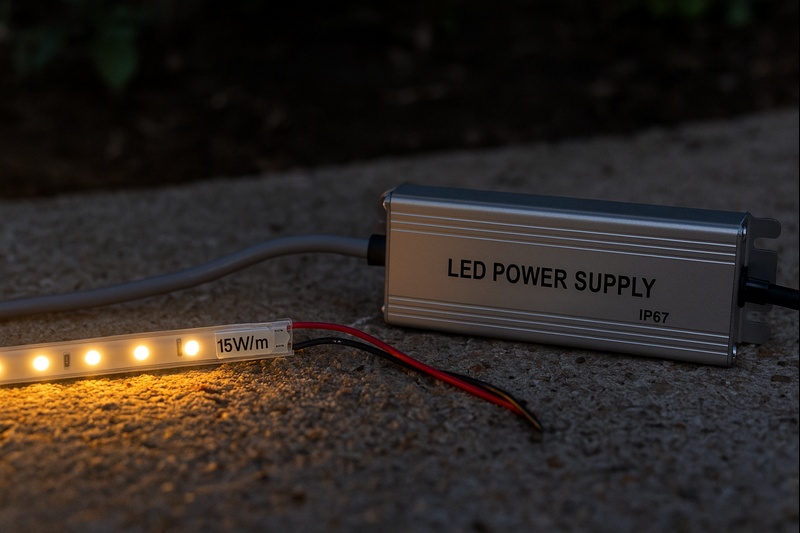
Knowing the power consumption is essential for any electrical installation, especially for larger outdoor setups common in commercial or extensive residential projects. At Rhlite, we provide accurate wattage information for our outdoor LED strips. This allows clients like wholesalers and contractors to correctly size power supplies, estimate running costs, and evaluate the overall energy efficiency of the lighting design. Inaccurate power ratings are a major issue with some low-quality suppliers, leading to undersized power supplies and system failures – a pain point Tom would want to avoid.
Power, Efficiency, and System Design
The wattage of an LED strip tells you more than just its energy use:
- Relationship with Brightness and Density: Generally, strips that are brighter (more lumens) or have a higher LED density will consume more watts per meter. More work (producing light) requires more energy.
- Power Supply Sizing (Crucial!)7: This is the most direct application of the W/m rating.
- To calculate the minimum power supply size: Total Strip Length (meters) x Watts per Meter (W/m) = Total System Wattage.
- The 20% Rule8: Always choose a power supply that has at least 20% more wattage capacity than your calculated total system wattage. For example, if your outdoor LED strips total 80W, you need a power supply of at least 96W (80W * 1.2). A 100W PSU would be a good choice. This headroom prevents the PSU from being constantly overworked, leading to better reliability and longer life, especially important for outdoor units that can face temperature swings.
- Luminous Efficacy (Efficiency – Lumens per Watt, lm/W)9:
- This is the true measure of how efficiently an LED strip converts electricity into light. Calculated as: Lumens per Meter / Watts per Meter = Lumens per Watt (lm/W).
- A higher lm/W value means the strip is more energy-efficient. Rhlite strives to offer outdoor LED strips with excellent luminous efficacy, providing bright light without excessive energy consumption.
- Impact of Voltage (12V vs 24V): For the same wattage strip, a 24V system will draw half the current (Amps) of a 12V system (since Power = Voltage x Current). This affects wire gauge and voltage drop, but the power consumption (Watts) for a given light output and strip technology will be very similar.
I worked with an installer in the US who was new to a large outdoor landscape project. He underestimated the total wattage for the 24V Rhlite LED strips he ordered and bought power supplies that were too small. The lights were dim, and the power supplies were overheating. Once we helped him recalculate based on the correct W/m and apply the 20% headroom rule, he got the right power supplies, and the installation was perfect. This highlights how critical accurate W/m data and proper PSU sizing are.
| Power Aspect | Description | Outdoor Significance | Rhlite Standard |
|---|---|---|---|
| Unit of Measurement | Watts per meter (W/m) or Watts per foot (W/ft). | Indicates energy draw; crucial for PSU sizing and energy cost calculation. | Accurate, verified W/m ratings for all strips. |
| Power Supply Sizing | (Total Length x W/m) + 20% safety margin = Required PSU Wattage. | Essential for system safety, reliability, and PSU longevity outdoors. | Guiding clients on correct PSU selection. |
| Luminous Efficacy | Lumens per Watt (lm/W). Higher value = more efficient. | Defines energy efficiency; impacts long-term running costs & sustainability. | Designing for high lm/W across our outdoor range. |
| Link to Brightness | Higher brightness or density strips typically have higher W/m ratings. | Understand the power needed to achieve desired outdoor light levels. | Offering a spectrum of power/brightness options. |
| Heat Generation | Higher wattage generally means more heat generated by the strip. | Important for heat dissipation in outdoor enclosures or direct sun. | Ensuring thermal design matches power output. |
Understanding the power rating ensures your outdoor LED strip installation is safe, efficient, and performs reliably for years.
How Do Brightness, Density, and Power Interrelate in Outdoor LED Strips?
It’s important to realize that brightness (lumens), LED density (LEDs/m), and power (W/m) are not independent. They are closely linked and together determine the overall character and suitability of an outdoor LED strip.
Choosing the right outdoor LED strip means finding the right balance of brightness for the task, density for the desired visual smoothness, and power for efficient operation and correct power supply matching. These three specifications must be considered together.
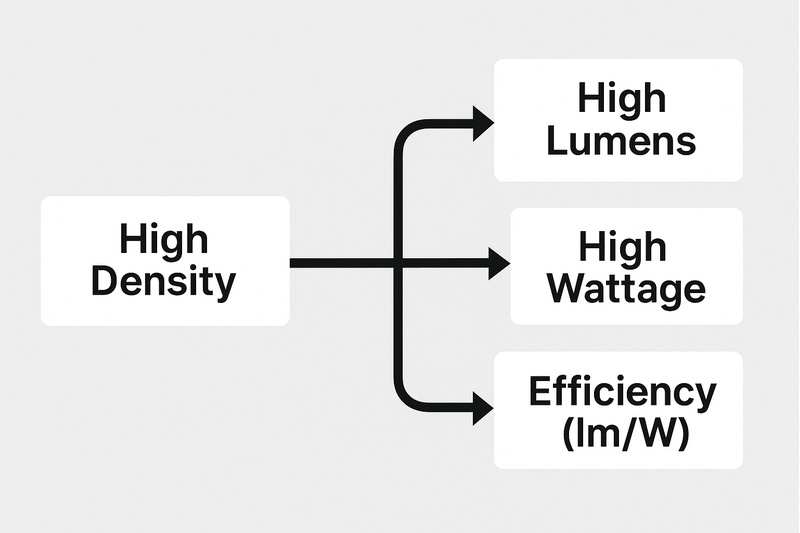
At Rhlite, our goal is to provide clear data on all these parameters for our outdoor LED strips. This allows lighting professionals like Tom to make informed trade-offs. For instance, if an architectural design in Japan requires a very bright, perfectly seamless line of light for an outdoor facade, it will likely mean a high-density, high-lumen, and consequently higher-wattage COB strip.
Making a Holistic Choice for Outdoor Applications
Here’s how to think about these specs working in concert:
-
Define the Outdoor Application First:
- Ambient Lighting (e.g., soft glow on a deck, landscape accents): May require moderate lumens (e.g., 400-800 lm/m). LED density can be medium if indirect, or high/COB for visible areas. Wattage will be relatively low to moderate.
- Task/Safety Lighting (e.g., lighting outdoor steps, pathways, BBQ areas): Needs higher lumens (e.g., 800-1500 lm/m). Higher density or COB is often preferred for even light to prevent shadows. Wattage will be moderate to high.
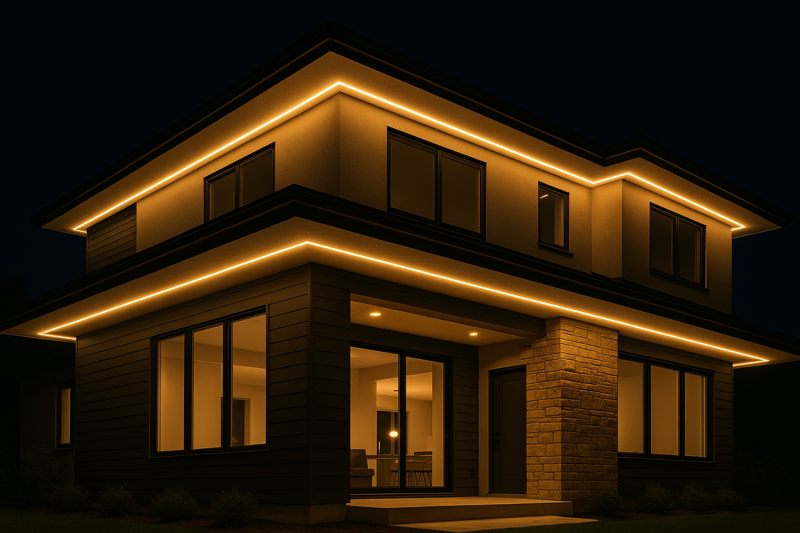
- Architectural / Feature Lighting (e.g., wall grazing, outlining building features): Lumen needs can vary greatly, from moderate to very high (e.g., 500-2000+ lm/m). Density is critical for smooth lines (high density or COB essential). Wattage will align with the brightness and density.
-
Balancing Visuals (Density) with Brightness:
- If you need high brightness and a perfectly smooth line of light (e.g., for reflecting pools or glass balustrades), you’ll need a strip with high LED density (or COB technology) using efficient, bright LED chips. This will usually be a higher wattage strip.
- If some light spotting is acceptable (e.g., strip hidden in a deep channel for uplighting trees), you might achieve your brightness target with a medium-density strip, potentially at a lower wattage.
-
Considering Power, Efficiency, and Practicalities:
- Once you’ve narrowed down options based on brightness and visual appearance, compare their W/m ratings. Calculate the luminous efficacy (lm/W) to choose the most energy-efficient option that meets your needs.
- Crucially, ensure your chosen power supply (or supplies) can comfortably handle the total wattage of all the LED strips in your outdoor design, including the 20% safety margin.
For example, if Tom is sourcing for a project that requires illuminating long outdoor walkways in a resort in North America, he’d need strips with good brightness for safety (perhaps 1000 lm/m), high density for a smooth, welcoming light (e.g., 120 LEDs/m or COB), and because of the long runs, he’d need to carefully calculate total wattage to specify appropriate 24V Rhlite power supplies.
| Outdoor Scenario | Typical Lumens/m | Density Preference (LEDs/m) | Expected Wattage/m | Key Factor |
|---|---|---|---|---|
| Subtle Planter Accents | 300-600 | 60-120 | Low | Ambiance, dots may be fine if strip is hidden. |
| Deck Step Lighting | 700-1000 | 120+ or COB | Medium | Safety, smooth light preferred to avoid glare. |
| Building Facade Grazing | 1000-2000+ | High Density or COB | Medium to High | Visual impact, perfectly uniform line of light. |
| Covered Patio Ceiling | 800-1200 | 120+ or COB | Medium | General illumination, smooth appearance desired. |
By looking at brightness, density, and power together, you can select the ideal Rhlite outdoor LED strip that perfectly matches the functional requirements and aesthetic vision of your project.
Conclusion
For outdoor LED strips, brightness (lumens/m), LED density (LEDs/m), and power (W/m) are vital. Understand how they interrelate to choose strips that offer the right light output, visual quality, and energy efficiency for your project.
-
Understanding lumen ratings is crucial for selecting the right lighting for your needs. Explore this link to learn more about it. ↩
-
Discover how different LED chip types impact efficiency and brightness, helping you make informed lighting choices. ↩
-
Learn why CRI matters in lighting quality and how it affects color perception, enhancing your understanding of lighting choices. ↩
-
Understanding light uniformity is crucial for achieving optimal lighting effects and avoiding unwanted hotspots in your projects. ↩
-
COB strips provide a uniform light output, making them ideal for architectural applications. Explore their benefits for your next project. ↩
-
Learn how LED density impacts brightness to make informed decisions for your lighting needs and enhance your designs. ↩
-
Proper power supply sizing ensures your LED strips operate efficiently and reliably, preventing potential damage and extending their lifespan. ↩
-
Learning about the 20% rule can help you select the right power supply, ensuring your LED system runs smoothly without overloading. ↩
-
Understanding luminous efficacy helps you choose energy-efficient LED strips that provide more light for less power, saving you money. ↩