Choosing a new supplier in China feels like a gamble. A bad partnership can lead to project delays, angry clients, and massive financial losses. You need a reliable way to separate the experts from the amateurs.
Look beyond the price. A superior supplier provides verifiable certifications (like UL/ETL), detailed component datasheets, responsive technical communication, and a transparent quality control process. Evaluate their manufacturing expertise, not just their product catalog, to find a true partner.
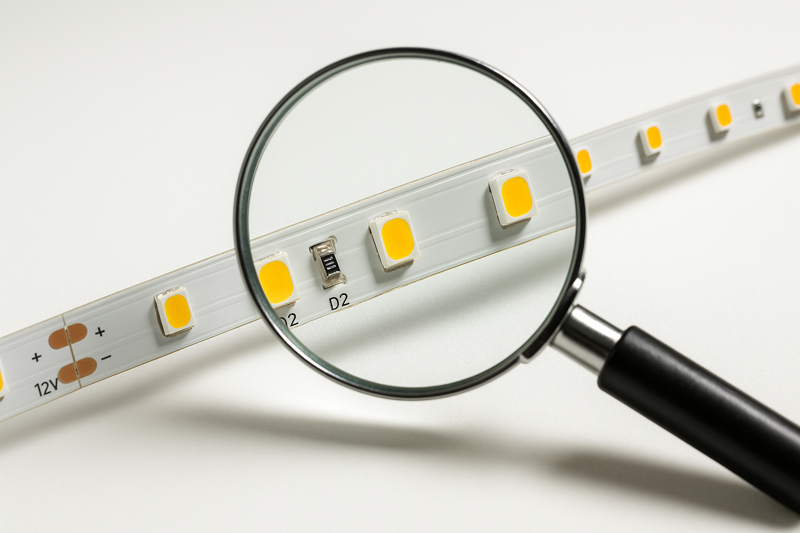
This is one of the most critical skills a buyer can have. Early in my career, I learned this lesson the hard way, but from the other side. A potential client from the US, we’ll call him David, sent me a sample from his current supplier. It was a disaster. The soldering was messy, the color consistency was terrible, and the silicone coating was already starting to yellow. He said, "The first sample they sent was perfect, but the bulk order was junk. Now they won’t even answer my emails." David had been burned by the classic "golden sample" trick, where a factory sends a perfect sample and then cuts corners on the mass production run. This guide is designed to give you the tools to avoid that exact situation. It’s a system for vetting suppliers that I’ve developed over years in this business, helping you identify a long-term partner, not just a one-time vendor.
How Do You Verify True Product Quality and Consistency?
The sample you received looks great, but how can you be sure the 10,000 meters you order will be identical? This fear of inconsistent quality is what keeps importers up at night.
Demand a detailed technical datasheet that specifies the exact brand and model of the key components, like the LEDs and resistors. A professional factory will provide this and guarantee consistency. A trader or low-quality factory will be vague.
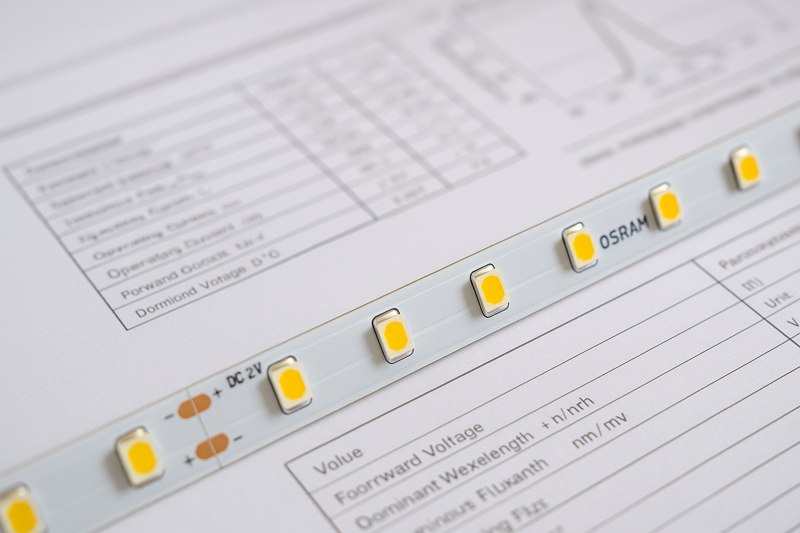
I had a conversation with Tom, one of my best distributors in the United States, about this very issue. He was evaluating a new, very low-cost supplier for a budget-focused product line. The price was almost too good to be true. He asked them for the component spec sheet. The supplier’s answer was, "We use good quality brand LEDs." Tom pressed them, "Which brand? What binning process do you use?" They couldn’t give him a straight answer. That was a huge red flag. For comparison, he asked my team for the datasheet for a similar Rhlite product. Our sheet listed: "LED Chip: San’an, Model 2835, Bin R3-5-C. PCB: 2oz rolled copper. Resistor: Uni-Royal 1% tolerance." Tom knew immediately that we controlled our supply chain and our production, while the other supplier was likely just buying whatever was cheapest on the spot market that week. He knew that their product’s color and brightness would shift from one batch to the next. He chose not to work with them, avoiding a major future headache.
Digging into the Details: What to Ask For
A professional factory has deep control over its manufacturing process. A trader or a low-tier assembler does not. You can expose the difference by asking specific questions.
- LED Chip Specification1: Don’t just accept "Epistar" or "San’an" (two major chip manufacturers). Ask for the specific bin codes. Professional factories buy LEDs sorted into very tight bins for color and brightness (e.g., within a 50K CCT range). Bad suppliers use mixed bins, which results in visible color differences along the same strip.
- PCB (Printed Circuit Board) Details2: Ask for the copper weight. A 2oz or 3oz copper PCB dissipates heat better and suffers less voltage drop than a cheap 1oz board. This directly impacts the strip’s lifespan and performance.
- Other Components: Ask about the resistor brand3 and the 3M adhesive model number4 on the back. A factory that has standardized these small parts is a factory that is serious about consistency.
Here is a comparison of what you will get from different supplier tiers:
| Component Query | Low-Tier Supplier / Trader’s Answer | Professional Factory’s (e.g., Rhlite) Answer | Why It Matters to Tom |
|---|---|---|---|
| "What LED do you use?" | "A good quality, famous brand LED." | "San’an 2835 chips, SDCM<3, sorted for a specific CCT bin." | Guarantees color consistency across the entire project and future orders. |
| "What is the PCB spec?" | "It’s a standard PCB." | "2oz rolled-annealed copper for better flexibility and heat dissipation." | Ensures longer life and more reliable performance, especially on long runs. |
| "Can you guarantee this for my next order?" | "The price might change, it depends on the market." | "Yes, these components are part of our standard BOM for this model." | Provides confidence that the product will be identical year after year, protecting brand reputation. |
By demanding this level of detail, you are not being difficult. You are performing professional due diligence. A good factory will respect these questions and have the answers ready. A bad one will get defensive or evasive.
What Separates Real Product Certificates from Fake Ones?
Your supplier’s website is covered in logos: UL, CE, RoHS. But when your shipment gets held up in customs, you discover the certificate is fake or for a different product. This is a catastrophic, expensive problem.
Do not trust a PDF or logo. Use the certification body’s public online database to verify the certificate number. Check that it is active, matches the supplier’s exact company name, and covers the specific product category you are buying.
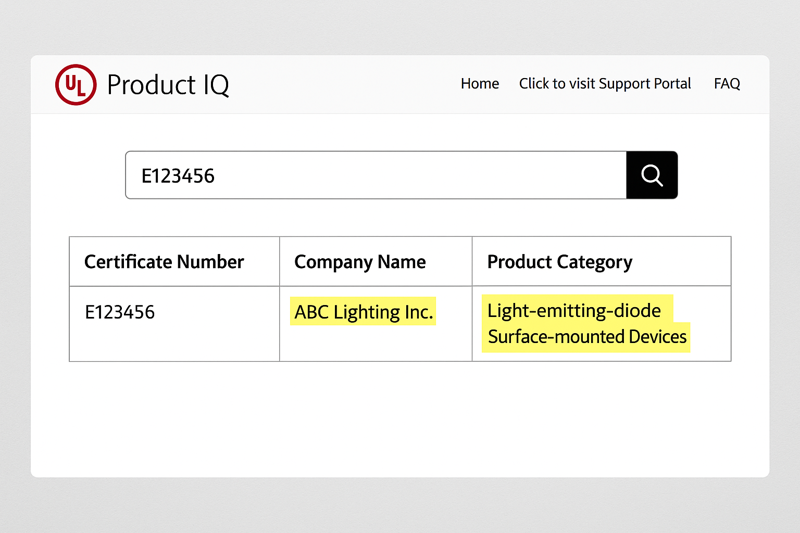
This is not a theoretical risk. I spoke with a potential client who was facing this nightmare. He had ordered a container of LED power supplies for a large commercial project. His previous supplier had provided a PDF of a UL certificate. The shipment was flagged for a random inspection by U.S. Customs. The customs agent checked the UL database and found that the certificate number belonged to a completely different company and was for lighting fixtures, not power supplies. The supplier had just Photoshopped their name onto a random certificate they found online. The entire container was impounded, and the client faced huge fines and project a delay of months. He came to us because he knew we, as a factory, hold our own legitimate certifications. I showed him how to look up Rhlite’s file number on the UL Product iQ database right there on the screen. He saw our company name and the correct product category. That simple, two-minute check provided the trust he needed.
Your 3-Step Verification Process
Always treat certifications with healthy skepticism until you verify them yourself.
- Get the File Number, Not a PDF: Ask the supplier for their UL, ETL, or CE file number. If they are hesitant to provide it, this is a major red flag.
- Use the Online Database: Every major certification body has a public database.
- For UL: Go to "UL Product iQ5". It’s a free, powerful tool.
- For ETL (Intertek): Search their "Listed Product Directory6".
- For CE: This one is trickier as it’s often a "self-declaration7." Ask for the full test report from the accredited lab8 and check that the lab itself is legitimate.
- Check the Details Carefully: When you find the certificate, verify three things:
- Company Name: Does it exactly match the company you are paying? If you are paying "Shenzhen ABC Trading Co." but the certificate is for "Dongguan XYZ Lighting Factory," you are likely dealing with a trader.
- Product Category: Does the certificate cover "Low-voltage Luminaire" or "LED Strip Light"? Or is it for something irrelevant like "Ceiling Fans"?
- Status: Is the certificate active, or has it expired or been terminated?
Here’s what to look for on a typical database entry:
| Database Field | What to Check | Red Flag Example | Green Flag (Good Sign) |
|---|---|---|---|
| Company Name | Must match your supplier’s full legal name. | "Guangdong Best Price LED" (generic) | "Rhlite Optoelectronics Co., Ltd." (specific) |
| Product Model/Category | Must cover the products you are buying. | Certificate is for "Power Supplies," but you are buying strips. | "Luminaires, Portable" or "Component – LED Light Engine" |
| Certification Status | Must be "Active" or "Listed." | "Expired," "Terminated," or "Information not found." | "Active" |
Faking certificates is incredibly common because many buyers don’t check. By performing this simple verification, you protect your business from massive risk and instantly identify which suppliers are legitimate professionals.
How Can You Judge a Factory’s True Capabilities?
Every supplier’s website says they are a "leading factory." How do you know if you are talking to a real manufacturer with R&D and quality control, or just a small workshop or trading company with a good website?
Ask them about their customization (OEM/ODM) process. A true factory can discuss modifying PCB layouts, developing new extrusion molds, and integrating specific components. A trader can only offer what’s in their catalog or change the packaging.
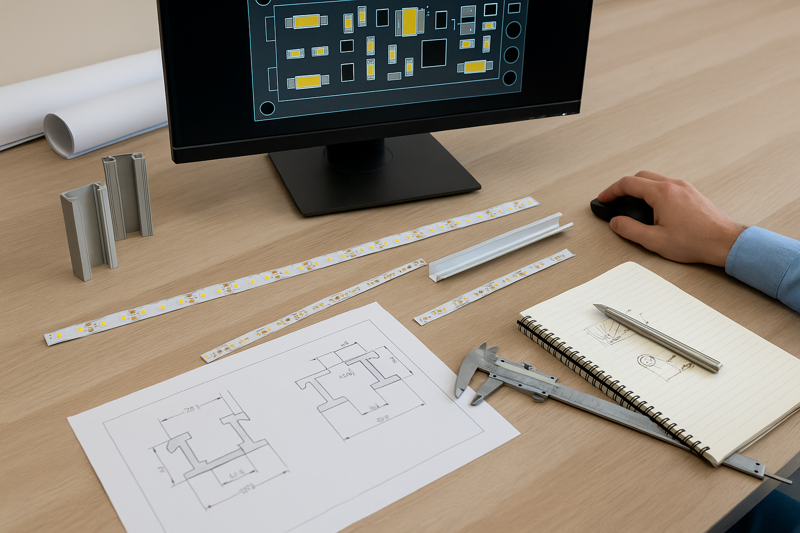
A lighting designer from North America, a new client, came to me with a unique challenge. He was designing a curved lighting element for a corporate lobby and needed an LED strip that could bend sideways, not just up and down, while maintaining a very specific color temperature of 3200K. He had asked his two previous suppliers. The first one, a trading company, said, "We don’t have that." They couldn’t help. The second, a smaller factory, said, "Our S-type strips can bend, but we only have 3000K or 3500K." He was stuck. When he asked me, my response was different. I said, "Okay, that’s an interesting project. We can use our existing S-shape PCB and populate it with custom-binned 3200K LEDs. We would need to run a small test batch to confirm the color after the phosphor is applied. The MOQ for this custom run would be X meters." He was thrilled. It wasn’t just a "yes" or "no" answer; it was a collaborative, problem-solving discussion. That conversation immediately showed him he was dealing with a real factory that controlled its engineering and production.
Questions that Reveal a True Manufacturer
Go beyond the "Are you a factory?" question. Ask operational questions that only a factory can answer properly.
- "What is your SMT line capacity9?" An SMT (Surface Mount Technology) machine is what places LEDs onto the PCB. A factory knows its production capacity in components per hour. A trader will have no idea.
- "What testing equipment do you use for quality control10?" A professional factory will talk about their integrating spheres (for measuring lumens and CCT), temperature/humidity chambers (for stress testing), and goniophotometers. A trader might say, "We visually inspect every strip."
- "Can you develop a custom aluminum profile for this strip?" A one-stop solution provider like Rhlite has partnerships or in-house capabilities for extrusion. A trader will have to source this from another factory, adding cost and complexity.
Use this table to gauge their responses:
| Your Question | Trader / Low-Tier Workshop Response | Professional Factory (Rhlite) Response | What It Tells You |
|---|---|---|---|
| "Can you make this strip in 3200K?" | "Sorry, we only have 3000K or 3500K." | "Yes, we can do a custom binning run. Let’s discuss the MOQ." | They have deep control over their supply chain and production. |
| "What is your QC process?" | "We test everything before shipping." | "We have IQC for raw materials, IPQC on the SMT line, and a 12-hour aging test in FQC." | They have a structured, multi-stage quality system to prevent failures. |
| "Can you create a custom product for me?" | "We can put your logo on the box." | "Absolutely. Let’s schedule a call with our engineer to discuss your technical requirements." | They are a true OEM/ODM partner capable of solving complex problems. |
The ability and willingness to engage in a technical, problem-solving conversation is the clearest sign that you have found a capable manufacturing partner, not just a reseller.
Conclusion
Finding a great supplier means becoming a great evaluator. Verify quality through component specs, validate trust with certified proof, and confirm capability by discussing customization. This turns a gamble into a strategic decision.
Understanding LED chip specifications ensures you choose quality components, leading to better performance and consistency. ↩
Learning about PCB copper weight can help you select products that last longer and perform better, enhancing your overall project quality. ↩
Exploring the impact of resistor brands can guide you in making informed choices for reliable and consistent LED performance. ↩
Discovering the importance of adhesive model numbers can lead to better product durability and performance in your projects. ↩
Explore UL Product iQ to access a powerful tool for verifying product certifications and ensuring supplier legitimacy. ↩
The Listed Product Directory is essential for confirming ETL certifications; learn how to navigate it effectively. ↩
Understanding self-declaration in CE certification is crucial for verifying product legitimacy; find out more here. ↩
Identifying an accredited lab is vital for ensuring product safety; discover how to find legitimate testing facilities. ↩
Understanding SMT line capacity helps you gauge a manufacturer’s production efficiency and capability. ↩
Exploring quality control practices reveals how manufacturers ensure product reliability and consistency. ↩