Your client wants a stunning holiday display, but traditional string lights look dated and are a nightmare to install and maintain. You’re losing time and money on a product that offers no creative control.
Use professional-grade, addressable (pixel) IP67 LED strips. They allow for dynamic, flowing color effects and animations that traditional lights cannot match, delivering a high-end, modern look that clients will pay a premium for.
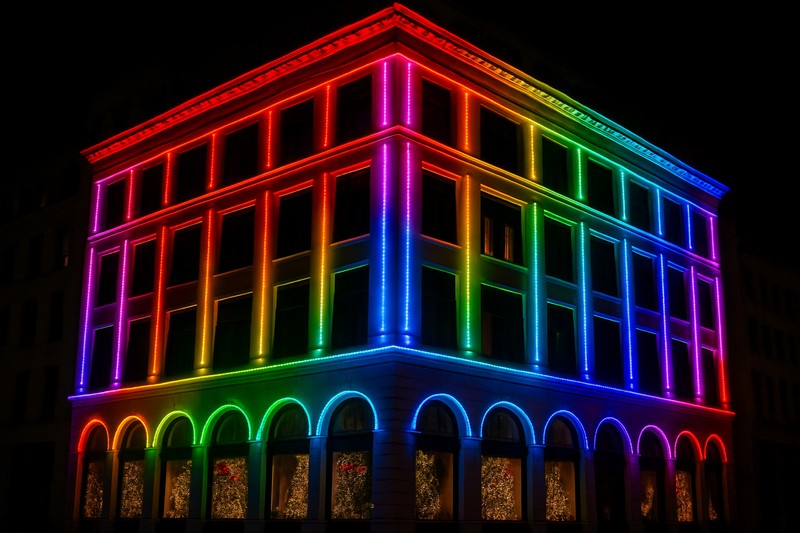
Every year around September, I start getting urgent calls from lighting contractors and designers. They’re planning large-scale holiday projects for commercial clients—malls, city centers, and high-end residences. They’ve grown tired of the limitations and failures of traditional C9 bulbs and consumer-grade string lights. They know there has to be a better way to create those magical, jaw-dropping displays. That’s when I introduce them to the world of professional LED strips. This isn’t about just outlining a roof in a single color; it’s about creating a fully programmable light show. It’s an opportunity to move from being a simple installer to a true lighting artist, and it’s a massive upgrade in both project quality and profitability. In this guide, I’ll walk you through how to make that leap.
What Makes LED Strips Better Than Traditional Christmas Lights?
You’re untangling yet another mess of old Christmas lights, finding broken bulbs and frayed wires. This yearly ritual is inefficient, and the final look is often underwhelming and generic for your clients.
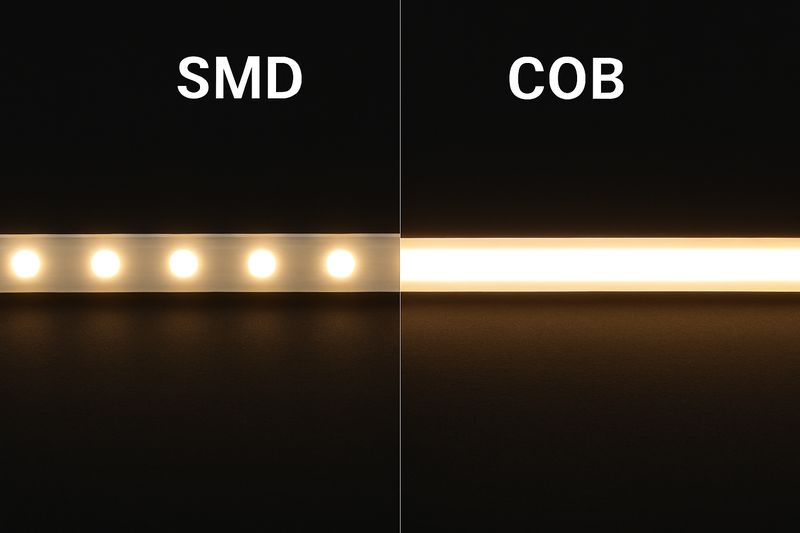
LED strips offer a clean, continuous line of light, eliminating the "dotted" look of bulbs. They are more durable, energy-efficient, and—most importantly—provide far superior creative control for custom colors, scenes, and animations.
A distributor I work with, Tom from the US, used to sell pallets of traditional Christmas lights every season. His contractor clients would buy them, spend weeks installing them, and then spend more time replacing failed sections. After the season, half of them would be thrown away. Tom saw the waste and the frustration. He started offering our IP67 LED strips as a "professional-grade holiday solution." At first, his clients were hesitant about the higher upfront cost per meter. But then they realized they could install them once inside a discreet aluminum channel and leave them up all year. For Christmas, they’re red and green; for Halloween, orange and purple; for the 4th of July, red, white, and blue. The labor savings and year-round value were immense. He’s now known as the go-to source for permanent, programmable holiday lighting.
Beyond the Bulb: The Aesthetic Advantage
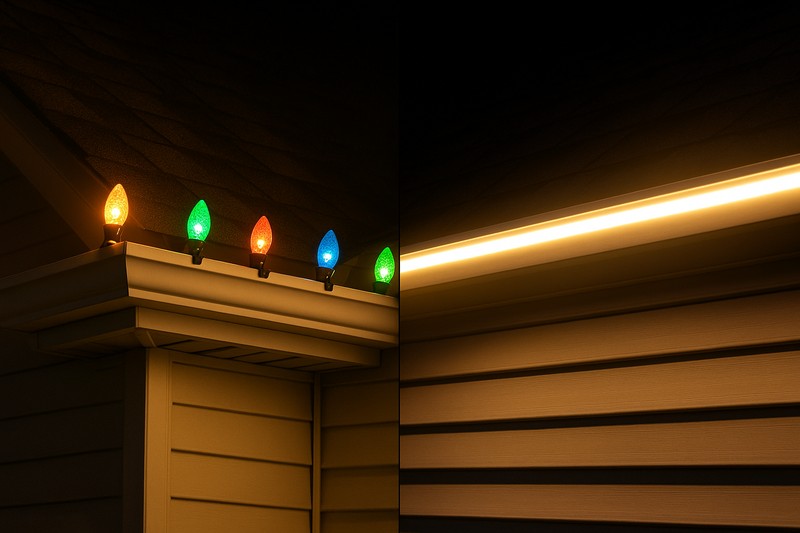
The most immediate difference is visual. Traditional C9 or C7 bulbs create a series of bright spots, a "connect-the-dots" effect. While nostalgic, it can look dated on modern architecture.
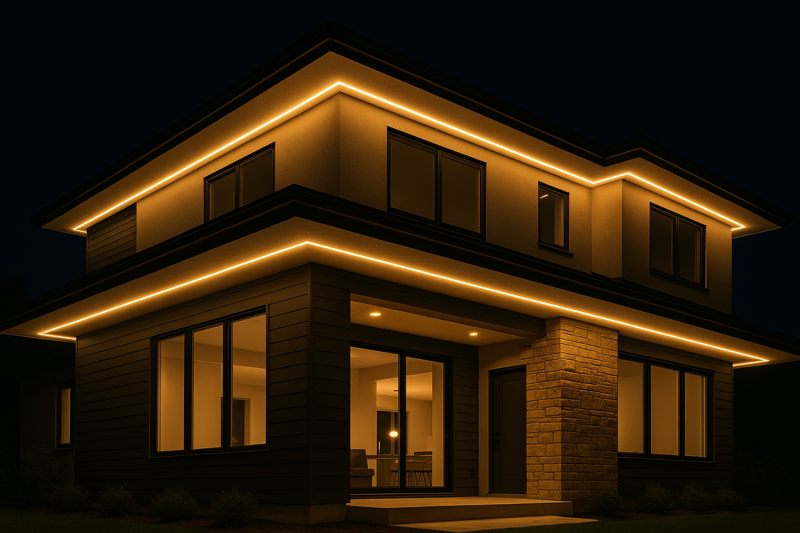
- Continuous Light1: LED strips, especially with a high density of LEDs and a diffused cover, create a seamless, uninterrupted line of light. This looks incredibly clean and architectural, highlighting building lines with a smooth, professional glow.
- Lower Profile: The strips themselves are incredibly low-profile. When installed in a channel, they can be nearly invisible during the day, preserving the building’s aesthetic. Traditional bulbs and wires are bulky and can look messy when the lights are off.
Durability and Efficiency: A Smarter Investment
Holiday lighting faces harsh winter conditions. LED strips are built to be more robust.
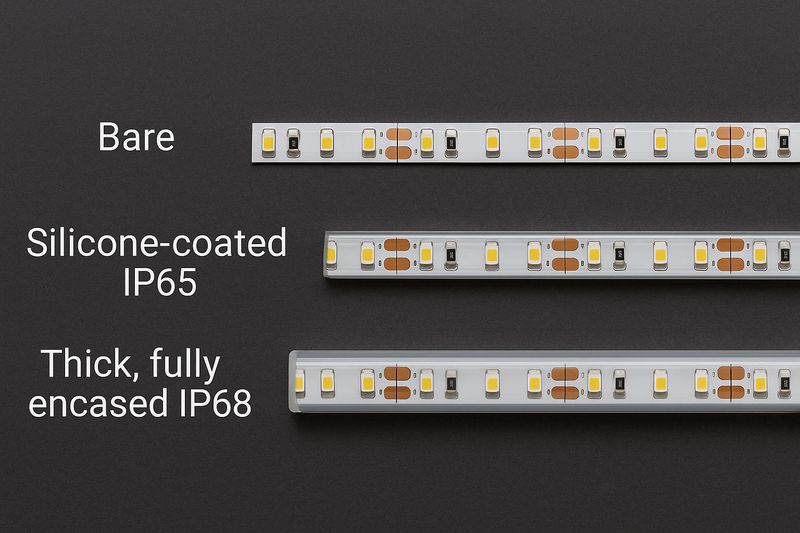
- Solid-State Durability2: LEDs are solid-state devices with no fragile filaments or glass bulbs to break. An IP67 silicone-encased strip is a solid, resilient product that can handle being installed, removed, and stored far better than delicate traditional lights.
- Energy Savings3: LED strips consume a fraction of the power of incandescent bulbs. For large commercial displays that run for hours every night, the energy savings over a single holiday season can be substantial, helping to justify the initial investment.
Here’s a direct comparison for a professional’s perspective:
| Feature | Traditional Holiday Lights (e.g., C9) | Professional LED Strip Lights | Advantage for Professionals |
|---|---|---|---|
| Appearance | Dotted, individual points of light. | Smooth, continuous line of light. | A cleaner, more modern, and architectural look. |
| Durability | Fragile glass/plastic bulbs, thin wires. | Solid-state, IP67 silicone-encapsulated. | Lower failure rates, survives seasonal install/removal. |
| Creative Control4 | Single static color per string. | Full color control, dynamic effects (with addressable strips). | Ability to sell "light shows," not just lights. |
| Installation | Bulky, tangled wires, temporary. | Low-profile, can be permanently installed in channels. | Huge labor savings; potential for year-round use. |
| Energy Use | High (especially incandescent). | Very Low. | Lower operating costs for the client. |
For a professional focused on quality, reliability, and offering premium services, LED strips are not just an alternative; they are a significant upgrade in every category.
How Do You Create Dynamic Color-Changing Holiday Effects?
Your client is bored with static red and green lights. They’ve seen videos of flowing, chasing, and sparkling effects online and want that "wow" factor for their property. How do you deliver it?
Use addressable LED strips (also known as pixel or digital strips). Each LED or small group of LEDs can be controlled independently, allowing you to program complex animations like color chases, fades, and sparkling effects using a compatible controller.
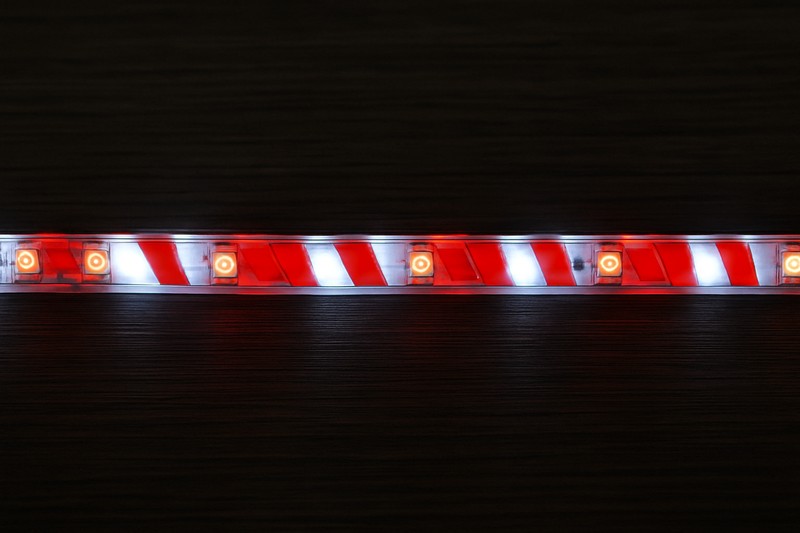
One of my clients, a lighting designer for commercial properties, landed a huge contract for a city’s downtown holiday display. Other bidders proposed static lights. He proposed a fully animated show using our addressable WS2811 strips. He programmed the lights on the streetlights to have a slow, sparkling "falling snow" effect. The strips outlining the buildings had a synchronized, flowing red-and-green chase. He even timed it all to music played in the town square. The result was absolutely spectacular and became a major local attraction. The city officials were thrilled. He won the contract because he wasn’t just selling light; he was selling an experience. That is the power of addressable technology. It transforms a static display into a dynamic performance.
Addressable vs. Standard RGB Strips
It’s critical to understand the difference between the two main types of color-changing strips.
- Standard RGB/RGBW: On a standard RGB strip, all the LEDs on the entire reel are connected to the same three or four channels (Red, Green, Blue, White). You can set the entire strip to be any color you want, but all the LEDs will always be the same color at the same time. You can make the whole strip fade from red to green, but you can’t have red and green on the same strip simultaneously.
- Addressable (Pixel) Strips5: These are the key to dynamic effects. They have an extra Integrated Circuit (IC) chip6 for every LED or for small groups of LEDs. Common ICs are WS2811, WS2812B, or SK6812. This IC gives each section its own unique "address." A special controller can then send commands to these individual addresses, telling one section to be red while the section next to it is white, and the next one is red, and so on. This is how you create chasing, flowing, and rainbow effects.
To create a dynamic show, you need a complete system:
| Component | Function | Professional Choice | Why it Matters for Holiday Displays |
|---|---|---|---|
| LED Strip | The light source. | Addressable IP67 Strip (e.g., WS2811). | Allows for individual LED control, crucial for animations like "candy cane" or "sparkle." |
| Controller | The "brain" that sends data to the strip. | A dedicated SPI controller7 (e.g., T-1000S, or a computer-based system like xLights). | Provides the processing power and software interface to program complex, custom scenes. |
| Power Supply | Converts AC power to DC power for the system. | A high-quality, weatherproof 12V or 24V power supply8. | Reliability is key; a failed power supply takes down the whole show. |
By using addressable strips, you elevate your offering from a simple lighting installation to a custom-designed visual production. It’s a higher skill and a higher value service.
What’s the Best Way to Power Long Runs for Holiday Lighting?
You’ve installed a beautiful 100-foot run of LED strips along a roofline, but the end is dim and yellowish-orange instead of bright white or red. Your impressive display is ruined by voltage drop.
For long runs, you must use power injection. This means running a separate, parallel power wire from the power supply and connecting it to the strip at regular intervals (e.g., every 5-10 meters) to maintain consistent voltage and brightness.
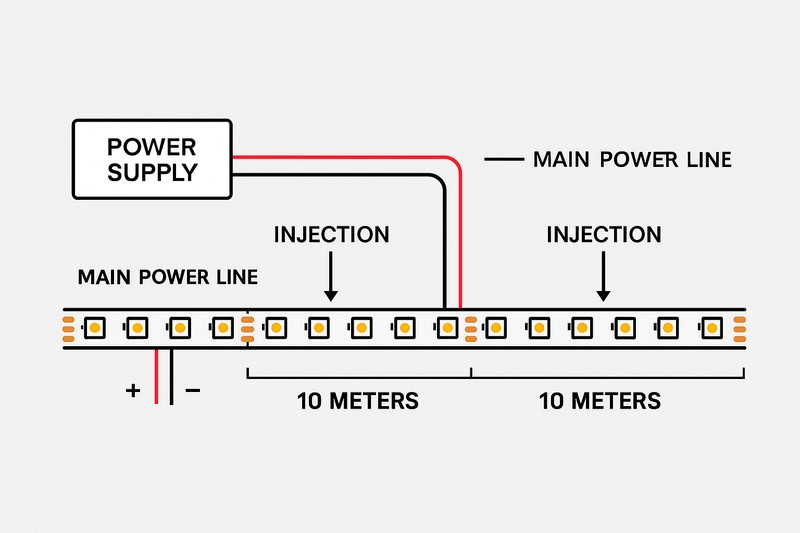
I get calls about this every holiday season. An installer will buy our 24V strips, which are much better for long runs than 12V, but they’ll try to power a 20-meter run from only one end. They call me saying the product is defective because the end is a different color. It’s not a defect; it’s physics! The thin copper traces on the flexible PCB can only carry so much current over a distance before the voltage starts to drop. I walk them through planning a proper power injection strategy. By running a thicker gauge two-conductor wire alongside the strip and connecting it to the strip’s power pads every 10 meters, the problem is completely solved. Uniform brightness from start to finish. Planning your power layout is just as important as choosing the right strip.
Understanding and Defeating Voltage Drop9
Voltage drop is the gradual loss of electrical voltage along the length of a conductor. In LED strips, this causes two major problems:
- Dimming: The farther the LEDs are from the power source, the less voltage they receive, and the dimmer they become.
- Color Shift: White or colored light from an RGB LED is a mix of red, green, and blue diodes. The red diodes require the lowest voltage to light up. As voltage drops, the blue and green diodes receive insufficient power first, making the light appear warmer, often shifting to a yellowish or reddish hue.
The Professional Powering Strategy
Never rely on powering a run longer than 5 or 10 meters from a single end connection.
- Choose 24V Strips: As a rule, always select 24V DC strips over 12V for any large-scale project. For the same power, 24V systems draw half the current (Amps) of 12V systems. Lower current means less voltage drop, allowing you to have longer segments between power injection points.
- Plan for Power Injection10: Before you install, map out your power plan. The gold standard is to power the strip from the center of the run, allowing power to flow 5 meters in each direction. For longer runs, use a parallel power bus wire.
Here is a simple guide for injection intervals:
| Strip Voltage | Maximum Length before Injection (High Brightness) | Recommended Injection Interval | Parallel Wire Gauge (for up to 30m) |
|---|---|---|---|
| 12V DC | 5 meters (16.4 ft) | Every 5 meters | 16 AWG or 14 AWG |
| 24V DC | 10 meters (32.8 ft) | Every 10 meters | 18 AWG or 16 AWG |
Properly powering your installation is the difference between a professional, uniform display and an amateur-looking one with failing, discolored sections. It’s a critical step that cannot be skipped.
How Do You Securely Install and Protect Strips for Seasonal Use?
You spent hours installing beautiful holiday lights, but a winter storm with heavy winds and ice has pulled them down. Now you have to do the work all over again in freezing weather.
Use aluminum mounting channels with mounting clips screwed directly into the surface. This provides a secure, permanent housing that protects the strip from physical impact, wind, and ice, and makes seasonal removal and reinstallation much easier.
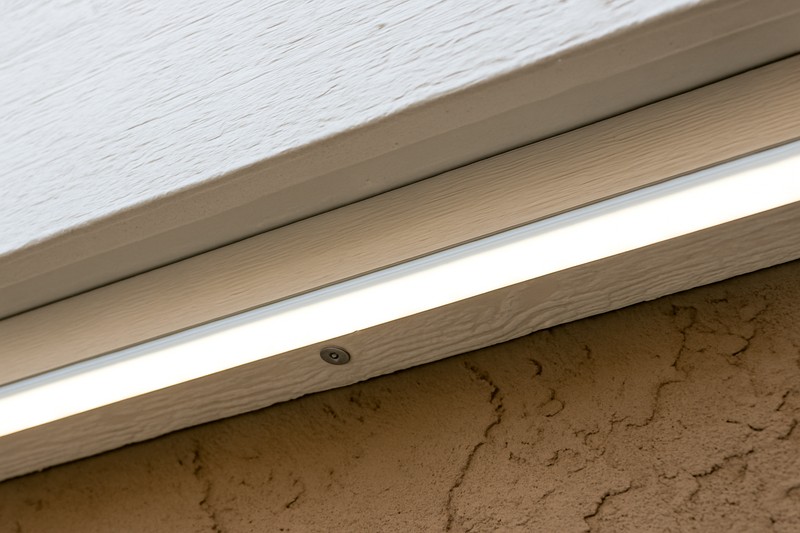
A contractor client who does high-end residential holiday lighting used to rely on the strip’s built-in adhesive tape and some plastic clips. It was a constant struggle. The adhesive would fail in the cold, and the plastic clips would become brittle and break. One windy season, he had to go back to a single house three times to fix sagging or fallen strips. He was losing all his profit on callbacks. I convinced him to switch to a system using our aluminum channels. He screws the channels permanently and discreetly to the client’s home. Each fall, his team simply snaps the LED strips into the channels and connects the waterproof wiring. In the spring, they snap them out for storage. It’s fast, secure, and the channels protect the strips. He now calls it his "Install-Once, Revenue-Forever" system.
The Case Against Tape and Plastic Clips
For professional, seasonal installations, you cannot rely on temporary solutions.
- Adhesive Tape: The double-sided tape on the back of LED strips is meant for initial positioning, not permanent outdoor mounting. It will fail with exposure to moisture, UV, and wide temperature swings.
- Plastic Mounting Clips: While better than nothing, cheap plastic clips become brittle in freezing temperatures and can be degraded by UV light. They are a common point of failure, especially under the weight of snow or ice.
The Aluminum Channel System: Protection and Permanence
Using aluminum channels is the definitive professional method.
- Secure Mechanical Fastening: The channel itself is secured to the structure with screws, a bond that will not fail due to weather. The strip is then held securely inside the channel.
- Physical Protection: The channel and its cover (which can be clear or diffused) act as a physical shield. They protect the strip from direct impact, debris, heavy snow, and ice buildup. They also add a layer of UV protection.
- Heat Dissipation: As a bonus, the aluminum acts as a heat sink, drawing heat away from the LEDs. Even in cold weather, this helps prolong the life of the LEDs.
- Simplified Servicing: If a strip ever needs to be removed for storage or replacement, it’s a simple matter of removing the cover and lifting the strip out. The secure mounting infrastructure remains in place.
Here’s how to build a weather-proof installation:
| Mounting Method | Security Level | Weather Resistance | Professionalism | Best Use Case |
|---|---|---|---|---|
| Adhesive Tape Only | Very Low | Poor | Amateur | Indoor, temporary use ONLY. Never outdoors. |
| Plastic Saddle Clips | Low-Medium | Fair | Low-End | Better than tape, but clips can break in cold/UV. |
| Aluminum Channel | Very High | Excellent | High-End Professional | The standard for any permanent or high-end seasonal outdoor installation. |
By investing in a robust mounting system, you are ensuring the longevity of your installation, drastically reducing frustrating and unprofitable callbacks, and delivering a truly professional and durable product to your clients.
Conclusion
Move beyond simple bulbs. Use addressable, IP67 silicone LED strips in channels to create durable, dynamic holiday masterpieces that will command a premium and delight your clients for years to come.
Explore how Continuous Light LED strips can enhance architectural aesthetics and provide a seamless lighting experience. ↩
Learn about the advantages of Solid-State Durability in LED strips, ensuring longevity and resilience in harsh conditions. ↩
Discover how LED strips can significantly reduce energy costs, making them a smart investment for holiday lighting. ↩
Find out how LED strip lights provide dynamic effects and full color control, enhancing creative possibilities for lighting designs. ↩
Explore this link to understand how Addressable Strips can enhance your lighting designs with dynamic effects. ↩
Learn about the role of IC chips in LED strips and how they enable individual control for stunning light displays. ↩
Discover the importance of a dedicated SPI controller in managing complex lighting setups effectively. ↩
Find out why a reliable power supply is crucial for maintaining the performance of your LED lighting systems. ↩
Understanding voltage drop is crucial for optimizing electrical systems and ensuring efficient performance. ↩
Learning about power injection strategies can significantly enhance the performance and longevity of your LED installations. ↩