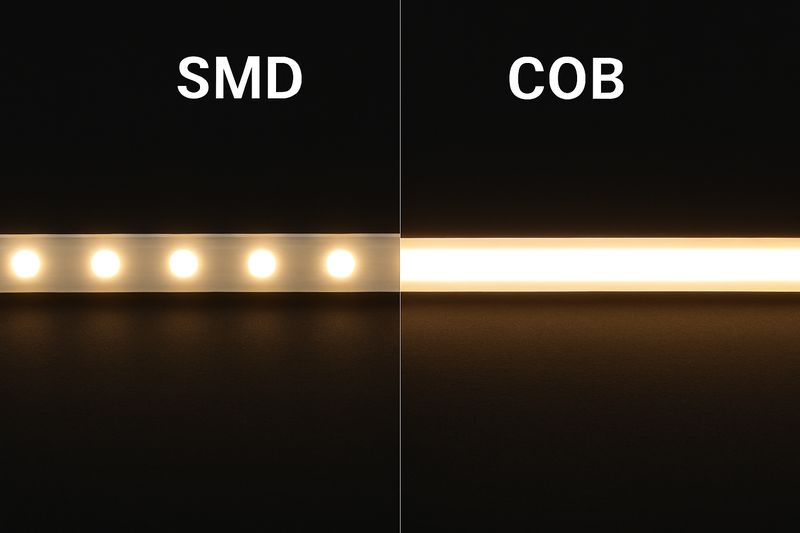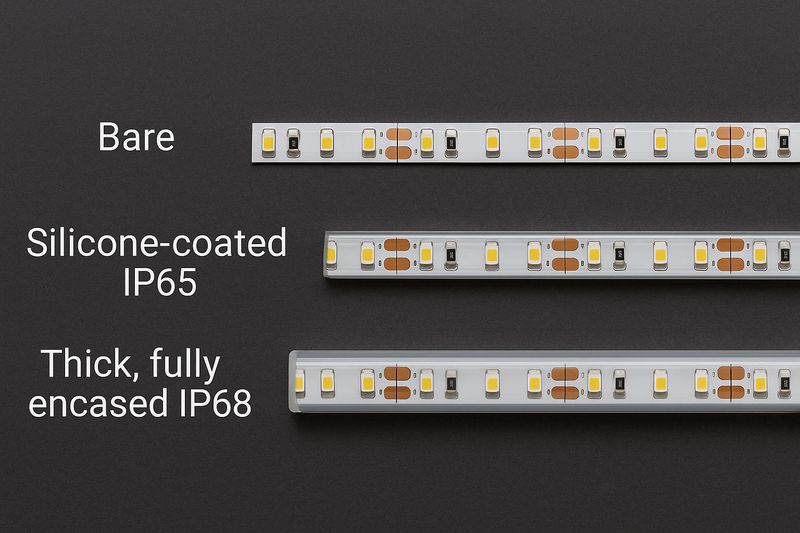
You’ve installed beautiful, high-quality outdoor LED strips, but they flicker or look dim. Worse yet, the cheap power adapter you used failed after a few months, forcing an embarrassing and costly repair visit.
To choose the right power supply, you must match its voltage to your strip, calculate the total wattage plus a 20% safety buffer, and ensure it has an IP67 waterproof rating and legitimate safety certifications like UL or ETL.
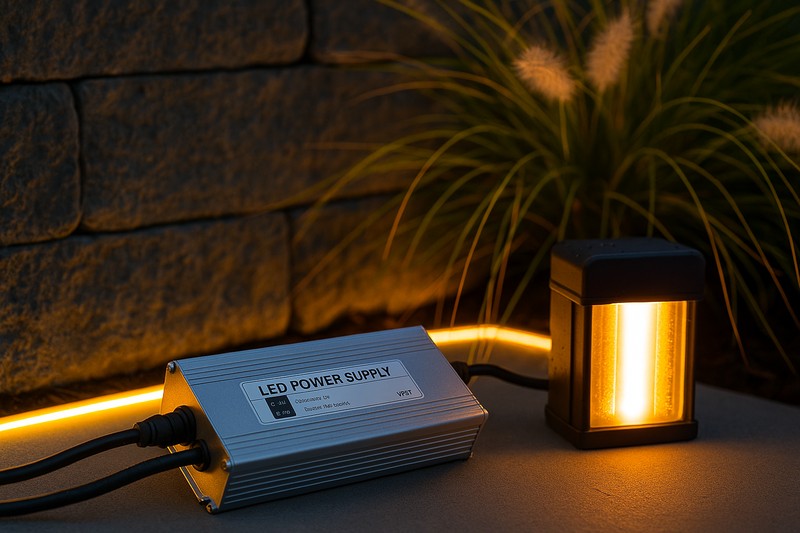
From my position as a factory providing complete lighting solutions, I can tell you that the power supply is the heart of your LED system. It’s the most common point of failure, and skimping on it is the worst decision a professional can make. A great power supply protects your investment, your reputation, and most importantly, your client’s property.
Why Are Voltage and Wattage the Most Critical Specs?
You found a power adapter, but you’re not sure if it’s the right one. Picking the wrong voltage could instantly fry your new lights, while picking one with too little wattage will cause frustrating performance issues.
You must strictly match the power supply’s voltage to your LED strip (e.g., 12V to 12V). Then, calculate the strip’s total wattage and select a power supply with at least 20% more capacity to ensure reliability.
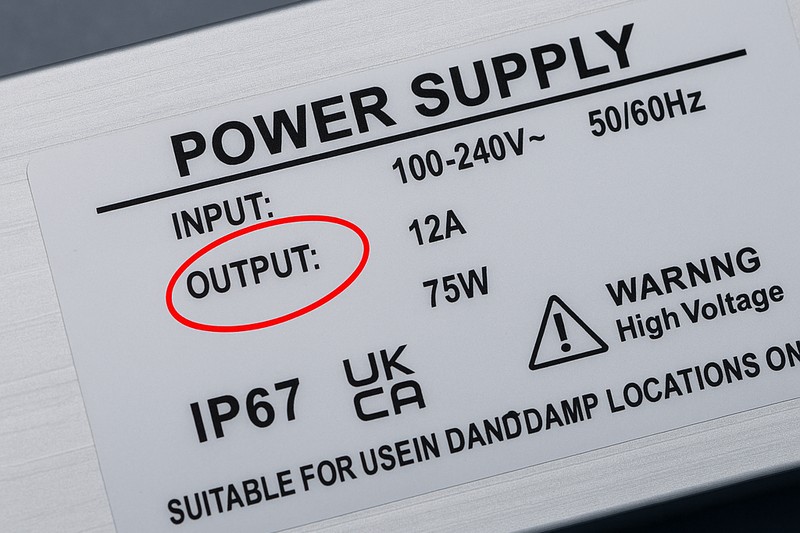
Getting these two numbers right is the first and most important step. A voltage mismatch is an instant, catastrophic failure. An wattage mismatch is a slow, heat-induced failure. Both are completely avoidable by following a simple rule.
The Two Pillars of Power
Let’s break down why these two specifications are non-negotiable.
1. Matching Voltage is a Strict Rule
LED strips are designed to operate at a specific DC voltage, almost always 12V or 24V. There is no flexibility here.
- What happens if you use a 24V power supply on a 12V strip? You will send double the required voltage through the strip’s circuits. This will instantly and permanently burn out the LEDs and resistors. The strip will be destroyed.
- What happens if you use a 12V power supply on a 24V strip? The LEDs will receive insufficient voltage. They will either be extremely dim or won’t light up at all.
The voltage must be an exact match.2. The 80% Rule for Wattage
The power supply’s wattage rating is its maximum capacity. Running any electronic device at 100% of its maximum capacity for long periods generates excess heat and drastically shortens its lifespan. To prevent this, professionals use the "80% rule1."
- How to Calculate: First, find your strip’s total power consumption. (Watts per meter) x (Total meters) = Total Watts.
- How to Apply the Rule: (Total Watts) x 1.2 = The minimum power supply wattage2 you need. This 20% buffer ensures the power supply runs cool and efficiently.
| Scenario | Calculation | Result |
|---|---|---|
| Undersized Supply | 100W strip on 80W supply | Flickering, overheating, premature failure. |
| "Perfectly" Sized | 100W strip on 100W supply | Runs hot, reduced lifespan, no room for error. |
| Professionally Sized | 100W strip on 120W+ supply | Runs cool, stable power, long and reliable life. |
What IP Rating Do You Need for an Outdoor Power Supply?
You found a power supply with the right voltage and wattage, but it’s a simple plastic box with an open frame. You know that if you install this outside, the first rainstorm or snowfall will destroy it.
For any outdoor LED installation, the power supply must have a minimum Ingress Protection rating of IP67. This certifies that it is completely sealed against both dust and temporary immersion in water, ensuring its survival outdoors.
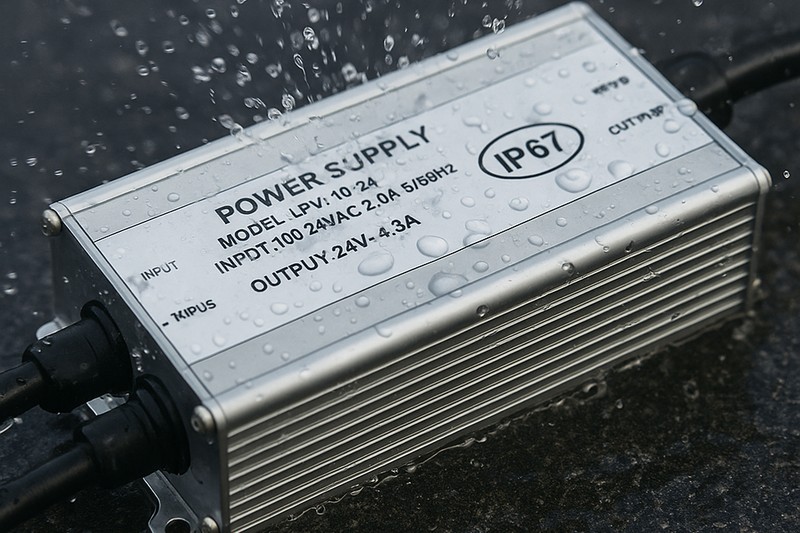
As a manufacturer for North American and European markets, I cannot overstate this. Water and electricity do not mix. Using an indoor-rated power supply (like IP20) outside is not just unprofessional; it’s a dangerous fire hazard. The IP rating is a direct measure of the product’s ability to protect itself, and your project, from the elements.
Built for the Outdoors
The IP rating is more than just a number; it’s a promise of durability.
Decoding IP Ratings
The IP code consists of two digits:
- First Digit (Solids): This rates protection against solid objects, from hands to dust. A ‘6’ is the highest rating, meaning it is completely "dust tight." This is important to keep dirt and insects out of the electronics.
- Second Digit (Liquids): This rates protection against moisture. A ‘5’ (IP65) means it can resist jets of water. A ‘7’ (IP67) means it can be temporarily submerged in water up to 1 meter deep. For outdoor power supplies that may sit in puddles or be exposed to heavy rain, IP67 is the safe, professional standard.
The Importance of Casing
Beyond the IP rating3, look at the physical construction. A high-quality outdoor power supply should have a sealed aluminum casing4, not plastic. Aluminum is essential for dissipating the heat generated during operation. A plastic case will trap heat, leading to overheating and a much shorter lifespan for the internal components, even if it’s waterproof. A rugged metal case also provides better physical protection.
| IP Rating | Protection Against Solids | Protection Against Liquids | Suitable Environment |
|---|---|---|---|
| IP20 | Fingers, large objects | None | Indoor only, dry locations. |
| IP65 | Dust tight | Water jets (e.g., hose spray) | Damp locations, protected outdoor areas (e.g., covered porch). |
| IP67 | Dust tight | Temporary immersion in water | Fully exposed outdoor locations, direct rain. |
Why Should You Always Look for UL or ETL Certifications?
You find two power supplies online. They look identical, but one is much cheaper. The cheaper one has no safety markings, while the other is "UL Listed." You are tempted to save money, but you worry about the risk.
You must always choose a power supply with a safety certification mark like UL, ETL, or CE. This mark proves it has been independently tested to meet strict safety standards for fire and electrical shock, protecting you from liability.
This is a major pain point for my clients like Tom, who know that some suppliers will falsify certificates. A legitimate certification is your assurance that the product will not be a liability. It’s a non-negotiable part of a professional’s component list. The small savings on an uncertified unit are not worth the immense risk to property and safety.
The Mark of a Safe Product
A safety mark is a sign of quality and accountability.
What Does a UL or ETL Mark Mean?
Underwriters Laboratories (UL) and Intertek (ETL) are Nationally Recognized Testing Laboratories (NRTLs) in North America. When a product is UL Listed or ETL Listed, it means a sample has been rigorously tested by that third-party lab and found to meet established safety standards. They check for things like:
- Proper wiring and insulation to prevent electrocution.
- Over-current and over-heating protection to prevent fires.
- Durable construction that won’t easily break and expose live parts.
Electrical inspectors will look for these marks. A non-certified power supply can cause an entire project to fail inspection.The Dangers of Uncertified Power Supplies
A cheap, uncertified power supply5 is a black box. You have no idea if the internal safety features are present or functional. They often use substandard components, have poor soldering, and may output unstable voltage that can damage your expensive LED strips over time. They are the number one cause of electrical fires in low-voltage lighting systems.
| Certification6 | Region | Primary Focus |
|---|---|---|
| UL / ETL | North America | Product Safety (Fire & Electrical Shock) |
| CE | Europe | Manufacturer’s declaration of conformity |
| RoHS | Global | Restriction of Hazardous Substances (e.g., lead) |
Should You Use a Constant Voltage or Constant Current Driver?
You see two types of power supplies listed: "Constant Voltage" and "Constant Current." They are both called "LED drivers," but they are fundamentally different. Choosing the wrong one for your LED strips will guarantee failure.
Flexible LED strips are designed to be used with a Constant Voltage (CV) power supply. A Constant Current (CC) driver will overpower the strip’s resistors and destroy the LEDs. You must use a CV driver.
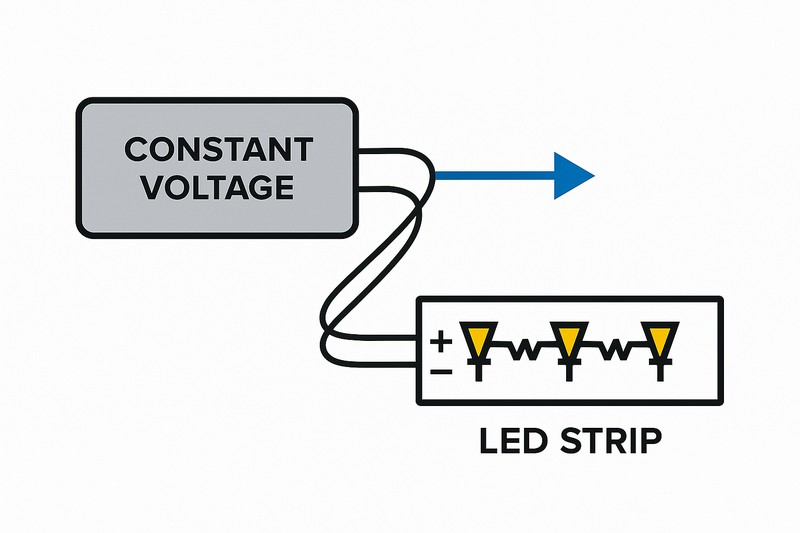
This is a point of confusion for many, but the rule is simple and absolute. From the factory, we design LED strips with tiny, built-in resistors to regulate the current for each small group of LEDs. They rely on receiving a steady, fixed voltage.
Understanding the Two Driver Types
Knowing the difference makes you an expert.
What is Constant Voltage (CV)?
A Constant Voltage power supply maintains a steady, fixed output voltage (e.g., 12V or 24V), regardless of how much load (how many LED strips) is connected to it, up to its maximum wattage rating. The LED strip itself, with its onboard resistors, is responsible for controlling the current. This is how all flexible LED strips are designed to work. You wire them in parallel to the CV power supply.
What is Constant Current (CC)?
A Constant Current driver does the opposite. It maintains a steady, fixed output current (e.g., 350mA or 700mA) by varying its output voltage. These are used for high-power LEDs that do not have resistors and are wired together in a series circuit, like those found in commercial downlights or streetlight modules.
The Result of a Mismatch
If you connect a standard 12V LED strip to a CC driver, the driver will try to force its full rated current through the LEDs. This will bypass the protection of the resistors, causing the voltage to spike far above 12V. The LEDs will shine intensely bright for a few seconds before burning out forever.
| Feature | Constant Voltage (CV) Power Supply | Constant Current (CC) LED Driver7 |
|---|---|---|
| Output | Fixed Voltage (e.g., 12V) | Fixed Current (e.g., 700mA) |
| Used For | Flexible LED Strips8 | High-Power LEDs, specific fixtures |
| How it Works | Supplies stable voltage to the strip’s resistors | Varies voltage to maintain a steady current |
| Wiring Method | Parallel | Series |
Conclusion
The power supply is the foundation of your outdoor lighting system. For a safe, professional, and long-lasting installation, always choose a power supply with the correct voltage, wattage, IP67 rating, and safety certifications.
Understanding the 80% rule is crucial for optimizing power supply efficiency and longevity. ↩
Learn how to accurately calculate power supply wattage to ensure device safety and performance. ↩
Understanding IP ratings is crucial for selecting the right outdoor equipment, ensuring it meets your environmental needs. ↩
Explore the advantages of sealed aluminum casings for outdoor power supplies, ensuring durability and heat dissipation. ↩
Understanding the risks associated with uncertified power supplies can help you make safer choices for your electrical needs. ↩
Exploring various power supply certifications will inform you about safety standards and help you choose reliable products. ↩
Understanding CC LED drivers is crucial for ensuring the longevity and performance of your LED installations. ↩
Explore the versatility of flexible LED strips and discover innovative applications for your lighting projects. ↩