You’ve found an outdoor LED strip at a price that seems too good to be true. But a few months after installation, it fails, forcing you to start over. This common scenario costs time, money, and reputation.
The biggest mistakes are focusing only on initial price, misinterpreting IP ratings, neglecting heat management, and ignoring color quality. Avoiding these pitfalls requires shifting focus from the strip’s price tag to the total system’s performance and longevity.
As a factory owner, I’ve seen these mistakes play out time and again. A smart business owner like Tom knows that the real cost of a product includes the cost of its failure. By understanding these common traps, you can make an informed purchasing decision that ensures your project is a long-term success, not a short-term headache.
Why Does Focusing Only on the Price Per Meter Lead to Higher Costs?
It’s incredibly tempting to choose the supplier with the lowest price per meter. In a competitive market, every dollar saved seems like a win. But what is the hidden cost of that "bargain"?
A rock-bottom price is almost always a sign of compromised quality in materials and manufacturing. This leads to premature failure, which means you pay twice: once for the cheap strip, and again for its replacement and the labor to install it.
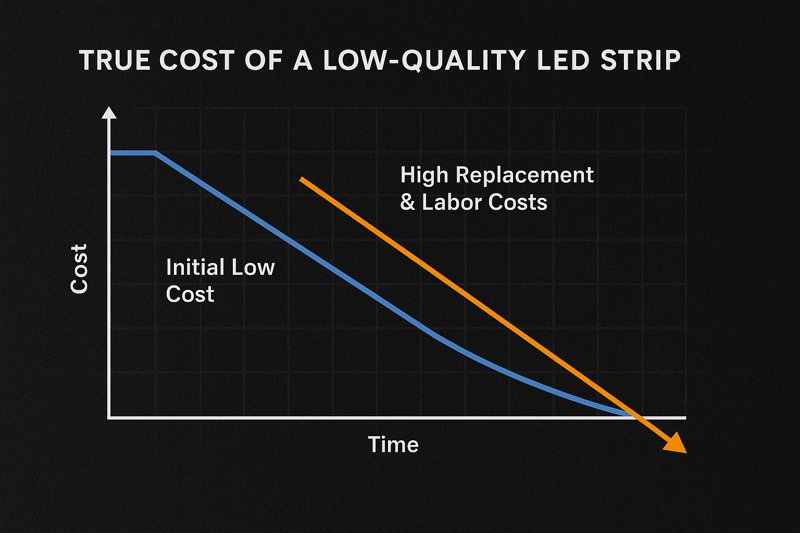
This is the classic "buy cheap, buy twice" trap. For a professional who sources products for large projects, reputation is on the line. A failed product doesn’t just cost money; it damages the trust you have with your client.
The Total Cost of a "Cheap" Strip
The initial savings are an illusion. The real costs appear later.
- The Cost of Replacement1: A cheap strip might use a thin PCB and low-grade LED chips. It could fail in less than a year. A quality strip from a reliable factory like Rhlite is designed to last for years. You would have to buy and install the cheap strip multiple times over the lifespan of one quality product.
- The Cost of Labor2: Labor is a huge expense. The cost to have an electrician access and replace a failed strip—especially on a building facade or high ceiling—can be many times more than the cost of the strip itself. This labor cost is incurred every time the cheap strip fails.
- The Cost of Reputation3: For a business owner like Tom, specifying a product that fails makes him look bad. It leads to angry client calls and can cost him future business. The damage to his reputation can be the highest cost of all.
Think of it as an investment. A quality strip is an investment in reliability.
| Factor | "Bargain" Strip (Low Initial Price) | Quality Rhlite Strip (Higher Initial Price) |
|---|---|---|
| Initial Cost | Low. | Moderate. |
| Expected Lifespan | < 1-2 years. | 5+ years. |
| Replacements | 2-3 replacements needed over 5 years. | Zero replacements needed. |
| Total Labor Cost | High (Cost of initial install + 2-3 re-installs). | Moderate (Cost of initial install only). |
| Total 5-Year Cost | Often 2x-3x the cost of the quality strip. | Just the initial investment. |
Are You Misinterpreting IP Ratings and Risking Water Damage?
You see a product listed as "IP65 waterproof" and assume it’s fine for any outdoor location. But after the first winter with rain and snow, the lights are dead.
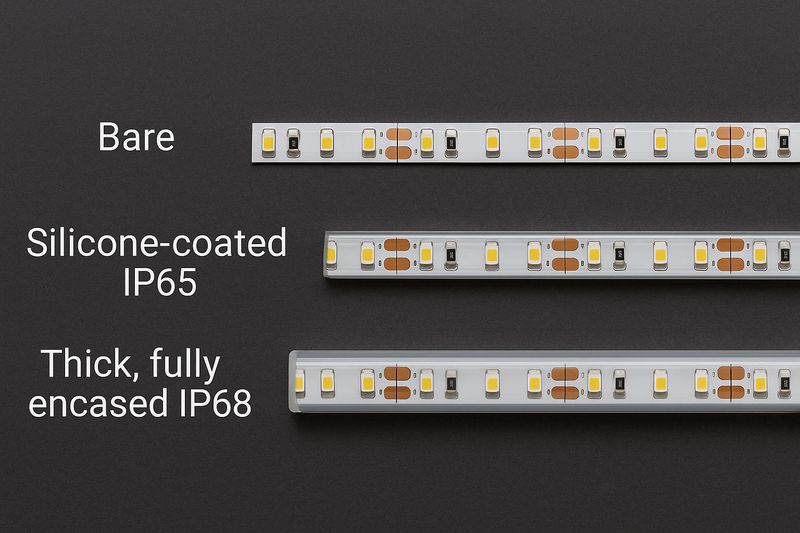
A huge mistake is using a strip with an inadequate IP (Ingress Protection) rating for its environment. IP65 is only resistant to water jets; it is not protected against immersion, which is where IP67 and IP68 are required.
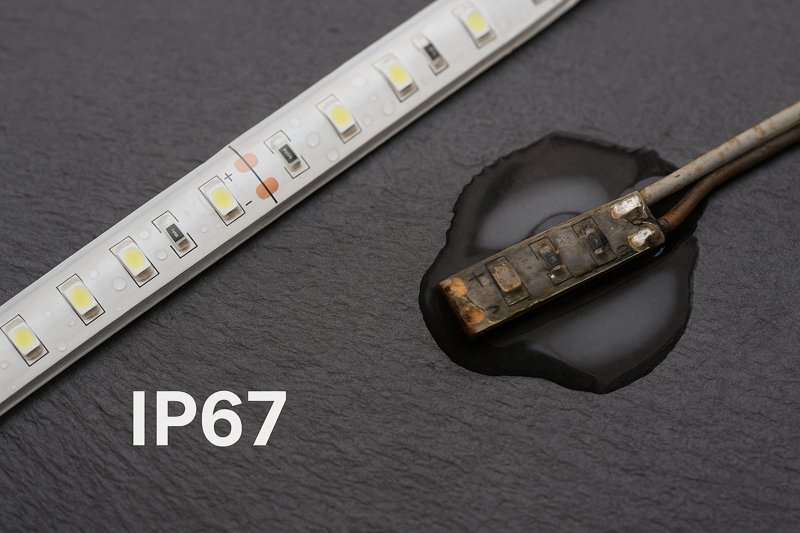
This is one of the most common technical errors. It’s also an area where some suppliers can be misleading, which addresses Tom’s pain point about falsified certificates. Understanding what these numbers actually mean is your best defense against water damage and premature failure.
A Practical Guide to IP Ratings
Let’s break down the ratings you’ll see for outdoor strips.
- What IP65 Really Means (Splash-Proof): The ‘6’ means it is dust-tight. The ‘5’ means it is protected against water jets from any direction. This is fine for areas that get rained on but have excellent drainage and will never have standing water, like a vertical wall or under a deep eave.
- When to Use IP674 (Immersion-Proof): The ‘7’ means the strip is protected against temporary immersion in water (up to 1 meter for 30 minutes). This is the minimum standard for ground-level installations, landscape lighting, or any area that might experience puddles or be hit by sprinklers.
- When to Demand IP685 (Submersible): The ‘8’ means the strip is protected against continuous, long-term immersion under pressure. This is essential for underwater applications like pools and fountains, or in extremely wet environments. A quality Rhlite IP68 strip will use superior materials like polyurethane (PU) to ensure this level of protection.
Choosing correctly is critical. Using an IP656 strip where an IP67 is needed is a guarantee of failure.
| IP Rating | Protection Level | Common Use Case |
|---|---|---|
| IP65 | Dust-tight, protected from water jets. | Under covered porches, on vertical building walls. |
| IP67 | Dust-tight, protected from temporary immersion. | Landscape paths, decks, near sprinklers. |
| IP68 | Dust-tight, protected from continuous immersion. | Inside pools, fountains, water features. |
Why Do LED Strips Fail Prematurely Without Proper Heat Sinking?
Your beautiful, bright LED strip installation looks great for the first few months. Then, you notice it’s getting dimmer or starting to flicker. The strip itself might not be defective; it might be slowly cooking itself.
LEDs generate heat, and this heat is their number one enemy. A common mistake is installing an LED strip, especially a mid-to-high power one, directly onto a surface like wood or plaster without an aluminum channel to act as a heat sink.
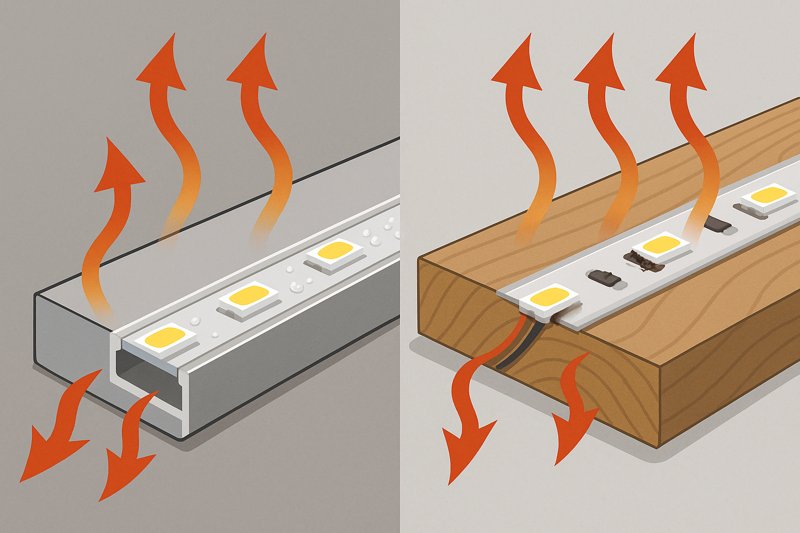
Heat dramatically accelerates the degradation of the LED chip, a process called lumen depreciation. Without a way for the heat to escape, the strip’s lifespan and brightness will be severely reduced. This is a technical detail that, when ignored, has massive financial consequences.
Managing the Silent Killer
Heat management is not an optional accessory; it is a core part of a reliable system.
- Heat and Lumen Depreciation7: Every LED has a rated lifespan, often L70 at 50,000 hours. This means it will retain at least 70% of its initial brightness after 50,000 hours if kept at its specified operating temperature. If it runs too hot, it might drop to 70% brightness in just 10,000 hours.
- The Role of the Aluminum Channel8: Aluminum is an excellent thermal conductor. When you mount the strip inside an aluminum channel, the channel pulls heat away from the LED chips and dissipates it into the air. This keeps the LEDs running cool and ensures they reach their rated lifespan.
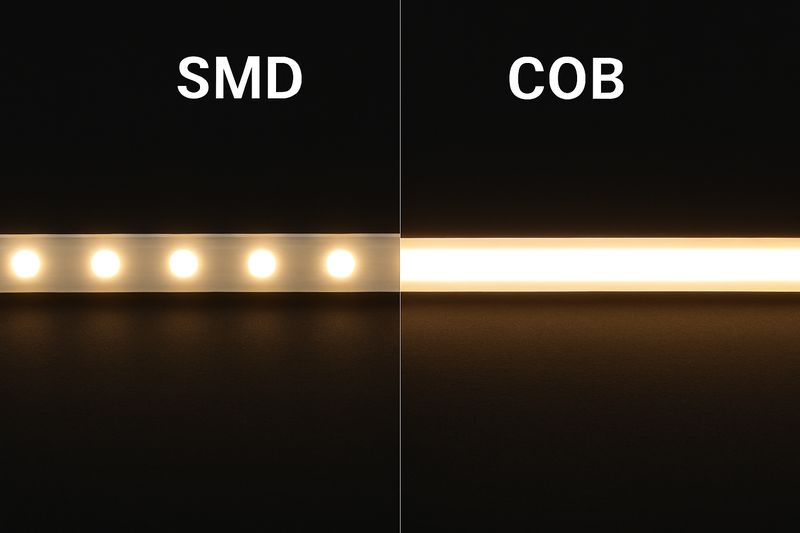
- More Than Just a Channel: The channel also provides physical protection for the strip and, with a diffuser, creates a more professional, even, and dot-free line of light. This improves the aesthetics, which is important for a buyer like Tom who understands sales but wants to deliver a high-quality look.
For any outdoor strip over about 10 watts per meter, using an aluminum mounting channel9 should be considered mandatory, not optional.
How Can Inconsistent Color Ruin a High-End Project?
You complete a long architectural lighting installation. When you turn it on, you see a disaster: one section of the wall looks warm white, while the next section looks cool and blueish.
A critical mistake is ignoring color consistency, both in terms of Color Rendering Index (CRI) and color binning. Using cheap strips with a low CRI and from wide, inconsistent bins will ruin the professional look of any project.
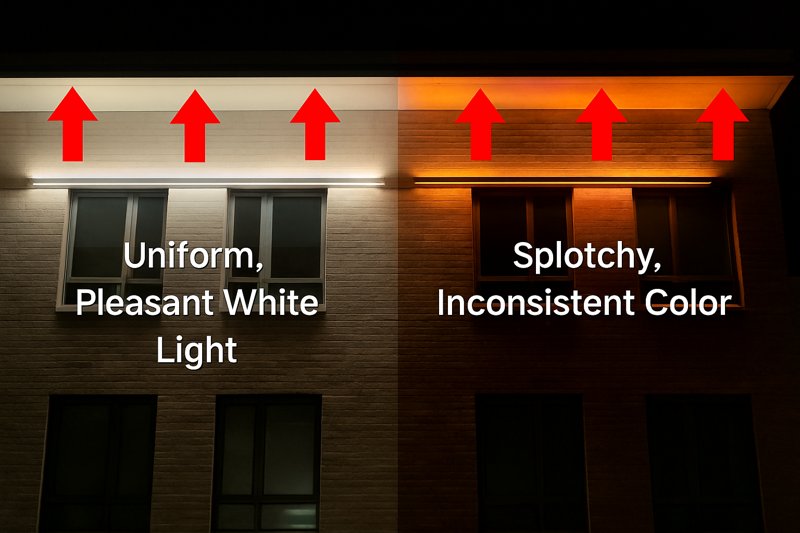
This issue can turn a potential masterpiece into an amateur-looking failure. For clients in North America and Japan, who have high standards for quality and aesthetics, this is an unacceptable outcome. It’s a pain point that a reliable factory partner like Rhlite solves by maintaining strict quality control over color.
The Science of Quality Light
Two metrics are key to avoiding this mistake.
- CRI (Color Rendering Index): This measures how accurately a light source reveals the true colors of objects. Sunlight has a CRI of 100. A CRI of 90+ is considered excellent for professional applications, making colors look rich and natural. A cheap strip might have a CRI of 80 or less, making everything look dull or washed out.
- Color Binning (MacAdam Ellipse): During manufacturing, LEDs are sorted into "bins" based on their precise color temperature. A tight bin (e.g., a 3-Step MacAdam Ellipse) ensures that all the LEDs on a strip, and between different strips, have a virtually identical shade of white. Cheap strips use wide bins, leading to the noticeable and unprofessional color variations.
When Tom specifies a project, he needs to be able to guarantee his client a uniform, high-quality light. He can only do that by sourcing from a factory that guarantees a high CRI and tight color binning. This is a non-negotiable feature for any high-end application.
Conclusion
Avoiding these common mistakes is simple. It requires a shift in mindset: from hunting for the lowest price to investing in a complete, high-quality system from a partner you can trust. This approach saves you money and protects your reputation.
Exploring replacement costs can reveal the true value of investing in quality LED strips over cheaper alternatives. ↩
Understanding labor costs can help you make informed decisions about LED strip installations and their long-term expenses. ↩
Learn how product reliability impacts business reputation and customer satisfaction, crucial for long-term success. ↩
Understanding IP67 is crucial for ensuring your outdoor lighting is safe and effective in wet conditions. ↩
Explore the advantages of IP68 rated lights for underwater and wet environments to make informed choices for your projects. ↩
Learn how IP65 rated lights can withstand outdoor conditions, ensuring durability and reliability in your installations. ↩
Understanding Heat and Lumen Depreciation is crucial for maximizing LED lifespan and efficiency. Explore this link for in-depth insights. ↩
Discover how aluminum channels enhance LED performance and longevity, ensuring optimal heat management and aesthetics. ↩
Learn why using an aluminum mounting channel is essential for outdoor LED strips to ensure durability and performance. ↩