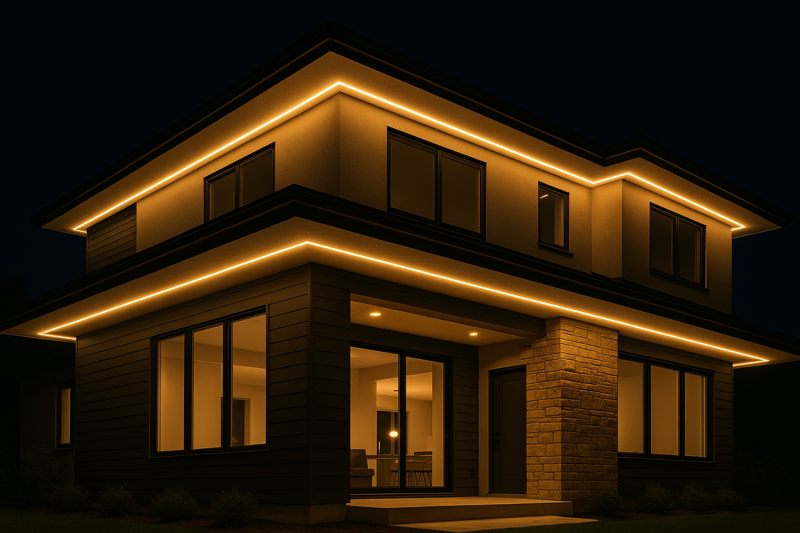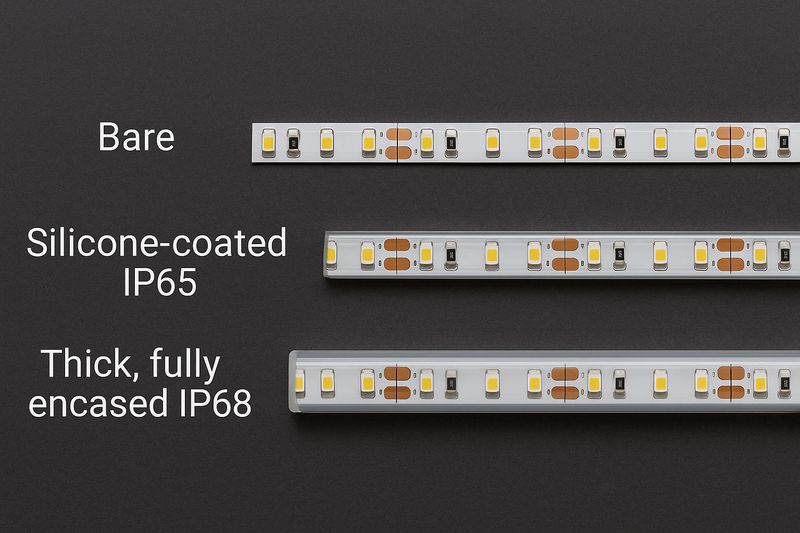
Worried about outdoor lights failing in rain or snow? Water damage can ruin your expensive lighting projects. This guide reveals the best waterproof LED strips for lasting outdoor use.
The best waterproof LED strip lights for outdoor installations feature high IP ratings like IP67 or IP68. These ratings mean they are protected against dust and significant water exposure, ensuring reliability and longevity.
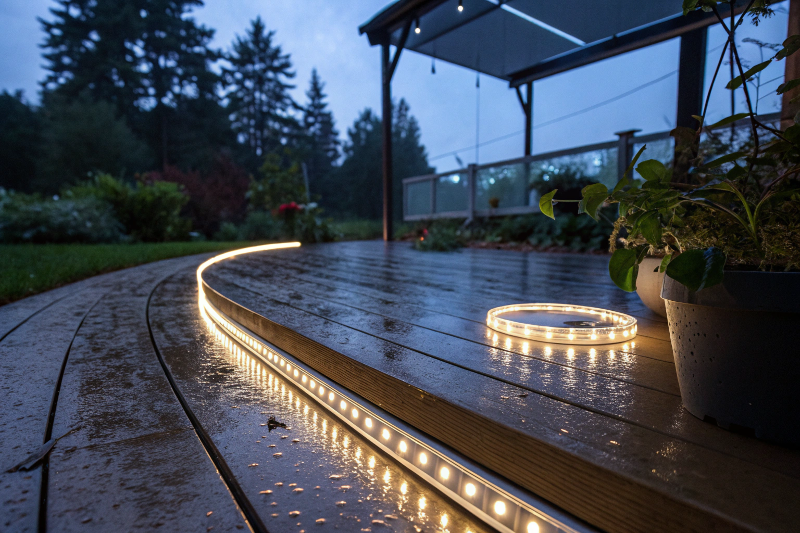
Choosing waterproof LED strip lights might seem straightforward, but there’s more to it than just a "waterproof" label. As someone who owns Rhlite, a factory specializing in LED strip solutions, I’ve seen many clients, like Tom, struggle with products that don’t live up to their outdoor claims. Let’s dig into what truly makes an LED strip light ready to face the elements.
Understanding Waterproof Ratings: What do IP65, IP67, and IP68 Really Mean for Outdoor LED Strips?
Confused by all the different IP ratings? Choosing the wrong one can lead to your outdoor LED strips failing quickly when exposed to rain, sprinklers, or humidity, causing costly replacements and unhappy clients. Learn what these codes mean so you pick the right protection.
IP65 strips resist water jets, suitable for light rain. IP67 strips can be temporarily submerged (up to 1m for 30 mins). IP68 offers continuous submersion protection. For most outdoor installations, IP67 or IP68 is best.
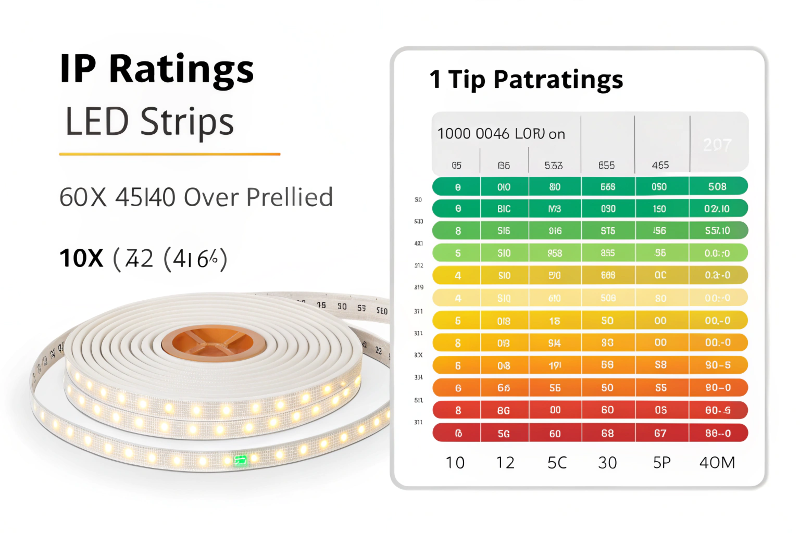
When I talk to buyers, especially experienced ones like Tom who source for major lighting and architecture projects in places like the United States, the IP (Ingress Protection) rating is one of the first technical specifications we discuss for outdoor LED strips. It’s a fundamental indicator of how well the strip will survive outdoors. It’s not just a marketing term; it’s a standardized system.
Decoding IP Ratings: The Two Key Numbers
An IP rating is composed of two digits. The first digit tells you about protection against solid objects, like dust or accidental contact. This ranges from 0 (no protection) to 6 (completely dust-tight). For any decent outdoor LED strip, you’ll want to see a ‘6’ as the first digit. This means no dust or dirt can get inside the strip, which is important for longevity.
The second digit is crucial for waterproofing1. This number ranges from 0 (no protection) to 9 (protection against high-pressure, high-temperature water jets). Here’s a breakdown of the common ones you’ll see for outdoor LED strips:
- IPX5 (e.g., IP65): Protected against low-pressure water jets from any direction. This means the strip can handle rain and splashes. It’s okay for some sheltered outdoor applications but might not be enough for very exposed areas or ground-level installations.
- IPX7 (e.g., IP672): Protected against temporary immersion in water (up to 1 meter deep for up to 30 minutes). This is a significant step up. IP67 rated strips are suitable for most outdoor applications, including areas that might get puddles or heavy rain. This is often the minimum I recommend for reliable outdoor performance at Rhlite, as it gives peace of mind. We ensure our IP67 products are genuinely tested. I know from experience that some suppliers might claim ratings they haven’t properly verified, which is a big pain point for buyers.
- IPX8 (e.g., IP683): Protected against continuous immersion in water under conditions specified by the manufacturer. This is the highest level of water ingress protection commonly found for LED strips. IP68 strips are suitable for underwater applications like pools (though specialized pool lights are often better), fountains, or areas with constant water exposure. The exact depth and duration for IP68 can vary, so it’s important to check the manufacturer’s specifications.
Here’s a simple table to illustrate:
| IP Rating | First Digit (Solids) | Second Digit (Liquids) | Common Outdoor Use Examples |
|---|---|---|---|
| IP65 | 6 (Dust Tight) | 5 (Protected against water jets) | Sheltered patios, under eaves, sign backlighting (mild exposure) |
| IP67 | 6 (Dust Tight) | 7 (Protected against temporary immersion up to 1m) | Garden lighting, deck lighting, pathway illumination, exposed areas |
| IP68 | 6 (Dust Tight) | 8 (Protected against continuous immersion, conditions vary) | Ponds, fountains, very wet environments, ground burial (with protection) |
When selecting, always consider the specific environment. For general garden and patio lighting, IP67 is usually a robust choice. If the lights will be near a pool edge or in an area prone to flooding, IP68 provides that extra security. At Rhlite, we focus on providing reliable IP67 and IP68 solutions because we understand that callback and replacement costs for outdoor installations can be very high for our clients.
Which Materials Offer the Best Waterproofing and Durability for Outdoor LED Strips?
Are your outdoor LED strips yellowing, cracking, or letting water in too soon? Poor quality materials are often the culprit, leading to premature failure and a compromised look for your lighting design. Find out which materials truly stand up to the elements.
High-grade silicone and polyurethane (PU) coatings offer superior waterproofing and UV resistance for outdoor LED strips. These materials remain flexible and clear, protecting the LEDs effectively against moisture and sun damage.
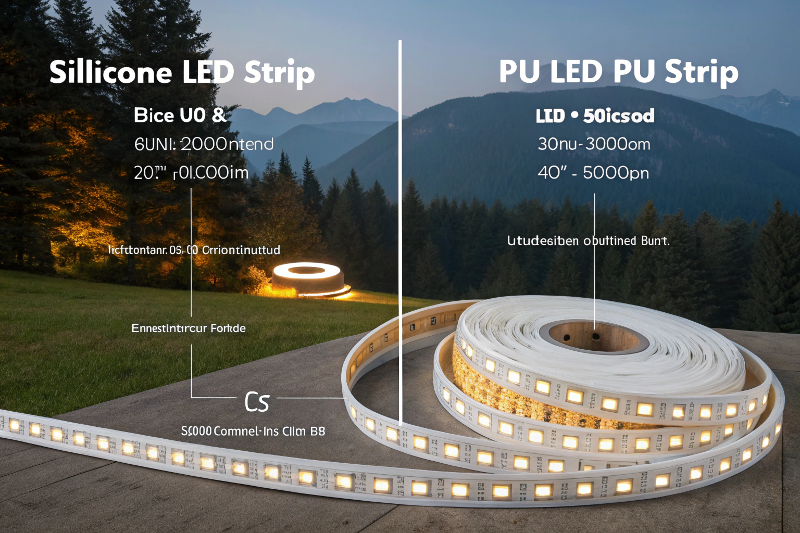
The IP rating tells you about the level of protection, but the materials used to achieve that protection are just as important for long-term durability, especially outdoors. Exposure to sunlight (UV radiation), temperature fluctuations, and moisture can degrade inferior materials quickly. This is something I always emphasize to clients like Tom, who are sensitive to quality because they understand that the product’s lifespan directly impacts their reputation and bottom line.
Silicone: The Popular Choice
Silicone is widely used for waterproofing LED strips4 due to its excellent flexibility, good temperature resistance, and inherent water-repellent properties. However, not all silicone is the same.
- Extruded Silicone Sleeves/Tubes: Many LED strips are housed within a silicone tube or sleeve, which is then sealed at the ends. This is a common and effective method for achieving IP67 or IP68.
- Silicone Coating/Encapsulation: Some strips have a direct silicone coating or are fully encapsulated in silicone. This can offer a more seamless look.
The key here is the quality of the silicone. Lower-grade silicone can turn yellow, become brittle, and crack after prolonged UV exposure. This compromises the aesthetic and, more critically, the waterproof seal. At Rhlite, we specify UV-stabilized, anti-yellowing silicone5 for our outdoor-rated products. This ensures they maintain their clarity and flexibility for much longer, even in sunny climates common in North America or Singapore.
Polyurethane (PU)6: A Premium Alternative
Polyurethane is another excellent material for waterproofing LED strips, often considered a premium option.
- PU Encapsulation: PU offers excellent UV resistance, often better than standard silicone, and is less prone to yellowing. It also has very good abrasion resistance and can be very clear.
- Adhesion: PU can sometimes offer better adhesion to the LED strip components, leading to a more robust seal.
The downside is that PU can be more expensive and sometimes a bit less flexible than silicone, depending on the formulation. We offer PU options for clients who require the utmost in UV stability and long-term clarity for high-end architectural projects.
Other Considerations: PVC and Connectors
While less common for flexible strip encapsulation, you might encounter PVC (Polyvinyl Chloride) in some rigid outdoor linear fixtures or as jacketing for certain types of outdoor LED neon flex. PVC can be durable but may not offer the same flexibility or UV stability as high-grade silicone or PU over many years.
Beyond the strip material itself, the end caps and connectors are critical weak points for water ingress if not properly sealed.
- Factory-Sealed Ends: Ideally, the ends of the LED strips should be factory-sealed for the best waterproof integrity.
- Waterproof Connectors: If strips need to be joined or connected to a power supply in the field, specific IP-rated waterproof connectors must be used. These often have O-rings and screw-tight mechanisms to ensure a watertight seal. Simply using heat shrink over a standard connector is often not sufficient for long-term outdoor reliability, especially for IP67 or IP68.
At Rhlite, we can supply strips cut to custom lengths with factory-sealed ends, minimizing potential failure points for installers. We also provide a range of compatible waterproof connectors and accessories. For businesses like Tom’s, who may be rebranding and distributing, ensuring these details are covered means fewer customer complaints and returns.
| Material | UV Resistance | Flexibility | Waterproofing | Cost | Common Use |
|---|---|---|---|---|---|
| High-Grade Silicone | Good to Very Good | Excellent | Excellent | Moderate | IP67/IP68 Strips, general outdoor |
| Polyurethane (PU) | Excellent | Good | Excellent | Higher | Premium IP67/IP68 Strips, high UV exposure |
| Low-Grade Silicone | Poor to Fair | Good | Good initially | Low | Cheaper strips, prone to yellowing/cracking |
| PVC | Fair to Good | Fair to Poor | Good | Low-Moderate | Rigid fixtures, some neon flex jacketing |
Choosing the right material is an investment in the longevity and performance of your outdoor lighting installation. It’s a detail that experienced professionals look for.
How Do You Ensure Long-Term Waterproof Performance in Outdoor LED Strip Installations?
Bought top-rated waterproof LED strips, but they still failed? Even the best strips can be compromised by poor installation, leading to water damage, short circuits, and a short lifespan for your outdoor lighting. Discover essential installation techniques for lasting waterproof performance.
Ensure long-term waterproof performance by using mounting channels for protection and heat dissipation, meticulously sealing all connections with IP-rated accessories, creating drip loops, and housing drivers in weatherproof enclosures.
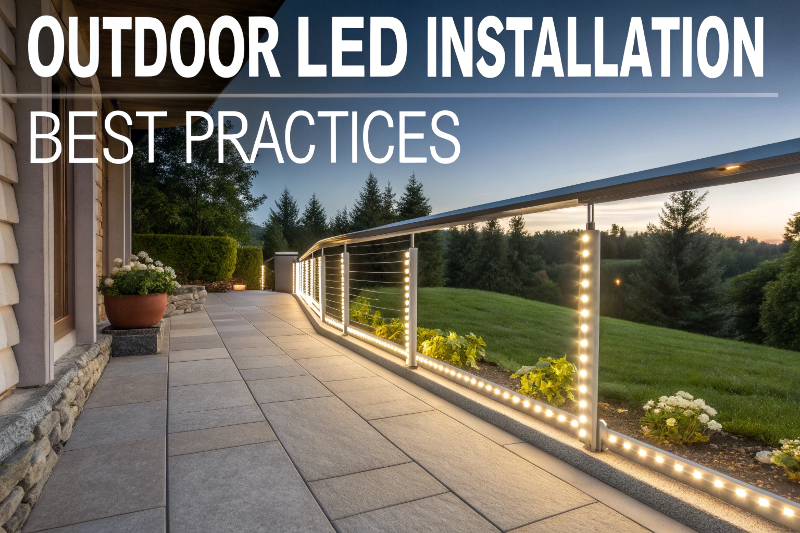
Having a high-quality, IP67 or IP68 rated LED strip made with durable materials is the first step. But the installation itself plays a massive role in whether that waterproofing will last. This is often where things can go wrong, leading to frustration for end-users and installers. As a factory, we provide the best possible product, but we also try to educate our clients, like Tom who manages projects and product lines, on best practices to ensure success downstream. Inefficient communication with suppliers can be a pain point, so clear guidance on installation is something we try to provide.
Mounting and Physical Protection
While many waterproof LED strips are robust, providing additional physical protection can extend their life and maintain waterproof integrity.
- Aluminum Channels/Profiles7: Using aluminum mounting channels with diffusers is highly recommended for outdoor installations. Channels offer several benefits:
- Protection: They shield the strip from direct impact, abrasion, and heavy water flow (like runoff from a roof).
- Heat Dissipation: Aluminum helps dissipate heat from the LEDs, which improves their lifespan and performance.
- Clean Aesthetics: They provide a more finished and professional look.
- Secure Mounting: Ensures the strip stays in place and isn’t stressed by movement.
When using channels, ensure they have weep holes or are angled to allow any water that might get in to drain out, especially if they are not fully sealed units themselves.
- Avoid Stress on the Strip: Don’t bend the strip too sharply, especially at connection points, as this can damage the internal circuitry or compromise the waterproof casing. Adhere to the manufacturer’s minimum bend radius.
Sealing Connections: The Critical Point
Anywhere the strip is cut, joined, or connected to a power supply is a potential entry point for moisture. This is where meticulous attention is needed.
- Use IP-Rated Waterproof Connectors8: As mentioned earlier, if you’re not using factory-sealed custom lengths, you must use connectors specifically designed for outdoor use with the correct IP rating. These often involve silicone gaskets, O-rings, and threaded collars.
- Silicone Sealant9: For extra security, high-quality, neutral-cure (non-acidic) silicone sealant can be applied around connector joints and end caps. Ensure the surfaces are clean and dry before application.
- Heat Shrink Tubing with Adhesive Lining: For soldered connections, use marine-grade heat shrink tubing that has an adhesive lining. When heated, the tubing shrinks and the adhesive melts, creating a waterproof seal around the joint. This is often a more reliable method than just connectors for permanent outdoor joins.
Strategic Placement and Cable Management
- Drip Loops: When running cables to the LED strip or between strip segments, create a "drip loop." This means allowing the cable to dip down below the connection point before rising up to it. Any water running down the cable will then drip off at the bottom of the loop instead of wicking into the connector or the strip. This is a simple but very effective technique.
- Elevate Where Possible: If installing strips on the ground (e.g., pathway lighting), try to elevate them slightly or use channels that keep them out of standing water as much as possible, even if they are IP68.
- Power Supply (Driver) Location: The LED driver/power supply must also be protected from the elements. Use a suitably IP-rated weatherproof enclosure if the driver itself isn’t outdoor rated. Ensure all connections to and from the driver are also watertight. At Rhlite, we also supply a range of IP-rated LED power supplies designed for outdoor use.
Testing Before Final Installation
It’s always a good idea to test your LED strips and connections for waterproofing (if practical and safe) before final installation, or at least inspect them very carefully. A common issue I’ve heard from clients dealing with other suppliers is receiving products with pre-existing flaws in the waterproofing due to poor QC. We have stringent QC processes to avoid this, but installer vigilance adds another layer of assurance.
A summary of installation best practices:
| Practice | Why It’s Important | Rhlite Support/Product Relevance |
|---|---|---|
| Use Mounting Channels | Protection, heat sink, aesthetics, secure mounting | Supply of various aluminum profiles |
| IP-Rated Connectors | Maintain waterproof seal at connection points | Provision of compatible waterproof connectors |
| Silicone Sealant/Adhesive Heat Shrink | Reinforce waterproofing at joints and ends | Guidance on best practices |
| Create Drip Loops | Prevent water wicking into connections | Installation advice |
| Weatherproof Driver Housing | Protect power supply from moisture | Supply of IP-rated LED drivers/enclosures |
| Adhere to Bend Radius | Prevent damage to strip casing and circuitry | Clear product specifications |
| Regular Inspection (if accessible) | Catch potential issues early | – |
By following these installation best practices, the longevity and reliability of even the best waterproof LED strip lights can be significantly enhanced. This ensures the lighting system performs as expected, minimizing maintenance and maximizing satisfaction for clients like Tom.
Conclusion
For truly waterproof outdoor LED strips, choose high IP ratings (IP67/IP68) and quality materials like silicone or PU. Proper installation and sealed connections are key to lasting performance in any weather.
Discover how waterproofing impacts the longevity and functionality of outdoor LED strips, crucial for outdoor lighting solutions. ↩
Explore the importance of IP67 ratings for outdoor LED strips to ensure durability and reliability in various weather conditions. ↩
Learn about the best uses for IP68 rated LED strips, especially in underwater and high-moisture environments, ensuring optimal performance. ↩
Learn about the various methods and materials for waterproofing LED strips, ensuring optimal performance and longevity in different environments. ↩
Explore this link to understand how UV-stabilized silicone enhances durability and clarity in outdoor applications, ensuring long-lasting performance. ↩
Discover the benefits of Polyurethane (PU) as a premium waterproofing material, including its UV resistance and durability for high-end projects. ↩
Explore the advantages of aluminum channels for LED strips, including protection, heat dissipation, and aesthetics. ↩
Learn about IP-rated connectors to ensure moisture protection for your LED installations, enhancing durability and reliability. ↩
Discover how silicone sealant can provide an extra layer of protection for your LED strip connections against moisture. ↩